Consider a dealership repair bill. There is the work, the amount owed, and the customer who would quite like the car back. Then comes another transaction: someone transfers the order number, customer details, and price into a payment system. For the driver, this is the uninteresting end of an expensive afternoon. For MiCamp Solutions, it is an opening. Whoever connects the repair order to the payment can solve a small operational problem and earn a place in a transaction that happens again tomorrow.
- WAVit tackles the merchant’s processing bill through cash discount and related pricing programs.
- Integrations connect payments to dealership, salon, restaurant, and retail workflows.
- The current pitch adds private capital for selected software companies.
That small handoff is easy to ignore until it becomes part of every working day. That is a useful way to understand the Scottsdale company. Founded in 2007, MiCamp supplies merchant payment processing, terminals, gateways, and software integrations. It serves businesses taking money across counters, online, and remotely. Its more revealing ambition is to move closer to the software those businesses depend on, where collecting money becomes part of doing the work.
A fee gets a new address
In May 2017, MiCamp and CapX Payments announced WAVit, a cash discount program designed to reduce merchants’ card processing costs. The appeal required little explanation. A business could sell the same goods, serve the same people, and retain more of each sale. For an operator watching expenses, that is a more immediate conversation than a lecture about financial technology.
But “zero processing fees” deserves a second look. The economic cost of accepting a payment still exists. Cash discounts, dual pricing, and surcharges allocate that cost differently; the labels are not interchangeable. MiCamp’s later marketing uses several of them. A merchant evaluating the offer needs the actual checkout prices, applicable program terms, and likely customer response, rather than the comforting arithmetic of a zero.
MiPOS adds another incentive. MiCamp says the program covers a merchant’s chosen point-of-sale equipment and gives the merchant ownership. Its 2025 announcement presents this as an alternative to restrictive leases and forced upgrades. The useful comparison is total operating cost: equipment, processing, software, and the effect of the pricing arrangement on customers. A free terminal alone cannot answer that question.
Buy the relationship. Improve the economics.
One route to more transactions is to acquire businesses that already have them. In 2021, MiCamp bought American Bank Payments with joint venture partner Twenty20 Payments. The acquired portfolio brought existing merchant relationships, and WAVit had already been introduced to some accounts. The strategy was practical: improve the offer while increasing the number of merchants behind the negotiating table.
Kinsler described acquisitions as a way to add accounts and gain pricing leverage with Fiserv. Later that year, MiCamp acquired California-based Express Payment Solutions, again alongside Twenty20. The announcement explicitly tied the deal to California expansion and access to WAVit and the MiPayment Choice gateway. It also described several available deal structures, including full acquisitions, partial acquisitions, and rollups.
In December 2023, MiCamp increased its investment and involvement in COCARD, a group built around owner-operated independent sales organizations. Here, distribution itself was part of the attraction. Software, underwriting, and merchant support can travel through relationships maintained by other entrepreneurs. That gives MiCamp a way to expand without personally making every first sales call.
“Your Best Relationship in Business.”MiCamp’s stated commitment
The repair order is the sales pitch
MiCamp’s current automotive offering shows what the software strategy looks like at ground level. It describes connections to CDK Global, Reynolds & Reynolds, and Dealertrack. Order numbers, amounts, and customer information move into WAVit automatically. A payment adjustment appears on the repair order before checkout, and customers can receive a text or email link to pay before collecting their vehicles.
The benefit is almost comically ordinary: fewer numbers to type, fewer places to check, less waiting around. Yet ordinary is valuable when it happens repeatedly. An integration that preserves an existing workflow asks less of a business than a replacement system. This is the part another company can copy: start with the repeated handoff, then remove it.
The same logic appears in the April 2025 STX Software partnership. STX supplies salon and spa management software; MiCamp embeds payments into that environment. Appointment booking, services, and payment can share an interface. A salon and a service department have different customers, but both already have software describing what the customer owes.
- 01Repair order
Created in the DMS - 02Data moves
Into WAVit - 03Customer pays
At checkout or remotely
More control comes with more responsibility
The infrastructure changed too. In March 2023, REPAY announced that MiCamp had selected it for clearing and settlement. The arrangement included next-day funding, reporting, chargeback management, and tools for boarding merchants, risk, and accounting. REPAY described MiCamp’s move from a retail ISO to a full-liability portfolio. That is a substantial change behind a familiar checkout screen.
Kinsler identified the independent software vendor business as a growth driver. The announced capabilities help explain the direction: deeper software relationships need operational support after the integration is switched on. A disputed payment still needs handling. Funds still need settling. The checkout experience rests on a business that can manage what happens afterward.
For merchants choosing between MiCamp and alternatives such as Square, Stripe, or a bank’s merchant services, the useful question is fit. Does the provider support the actual software, payment methods, and service requirements? A lower headline rate loses its appeal if staff must work around the integration every day.
Now the processor brings capital
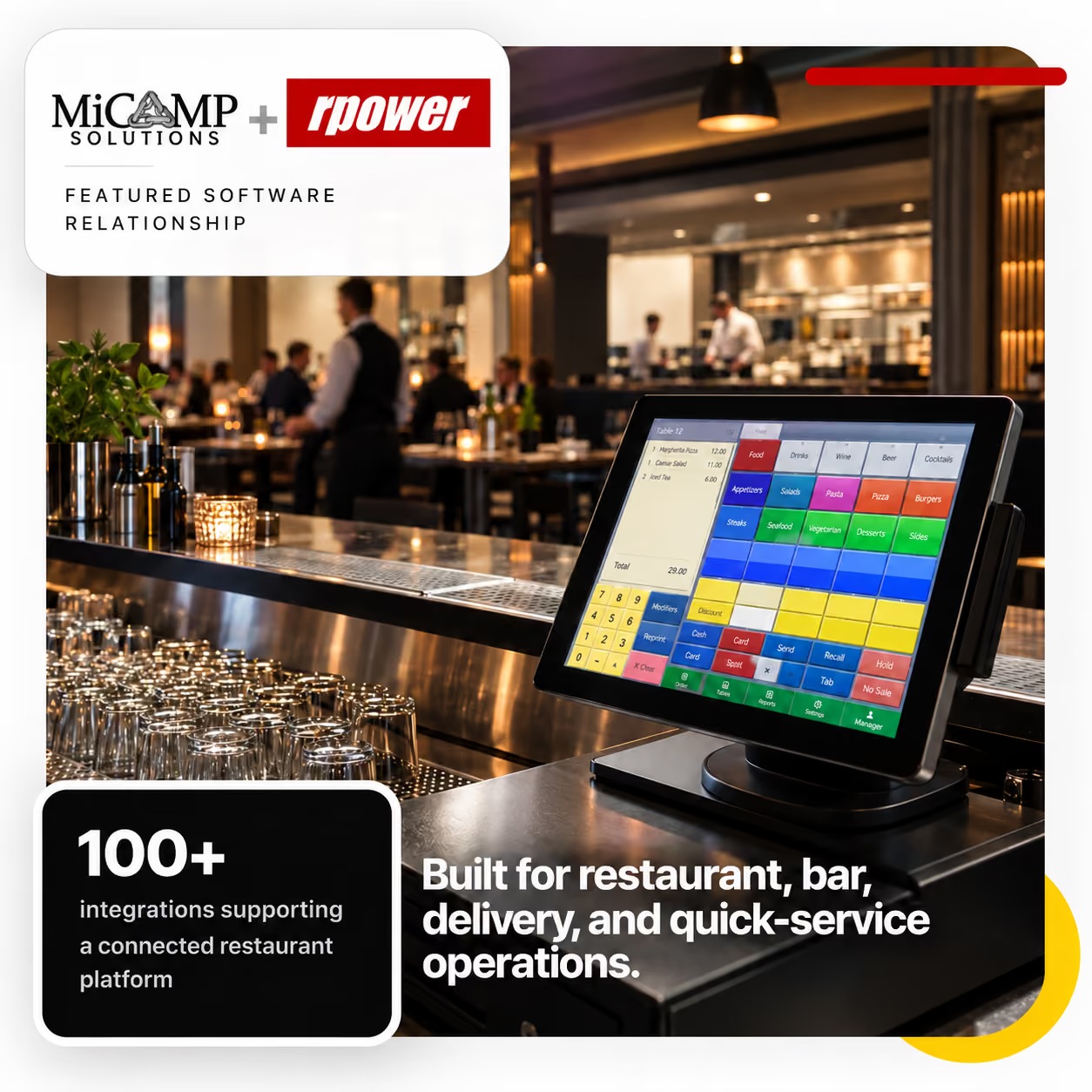
By October 2026, MiCamp’s homepage leads with private, non-dilutive funding for selected software companies. Its ESS and ESF relationships combine capital with potential growth, marketing, and distribution support. RPOWER, a restaurant and hospitality software provider, is the featured example. The proposition extends MiCamp’s position: help the software business grow, then participate in the commercial relationship around it.
For applicable software relationships, MiCamp publishes processing at 2.75% plus $0.20 per transaction. On a $100 payment, that is $2.95 under the stated formula. Eligibility and account terms belong in the agreement. Funding commitments are separately negotiated; the published processing rate is not a public price for capital.
The reported scale is considerable: MiCamp’s 2025 announcement claimed more than 60,000 merchants and $75 billion in annual volume. In August 2026, it announced an eighth consecutive Inc. 5000 appearance. Those figures describe reach, not a guarantee that any particular integration pays off. The lesson is narrower and more useful: find the moment a business already collects money, understand the work surrounding it, and make that moment easier to repeat.
Follow the transaction
Explore MiCamp, its automotive workflows, RPOWER relationship, and software processing pricing.
Follow: LinkedIn, X, Instagram, and Facebook. Read the Kinsler interview and company announcements.