The awkward thing about buying a new computer system is that the old one insists on coming along. Its records, exceptions and accumulated habits need somewhere to go. In Indiana, this was more than an inconvenience. A previous attempt to modernize corrections software had run into data-migration problems. Before a new system could become useful, it had to carry the past.
- Mi-Case builds software for state corrections, county jails and regulatory agencies.
- Indiana replaced 13 legacy systems with one platform in a 27-month project.
- The method combined migration rehearsals, frequent test builds and agency expertise.
- Its next expansion connects jail operations with Mark43’s dispatch and police records tools.
That makes Mi-Case an interesting company to watch even if you never intend to run a jail. Every organization replacing an old database faces a smaller version of the same question: does the new system understand what the old records mean? A handsome interface is lovely company at a sales meeting. It is less helpful when a historical record arrives in the wrong place.
The past gets a rehearsal
Indiana parted ways with an earlier vendor in 2017, then evaluated its options. In 2021, the Department of Correction awarded Mi-Case the replacement contract. The project began in February. AWS’s account credits three ingredients: committed agency leadership, subject matter experts and an iterative implementation process. The full offender management system went live in May 2023.
Mi-Case’s own case study supplies the mechanics. Migration began at the outset. The team ran four complete cycles of extracting, transforming and loading the data. Later cycles included both current and historical records. Each complete migration took less than 12 hours, the company reports. The point of repeating the exercise was to improve the records and expose problems while there was still time to fix them.
Legacy corrections systems replaced by one integrated OMS in Indiana.
AWS project account, March 2024Meanwhile, people at the agency had something to inspect. An initial cloud build arrived in July 2021; offender trust fund management was the first component to go live. Updated builds reached the test environment every three weeks. Staff could try the functions and respond before the final rollout. This was a series of opportunities to catch mistakes, rather than a single invitation to admire the finished product.
- Feb 2021Project kickoff and early migration work
- Jul 2021First cloud build and trust fund component
- Every 3 weeksFurther builds released for testing
- May 2023Full offender management system goes live
The deployment covered 22 facilities in the company’s account, serving roughly 28,000 people in custody and 7,000 on parole at the time. Those figures describe the case study’s setting, not today’s population. They also explain why a migration cannot be treated as a tidying exercise: the agency needs continuity while the technology changes beneath it.
A record that follows the person
Mi-Case works in the part of enterprise software where the customer is a government agency and the consequences extend beyond the customer. Its Mi-OMS product brings together intake, classification, housing, case plans, sentence calculation and supervision. A shared record lets departments see changes without having to reconstruct them from separate systems.
The sentence engine illustrates the difficulty. Jurisdictions differ in their rules for credits, holds and concurrent or consecutive sentences. Mi-Case offers state-specific configuration and an audit trail. The useful promise is explainability: staff need to understand the calculation and its history. A release date deserves more scrutiny than the total in a shopping cart.
Mi-Mobile extends access to officers away from a desktop. Mi-JMS handles the county jail’s overlapping jobs, including booking, classification, movements, property and release. The intended users are working officials with practical questions: where is this person, what happened, what is authorized, and what must happen next?
Regulatory licensing might seem an odd companion to corrections. Mi-Licensing makes the family resemblance clear. Applications, supporting documents, fees, renewals and disciplinary proceedings all need a reliable record and a sequence of decisions. The product pairs an applicant portal with staff tools; it also checks continuing-education requirements during renewal. Different public service, familiar paperwork.
The person who has done the job
Mi-Case’s team includes former corrections professionals, probation officers, regulatory administrators and government technology leaders. Rick Davis, who wrote the AWS Indiana account, spent 33 years in Virginia government technology roles, including 11 as the corrections department’s CIO. That background matters when a software requirement is really an operational rule wearing an innocent little checkbox.

“We named it Mi-Case because every case in our software belongs to someone.”Dean Allen, president and co-founder
The company lists Dean Allen and Benjamin Bussenault as co-founders. Its LinkedIn profile dates its origins to 1992, but the present operating identity has a more recent chapter. In December 2021, it announced a separation process from Business & Decision and a shift to the Mi-Case name. The software brand had become recognizable enough to carry the business.
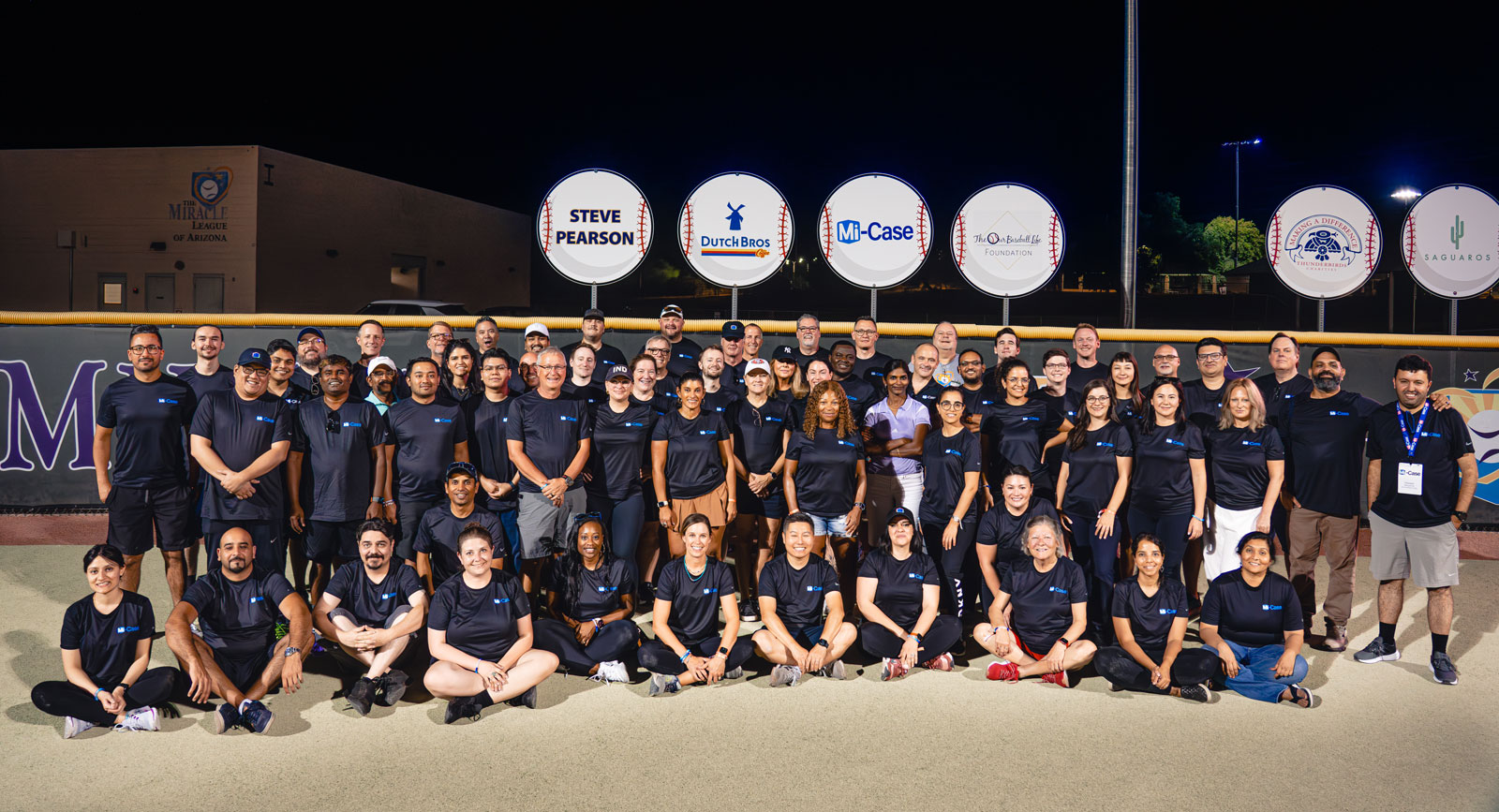
Its culture follows a distributed model. The careers page describes remote and hybrid work, investment in home working arrangements, and in-person company gatherings. This is also a business that promises familiar faces after implementation: the people who know an agency’s configuration remain involved in supporting it. That continuity is part of the product proposition.
The booking desk meets the dispatch screen
Fairfax County’s Sheriff’s Office selected Mi-Case for a new jail management system in 2023. The county had spent three years searching. Its stated priorities included replacing aging systems and fitting the particular needs of its Adult Detention Center. Mi-Case’s move into jails grew from that collaboration, with a product launch highlighted in its 2025 expansion announcement.
In March 2026, a partnership with Mark43 widened the proposition. Mark43’s dispatch, records, mobile and analytics tools are intended to work alongside Mi-Case’s JMS. For a sheriff’s office, the attraction is a connected path from activity in the field to custody operations. The announcement describes that integration as the goal; it is not a measured report of savings across deployed agencies.
This places Mi-Case among specialist government software vendors competing with incumbent systems, custom applications and collections of separate tools. Its case rests on implementation experience, agency-specific configuration and ongoing support. The company advertises zero failed implementations. That is its own track-record claim; Indiana provides a concrete project to examine rather than a reason to stop asking questions.
The price includes the work around the software
Mi-OMS pricing depends on correctional population, facility count and modules. The published contract scope includes migration, configuration, training, support, statutory updates and security infrastructure. Mi-Licensing prices vary by agency size and scope, with monthly or annual billing. These are negotiated government contracts, with the surrounding implementation work central to what is being bought.
There is one conspicuous public number: the AWS Marketplace JMS listing displays a $5 million pricing dimension for a 36-month contract. It is a marketplace listing figure, not a typical cost or the price of Indiana’s project. The listing also says additional AWS infrastructure charges may apply. Buyers should get a scoped proposal and separate recurring operating costs from the work required to launch.
The geographic ambition is expanding too. Mi-Case announced its Brussels hub in September 2025, describing a June launch and more than a decade of collaboration in Belgium. Its European plans emphasize local implementation expertise and data sovereignty. Software that understands one jurisdiction still needs careful adaptation to understand another.
Copy the rehearsal, not the stopwatch
The transferable lesson is fairly specific. Start moving real historical data early. Give operational experts working builds to test. Rehearse the complete migration. Make training and leadership participation part of the schedule. These practices make problems visible before a deadline makes them expensive.
They depend on conditions that a software vendor cannot simply deliver in a box. Agency leaders must commit, staff must have time to evaluate the system, and someone must own the meaning of the old records. Without those conditions, a fast build can leave an institution waiting on unresolved decisions. Indiana’s 27 months are a result to understand, not a promise to photocopy.
That is the appeal of Mi-Case’s story. The most instructive achievement is mundane enough to be useful: old records moved, people tested the work, and thirteen systems gave way to one. For anyone planning a difficult replacement, the rehearsal is worth a closer look.
Visit the working parts
Explore the products, follow the company, or watch its Indiana rollout film.