In December 2021, a bank agreed to sell something that banks rarely put on the market: its name. Meta Financial Group would receive $60 million for the Meta names and associated assets. The buyer, Beige Key, was affiliated with Facebook’s parent, Meta Platforms. The transaction did not buy the bank. It bought the words on the door.
- MetaBank became Pathward in 2022; the banking business continued.
- It supplies banking capabilities to brands such as MoneyLion and H&R Block.
- Its advantage depends on distribution, specialized lending and the ability to supervise partners.
For most businesses, surrendering the name would sound like surrendering the business. Here it exposed an intriguing distinction. The bank had spent years building a role behind other companies’ products. A customer could recognize the app, card or tax preparer without recognizing the institution making the financial machinery work. How much, then, was the bank’s own name doing?
The sign was worth $60 million
The accounting supplies a satisfying answer, with a complication. The sale brought $50 million initially and another $10 million when the required phase-out was completed in December 2022. Rebranding expenses were $13.1 million in fiscal 2022 and $3.7 million in fiscal 2023. Those figures are reported expenses, not a complete calculation of the transaction’s after-tax return.
The decision also had a history before Facebook arrived. MetaBank’s March 2022 announcement said a brand review had begun the previous year to unite businesses accumulated through acquisitions. The money supplied a reason to finish. Pathward became the legal name in July 2022; the corporate identity followed that autumn. The public parent kept a particularly apt stock ticker: CASH.
The account behind the app
Consider RoarMoney. MoneyLion supplies the app and customer-facing experience. Pathward supplies the demand deposit account behind it. The partnership began in 2020 and was extended in 2024 through 2029. The division of labor lets a financial technology company offer a banking product with an established national bank participating in its delivery.
This is payments sponsorship, often discussed under the broader heading of banking as a service. Pathward offers card issuing, acquiring and money movement, including ACH and other payment rails. Its payments page names Netspend, InComm Payments and Blackhawk Network among its relationships. Different partners need different combinations. The recurring idea is a bank whose capabilities travel through somebody else’s distribution.
For consumers, the practical question is which institution actually holds the account and which terms govern it. For a prospective partner, it is whether the bank can support the product, its controls and its growth. Pathward competes in the sponsor-bank market occupied by institutions such as The Bancorp Bank and Green Dot Bank. Choosing between them requires examining a particular program, rather than comparing slogans about innovation.
Access still has a price. H&R Block’s published offer for the November-December 2025 Emerald Advance application period described Pathward-originated loans of $350 to $1,500 at 35.9% APR, subject to approval. Those historical terms make the distinction concrete: a product can solve a timing problem and remain expensive credit. Anyone considering a partner product should check its current agreement, fees and repayment deadline.
A savings association learns to travel
The predecessor institution began in Storm Lake, Iowa, in 1954, founded by Stanley H. Haahr. Fifty years later, it launched Meta Payment Systems. The sequence matters: banking came first, then the technology and partner infrastructure. The MetaBank name followed in 2005.
Acquisitions widened the work. AFS/IBEX brought premium finance in 2014. Refund Advantage followed in 2015, then EPS Financial and Specialty Consumer Services in 2016. Crestmark, acquired in 2018, added commercial lending. Pathward’s present mix grew from these capabilities, rather than from a single consumer app spreading across the country.
Two businesses, one balance sheet
The commercial side helps companies finance receivables, inventory and equipment. It offers working capital, equipment loans and leases, and structured finance, including SBA and USDA lending. A business waiting for customers to pay invoices has a different problem from a consumer waiting for payday. Both problems involve money being available at the wrong time.
The economics connect. Payments programs bring deposits and fee opportunities; loans and investments generate interest income. Managing those flows is banking, with the accompanying funding and credit risks. Pathward’s expertise sits in coordinating these activities while serving partners whose products and customer relationships differ.
The parent’s latest results, released October 21, 2026, show the scale and the friction. Fiscal-year net income was $175.7 million, down from $185.9 million, while diluted earnings per share rose to $8.14 from $7.87. Commercial finance loans reached $4.44 billion. Profit, per-share results and portfolio growth need separate readings; they do not always move together.
The expensive lesson came earlier
There is a reason compliance belongs in this story. In 2010, the Office of Thrift Supervision determined that MetaBank’s iAdvance program involved unfair or deceptive practices and ordered new originations stopped. In 2011, the bank agreed to $4.8 million in customer remuneration and a $400,000 civil penalty, without admitting or denying the findings.
The lesson is uncomfortable but portable: distribution can expand a problematic product as efficiently as a useful one. Today, Pathward describes third-party monitoring and three lines of risk defense, ending with independent internal audit. That structure is a stated approach to oversight, not proof that every product will work well.
“At Pathward, expanding financial access is at the heart of our business.”Brett Pharr, CEO · October 2022
What survives the name
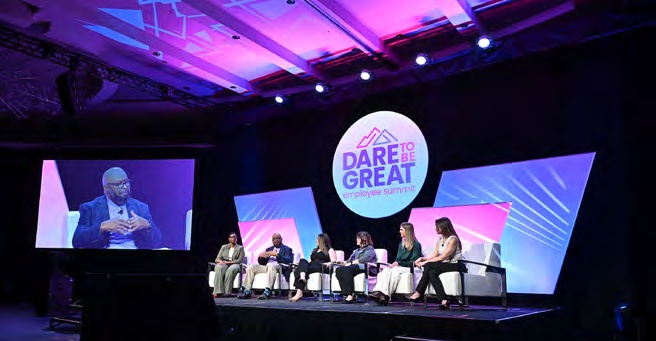
The people doing that work operate within a remote-first recruiting strategy called Talent Anywhere. The employee summit offers a glimpse of how a distributed company gathers. Culture matters here because partner oversight requires people across functions to notice the same problem and act on it.
In October 2026, Pathward renewed its relationship with Clair, continuing to originate earned wage advances through Clair’s payroll and workforce distribution. The old pattern survives: meet customers inside a service they already use. A company can copy that distribution logic. It cannot assume the charter, underwriting and oversight arrive automatically. Without those, embedding finance merely moves the point at which trouble appears.
Follow the money
Explore the products, people and next chapter.