In May 2020, the federal government had a delivery problem. Millions of Americans needed their Economic Impact Payments. Nearly four million would receive prepaid debit cards instead of checks. The cards arrived in plain envelopes from Money Network Cardholder Services. Visa appeared on the front. On the back sat another name: MetaBank. For recipients, that small detail explained who had actually issued the money-bearing plastic.
- Meta Payments supplied the banking behind other companies’ payment programs.
- Fees and low-cost deposits gave the bank two reasons to participate.
- The business continued under Pathward; the banking responsibilities came with it.
That arrangement gets us close to understanding Meta Payments. The Sioux Falls business, founded as Meta Payment Systems in 2004, was a division of MetaBank. Its specialty was helping partners move money. The customer might know a program manager’s brand. The bank supplied infrastructure that made the program possible. Banking could travel inside somebody else’s product.
The name on the back
Brad Hanson founded the division in May 2004. At the time, the bank itself was still called First Federal Savings Bank of the Midwest; it adopted MetaBank the following year. The sequence matters. Payments was a deliberate new direction within an existing bank, with an existing regulatory framework.
Consider the jobs involved in that stimulus card. Treasury sponsored the program. Money Network managed it. MetaBank issued the cards. Visa supplied the network brand. Recipients could make purchases, withdraw cash at in-network ATMs and transfer money to personal bank accounts without fees for those uses. A familiar object concealed a coordinated operation.
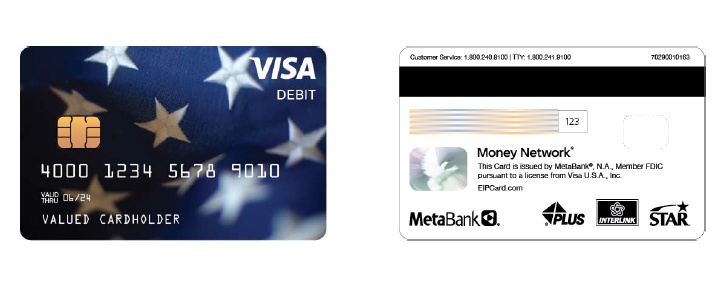
Meta Payments applied that division of labor more broadly: prepaid and debit issuance, ATM sponsorship, merchant acquiring and transactional payments. Its buyers were businesses building financial programs, including fintechs, financial institutions and payment companies. Consumers used the resulting products, often without choosing the underlying bank separately.
Today, that lineage continues at Pathward. Its issuing portfolio covers gift cards, payroll, rewards, government payments and reloadable prepaid products. Its digital payments services include ACH, wires and push to debit. A business can use those capabilities to distribute refunds, rebates or gig earnings. The useful product is access to banking operations, supported by people who know how the program must run.
A card with two engines
The economics become more interesting when you look beyond transaction fees. Meta’s 2018 annual report described the payments division as producing both fee income and low- and no-cost deposits. The same programs that created payment activity also brought balances into the bank. Distribution did double duty.
That helps explain the appeal of working through partners. A program manager brings a customer relationship and a way to distribute a product. The bank brings issuing capacity, banking connections and oversight. Each side contributes something expensive to reproduce. More transactions can mean more fee opportunities; deposit balances can help fund the bank’s wider activities.
Payment activityGenerates fee income
Customer balancesGenerate bank deposits
This places Meta Payments in the sponsor-bank market, alongside alternatives such as The Bancorp and Sutton Bank. Its competitive case rests on accumulated program experience and breadth: issuing, acquiring and multiple payment methods. A processor may participate alongside the bank. Comparing the two as interchangeable vendors misses the different jobs they perform.
The $5.2 million interruption
One early setback exposed the limits of that arrangement. In October 2010, regulatory directives required MetaBank to discontinue iAdvance, its line-of-credit product, following an Office of Thrift Supervision determination of unfair or deceptive practices. The directives also required prior approval for certain new third-party relationships and material amendments.
The consequences reached beyond one product. NetSpend disclosed that approximately 71% of its active cards at June 30, 2010, had been issued through MetaBank. That figure makes sponsor-bank dependence concrete. A regulatory constraint at the bank could affect a partner whose customers knew a different brand.
$4.8m customer remuneration + $400k civil penalty
In July 2011, MetaBank agreed to a $4.8 million customer remuneration plan and a $400,000 civil penalty. Its subsequent disclosures connected reimbursement to a failure to implement a recurring-use plan. This episode makes a practical point: consumer treatment and regulatory permission can constrain a financial program even when its distribution is already established.
The name was for sale
Then came an unusually literal branding transaction. In 2021, Meta Financial agreed to sell its Meta names and trademarks for $60 million to Beige Key LLC. Reuters confirmed that Meta Platforms stood behind the buyer. The bank estimated rebranding expenses of $15 million to $20 million. Those were projected expenses, rather than the final bill.
MetaBank legally became Pathward in July 2022. The trademark transaction concerned names, rather than an acquisition of the bank. Separately, Facebook Pay became Meta Pay. The similar names make the distinction worth keeping straight: this story follows the Sioux Falls banking operation.
The partner relationships continued. In January 2024, Ouro and Pathward extended their Netspend issuing agreement. “Our partnership runs deep,” said Pathward president Anthony Sharett. That September, Pathward renamed its Banking as a Service business line Partner Solutions, emphasizing experience, operations and risk infrastructure. The chosen language put the ongoing relationship at the center.
“Our partnership runs deep.”
Anthony Sharett, Pathward president
On the Ouro / Netspend renewal, January 2024
Borrow the distribution. Keep the responsibility.
Recent agreements show where the model has moved. An August 2026 TabaPay renewal extends into 2031 and broadens money-movement uses. An October renewal with Clair continues Pathward’s origination of earned wage advances through Clair’s platform. The products change; a partner still supplies the customer-facing setting for bank-supported activity.
For a founder, the approach offers a useful starting point: pair a specific distribution advantage with banking expertise. Agree on consumer protections, oversight and payment methods before promising the experience. It suits businesses prepared for an ongoing bank relationship. It loses its appeal when the plan requires unrestricted product changes, identical costs across payment methods or freedom from regulatory dependencies. The bank can become less visible to the customer. Its obligations remain.