At 11, Paul Jung and Kavi Samra met at school. Years later they were doctors in the NHS, looking at the same inequality through a less forgiving lens: health outcomes tracked background, and education helped set the track. They had also spent medical school tutoring children whose families could pay. The lesson was awkwardly clear. Personal attention worked. Access to it was rationed by income.
So they left medicine and built Medly, the study tool they wished they had owned. The London company now offers an AI tutor for GCSE, IGCSE, A-Level, IB, AP and SAT students, plus a curriculum-agnostic university product called Medly Open. In August, it announced an $8 million Seed round led by Felix Capital, with Eka Ventures and Ada Ventures returning. Medly says more than 400,000 students in the UK have used the platform.
The tempting description is “ChatGPT for exams.” It is also the lazy one. ChatGPT can explain photosynthesis. Medly wants to know whether the student sits AQA or Edexcel, which specification point their answer missed, why it earned three marks rather than six and what question should come next. Its commercial thesis lives in that difference.
That places Medly between three familiar purchases. Revision libraries such as Save My Exams and Physics & Maths Tutor organise content but usually leave students to compare their work with model answers. Quizlet, Gizmo and Knowt make recall quick, without recreating an examiner's judgement. Human tutors can diagnose and motivate, but their time does not scale. Medly is betting on the middle: more responsive than a library, more syllabus-aware than a general chatbot and cheaper than weekly human attention. The trade is plain. It can repeat a feedback loop at midnight; it cannot notice the look on a pupil's face.
The product is the correction, not the answer
Most study software is good at displaying information. Notes sit in folders. Videos explain a chapter. Flashcards ask whether mitochondria are still the powerhouse of the cell. The student must decide what to revise and judge whether an answer is any good. A private tutor closes that loop: attempt, diagnosis, explanation, another attempt.
Medly tries to compress that loop into software. Students type an answer, write with a stylus or upload work from elsewhere. The system marks it against the relevant specification and mark scheme, then updates a topic-by-topic view of what the student appears to know. Shuffle mode selects weak areas. Learn Mode explains before testing. Personalised papers change with ability and syllabus. The interface is conversational, but the conversation is not the point. The next useful action is.
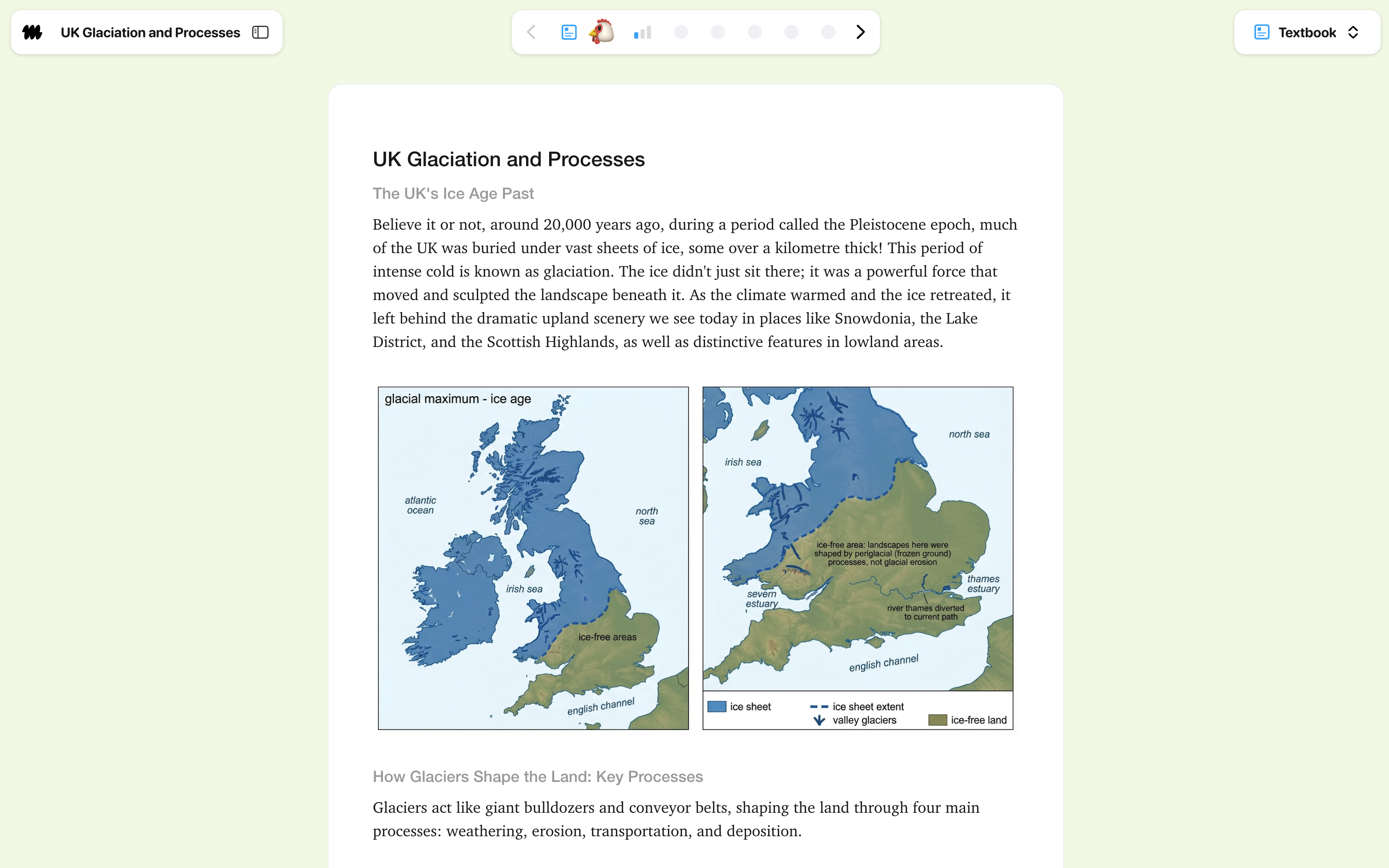
There are several products around the core. Medly Exams serves secondary-school qualifications. Medly Open turns university materials into notes, flashcards, assignment plans and practice tests. A teacher dashboard lets verified UK teachers set free homework, review or override marks and see class-level mastery. Medly Mocks supplies free national practice papers. A bursary offers up to 50 students a month full access for the rest of the school year.
What broke first was the thing that mattered most
An AI tutor can sound fluent while being wrong. That is irritating in a chat and corrosive in a marker. In late 2025, Medly users reported inconsistent grading on long English essays. The system could be too lenient, too strict or insufficiently alert to an answer that wandered near the topic without answering the question. Maths exposed a different weakness: method marks and scattered working are harder to read than a neat final number.
The company did not discover a single grand failure. It found edge cases - partially correct reasoning, small misconceptions, crossed-out attempts, missing keywords that concealed real understanding. Those are exactly the cases a student needs explained. Medly rebuilt parts of its marking engine, improved English essay grading and maths working recognition, and recorded the changes publicly. The founders also told students to treat AI marks as an indication and ask a teacher when uncertain.
That caveat makes the product more credible, not less. A teacher knows why a particular pupil has stopped trying. Software is better at scanning thousands of answers for repeated gaps. Medly's own evidence to Parliament draws the same border: pattern recognition can be automated; contextual, ethical and pastoral judgement remains human work.
The numbers are useful, with footnotes attached
Medly's most repeated result is that 74.1 percent of surveyed GCSE users improved by at least one grade in one or more subjects; 40.5 percent improved by two or more. The analytical sample contained 398 students from 626 survey respondents after removing pupils already near the grade ceiling. Everyone in the sample had taken Medly Mocks. The grades were self-reported on results day, and respondents chose whether to answer.
That makes the analysis promising evidence of association, not proof that Medly caused every improvement. The company has since moved toward harder tests. It assembled more than 30,000 real student answers from over 900 pupils, each graded twice by qualified examiners, then compared AI marks with the range of human disagreement. More than 5,200 answers were handwritten. It has also completed a randomised controlled trial with more than 1,000 students across eight UK schools; the detailed results were not part of the August funding announcement.
The price is part mission, part physics
Medly starts free, with daily limits that reset rather than a trial that expires. Unlimited use and AI marking cost £24.99 a month or £180 a year for the UK exam product. The company compares that with roughly £24 an hour for a private tutor, or around £96 monthly for one weekly session. It is not an even swap: a human supplies accountability, empathy and improvisation. Medly supplies availability, repetition and memory.
The tension is inference cost. Every practice answer and tutoring exchange consumes compute. In 2025, Medly reported gross margins around 55 percent for consumer subscriptions and 45 percent for business customers, alongside up to £150,000 of Microsoft credits and a £15,000 Innovate UK grant. Free access is not free to provide. After students objected to access limits, Medly shifted to permanent freemium use, free weekly subjects, free mocks and bursaries. The pricing page is where its equality mission meets its cloud bill.
What builders can copy - and where it stops working
The stealable idea is not “add AI.” It is to isolate a frequent, expensive human loop with a measurable output. Constrain the model to a real rubric. Collect ugly examples instead of synthetic perfection. Let experts disagree so you know what acceptable error looks like. Publish the failures, keep a human override and build the next action from the diagnosis. Medly's weekly student focus groups, school tests and embedded mini-trials turn product usage into a learning system for the company itself.
Copy this
Pick one costly feedback loop. Narrow the context. Benchmark against experts. Show the user why the output was reached. Feed every correction back into product design.
Do not force it
The model falls short when the user needs motivation, safeguarding judgement or an unsupported syllabus. It also assumes reliable internet and enough self-direction to keep practising.
International expansion will test whether the wedge travels. SAT support is live in the United States, with AP and ACT on the roadmap. But porting Medly is not merely changing spellings. Each qualification needs content, rubrics, examples and trust. Building proprietary education-specific models with the new funding could improve cost and accuracy. It could also create a larger research, content and safety burden.
For students, the practical rule is simpler. Use Medly when doing questions is more valuable than reading another page of notes, and when immediate feedback will keep the loop moving. Skip it when a free library already answers the need. Bring a teacher into high-stakes or ambiguous marking. The company is most interesting when it observes that boundary.
Jung and Samra began with inequality, tried ideas at university that went nowhere, and changed course after medicine made the cost of unequal education feel less abstract. Their current bet is neither that software becomes a perfect tutor nor that teachers disappear. It is that much of tutoring's daily value comes from noticing the small mistake soon enough to correct it. Four hundred thousand students have now handed Medly their workings. The next grade is the company's.