Homework has a visibility problem. A teacher can set it, explain it and remind a class about it, then spend the next lesson discovering who actually did it. Sparx Learning has built a business around that awkward interval between assignment and understanding. The Exeter company gives pupils personalised practice and gives adults a clearer view of what happens next. Its most interesting proposition is that the software comes with a routine.
That proposition now stretches across maths, reading and science. The corporate homepage reports more than 2.2 million students and 75,000 teachers using its systems. Schools buy access; pupils do the work; teachers interpret the results. Three constituencies, three different definitions of a good evening’s homework. Sparx has to satisfy all of them.
Its ambition is stated plainly: “To improve lives and the world through learning.” The practical version involves carefully written questions, progress reports, parent emails and former teachers helping schools establish habits. There is plenty of technology here. There is also quite a lot of organisational housekeeping.
The password was never the point
The most revealing evidence about Sparx is also a useful restraint on enthusiasm for education software. Researchers from RAND Europe and the University of Cambridge analysed data collected in 2019 from 3,956 Year 7 and Year 8 pupils across 14 UK schools. Sparx commissioned the research. Greater usage was associated with stronger maths outcomes.
But giving pupils access, irrespective of their usage, was not associated with different maths outcomes after accounting for their backgrounds. An account was insufficient. Active work mattered more than simply being able to log in.
The researchers translated test results into predicted GCSE grades. An hour of weekly active work across a school year was associated with almost 0.3 of a predicted grade. That was an association, not a guaranteed uplift or a measurement of those children’s eventual GCSE results. The report called for stronger future designs, including a randomised trial. Its lesson for buyers remains pointed: measure what pupils do.
Eight years before the wider launch
Sparx traces its beginnings to a 2010 conversation between founder Mark Dixon and another parent at the school gate. Maths became the starting point. The company’s account describes eight years of research and development in schools before Sparx Maths opened more broadly in 2018. The legal entity arrived along the way, incorporated in January 2012 as Supersparks Limited.
That development period required substantial backing. Contemporary reporting put Oxygen House’s September 2019 investment at approximately €22 million, following around €33.5 million in earlier funding. Those figures describe investment, rather than the cost of any individual feature. They give a sense of the financial commitment behind the long apprenticeship.
School collaboration was part of the method: the Ted Wragg trust helped inform development through trials. For a business whose users include tired teachers and children doing compulsory work, proximity to the classroom has obvious value. A technically correct exercise can still be the wrong exercise for Tuesday night.

The company also learned through combination. HegartyMaths joined Sparx in 2019. After incorporating features and lessons from that product, Sparx decided in 2022 to retire it. HegartyMaths founder Colin Hegarty became Sparx Learning’s CEO at the start of 2023. The succession puts a teacher who had built a school product in charge of the broader operation.
Different children, different questions
Sparx Maths is aimed at secondary pupils aged 11 to 16. It generates personalised homework connected to the school’s scheme of learning, with support videos and reporting for teachers. Students can also use Independent Learning to revisit topics. The appeal is concrete: a teacher need not assemble and mark a separate worksheet for every pupil to give them different practice.
There is an important boundary. Sparx’s own guidance says the maths system is for practising material already taught in class. It advises against using it to catch up on missed lessons. A worked example can help a stuck student; it cannot be assumed to supply the whole lesson they missed. Schools choosing topics still have to exercise judgment.
The company’s expertise shows up in the particulars of wrong answers. Its November 2025 baseline analysis drew on results from 146,806 pupils across 889 schools. Adding was relatively secure; area and perimeter were weaker. In a separate analysis of more than 580,000 attempts at one perimeter question, omitting a missing vertical side accounted for 48% of incorrect answers.
That is a more useful observation than a red mark. Sparx describes using common mistakes to shape targeted hints, and its assessment system can assign a fresh version of a fluency question a pupil previously got wrong. The practical sequence is straightforward: locate the gap, give another opportunity, then check whether the pupil can proceed.
- 01Spot the gapLook at the question, not only the total score.
- 02Offer a nudgeAddress the mistake the pupil actually made.
- 03Try againUse fresh practice to check understanding.
The book has a progress report
Reader extends the visibility idea into a less tidy subject. Pupils choose from books suited to their level and answer questions as they read. Teachers can see activity and use that information for conversations about the books. Weekly tasks are automated, and students earn Sparx Reader Points. Independent reading acquires a measurable school routine.
The product includes contextual word definitions, adjustable presentation, colour overlays and reading rulers. These are small interface decisions with a clear purpose: reduce obstacles between a child and the text. The company reports more than 1.7 million completed books on Reader’s website, a measure of activity rather than a direct measure of literary enthusiasm.
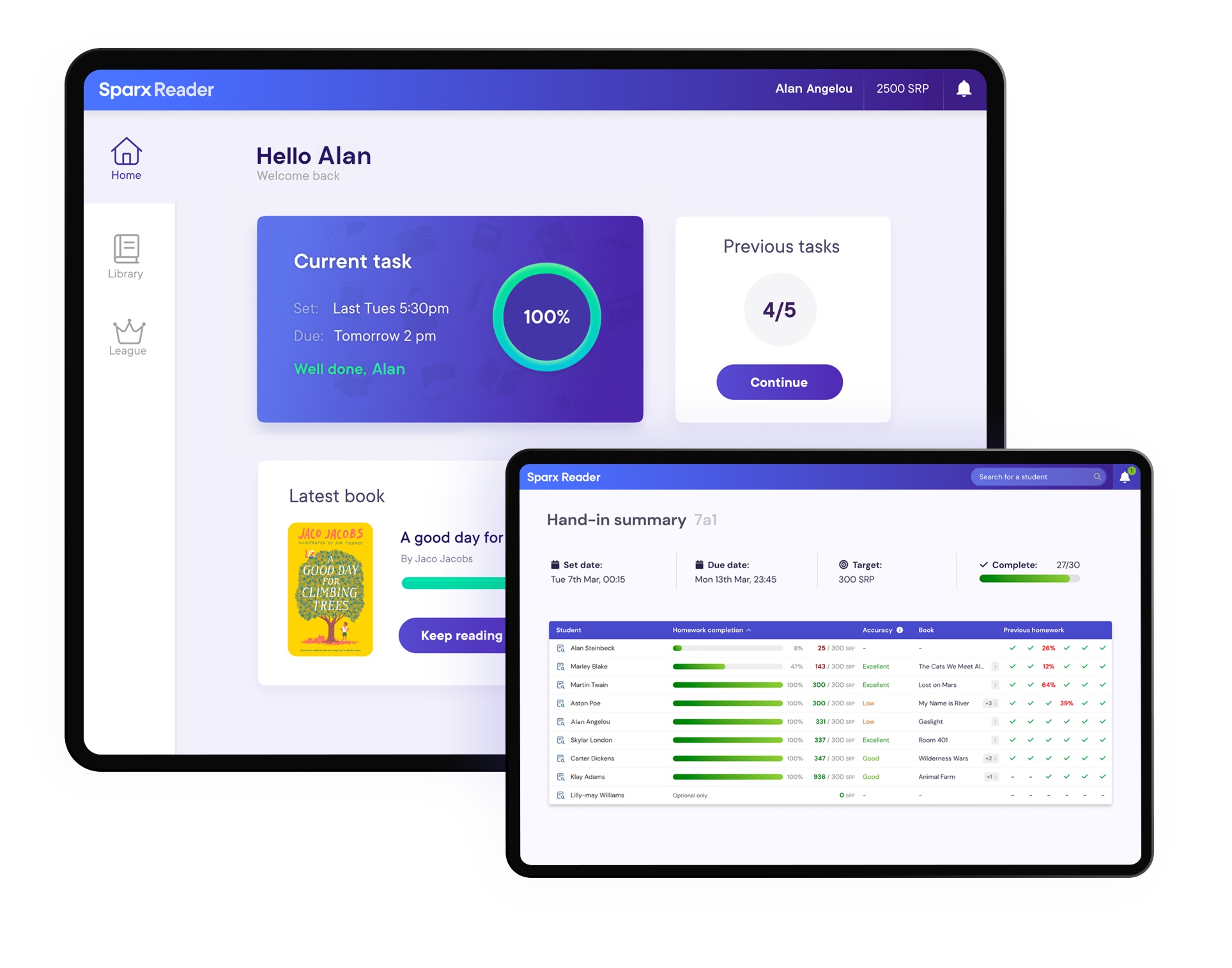
A March 2026 company case study offers a specific school example. At Bushey Meads, nearly half of incoming Year 7 pupils reportedly have a reading age below their chronological age. The school nevertheless reports more than 80% weekly Reader homework completion. That makes its routines worth investigating. It does not make that percentage a promise to every school, or establish that completion alone produces a love of books.
Science requires another treatment again. Sparx Science covers biology, chemistry, physics, working scientifically and maths for science, with more than 23,000 questions. Teachers can inspect student answers and identify class difficulties. Flashcards add targeted retrieval practice for factual knowledge. The common thread is regular practice and adult visibility; the content changes with the discipline.
The subscription includes a human problem
Sparx sells whole-school subscriptions, including arrangements managed by school trusts. Its July 2026 subscription guidance says discounts depend on student numbers, with no further discount for using several Sparx systems. Multi-year subscriptions require upfront payment. A department planning to use the software with one year group must therefore consider a whole-school purchase.
The economic question extends beyond the invoice. Teachers need time to learn the system, agree expectations and respond when pupils struggle. Sparx offers full-access trials and regular coaching meetings. Those are opportunities for schools to test whether saved marking time translates into useful support, and whether participation extends beyond their already diligent pupils.
The School Success Team includes former teachers and school leaders. The company describes an organisation mixing educators, engineers and data scientists; its published values emphasise learning, empathy and decisions informed by data. Even its recruitment materials reflect an interest in shared working habits: internships and the three-year programme are office-based in Exeter.
“Using Sparx Maths Homework has completely changed our homework culture”
Katie Holt · Head of Maths, South Dartmoor Community College · company-published testimonial
For buyers comparing alternatives, Dr Frost Maths also offers homework and progress tools alongside freely available teaching resources. Sparx’s particular proposition is the combination of personalised assignments, subject content and support for implementation. A school should compare the weekly job it wants done, including who will monitor unfinished work, rather than count features on competing homepages.
Onboarding makes the approach tangible. New Maths users encounter an introductory video, sample questions and optional tips. Sparx says completing all three steps normally takes 10 to 15 minutes. Teachers can explore a demonstration homework package themselves. That is a useful rehearsal: the person explaining the homework can experience the same navigation, answer formats and support that a pupil will encounter later.
There is less visible work behind those screens, too. Sparx uses Wonde to connect to school management information systems, with data synchronised nightly. Keeping classes and student records current helps the reports reach the right adults. For a school, that makes implementation partly an administrative project: someone must manage the connection and understand which data the school shares. The learning routine depends on those mundane arrangements being dependable.
What another school can borrow
Sparx’s staff guidance contains an inexpensive idea: coordinate hand-out and hand-in days so teachers have time to intervene before the deadline. Train staff, make expectations consistent and explain the system to parents. These practices can be copied without reproducing the technology. They also make a trial more informative because everyone knows what is supposed to happen.
The opposite conditions expose the limits. Practice set before teaching, unreliable access to a device, or completion reports nobody reviews can leave the routine ineffective. Schools need to distinguish a pupil avoiding work from one who cannot complete it. A percentage identifies a conversation to have; the adult still has to have it.
Sparx’s next steps remain practical. Its May 2026 upgrade announcement promised clearer reporting and Maths flashcards, with migration targeted for September at no additional subscription charge. July guidance also clarified that its core homework personalisation does not use large language models. The work rests on models built by its own specialists.
Its March 2025 B Corp certification, with a B Impact score of 110, adds an organisational credential. Classroom results require their own judgment. The useful test comes on the next hand-in day: who practised, who got stuck, and what will the teacher do with that information?
Open the exercise book
Explore the systems, school stories and demonstrations.