The revealing detail about MealPal is what happens before you arrive. A restaurant has chosen one dish. You have reserved it. The kitchen can prepare a run of similar orders, and you collect yours without joining the ordering queue. Somewhere inside that modest rearrangement, an ordinary office lunch becomes cheaper. The customer supplies the final ingredient: a pair of shoes.
- The deal: discounted restaurant meals, reserved ahead for pickup.
- The trade: one featured dish per restaurant, with no customization.
- The test: enough nearby choices, enough office days and a plan you will actually use.
Food apps often offer the pleasure of staying put. MealPal makes leaving your desk part of the transaction. Its place in the market is the space between packing lunch and paying for a restaurant order with delivery attached. It suits people who buy lunch repeatedly, work near participating kitchens and can make a collection fit between meetings.
The bargain begins in the kitchen
A menu is a promise of choice. In a busy kitchen, each choice can also become another instruction, ingredient or interruption. MealPal’s restaurant offer narrows the assignment to one item each day. No customization means fewer variations to manage. The company says this lets partners prepare orders three times as fast. Treat that as its sales claim, rather than a stopwatch reading from every kitchen.
Customers still choose between restaurants. They surrender the freedom to redesign the selected dish. This is a useful distinction: variety comes from the network, while repetition happens within each kitchen. A bowl restaurant and a sandwich shop can both participate without making identical food. What they share is a way of receiving and preparing orders.
In Sydney in 2017, early partners included Guzman y Gomez, Fratelli Famous and Zeus Street Greek. Biggins explained that buying meals in aggregate let restaurants produce them more efficiently. MealPal’s expertise lies in organizing this exchange: recruit restaurants, gather reservations and make collection straightforward. The platform coordinates the meal; the partner cooks it.
First came the bargain. Then the rebuild.
Mary Biggins had already co-founded ClassPass when she and Katie Ghelli created MealPal in late 2015. The service launched in January 2016. There was a recognizable family resemblance: one membership connected customers with independent businesses. Here, however, the recurring appointment was lunch.
The earliest software struggled. In a 2017 interview, Biggins said the initial product had been built in a month by an offshore team. Volume exceeded expectations. MealPal subsequently assembled an engineering team, rewrote its website and iOS app, and added Android. Demand had validated the proposition before the technology was ready to serve it comfortably.
“Eat intelligently and affordably.”Mary Biggins, describing MealPal in 2017
The company also revised how it presented choice. It began as MealPass, then became MealPal in September 2016 alongside a recommendation feature. Eater described a food matchmaking system designed to help members navigate the growing selection. Even a constrained menu can create a decision problem when enough restaurants join it.
Investors funded expansion. A $15 million Series A was announced in February 2017, followed by a $20 million Series B led by Menlo Ventures that September. At the second announcement, MealPal reported more than three million lunches across twelve markets and introduced New York dinner plans. Those dinner prices began at $6.49 per meal on a twenty-meal plan. They belong to 2017, not today’s checkout.
Capital raised, not revenue earned.
The office disappeared before the appetite did
Then the lunch geography changed. In 2020, offices emptied, workers left cities and restaurant partners closed. A business organized around the workplace could lose the customer’s daily route even when the customer remained hungry. The office commute had been doing more work than it appeared.
MealPal tested another use for its restaurant relationships: curated grocery boxes. Its marketing vice president, Erica Yamamoto, said MealPal Market was built in about a week. New York restaurants supplied boxes that could be reserved and collected, without requiring a subscription. Dig Inn offered produce; Regina’s Grocery included fruit, vegetables and even toilet paper. The constrained selection survived; the contents changed.
The current homepage explicitly addresses hybrid workers. Its corporate program pitches restaurant choice to employers alongside reduced ordering, cleanup and expense-report work. The recruiting page, meanwhile, lists restaurant partnerships, operations and marketing roles. There is a lot of human coordination behind this apparently simple app.
A discount has to survive your calendar
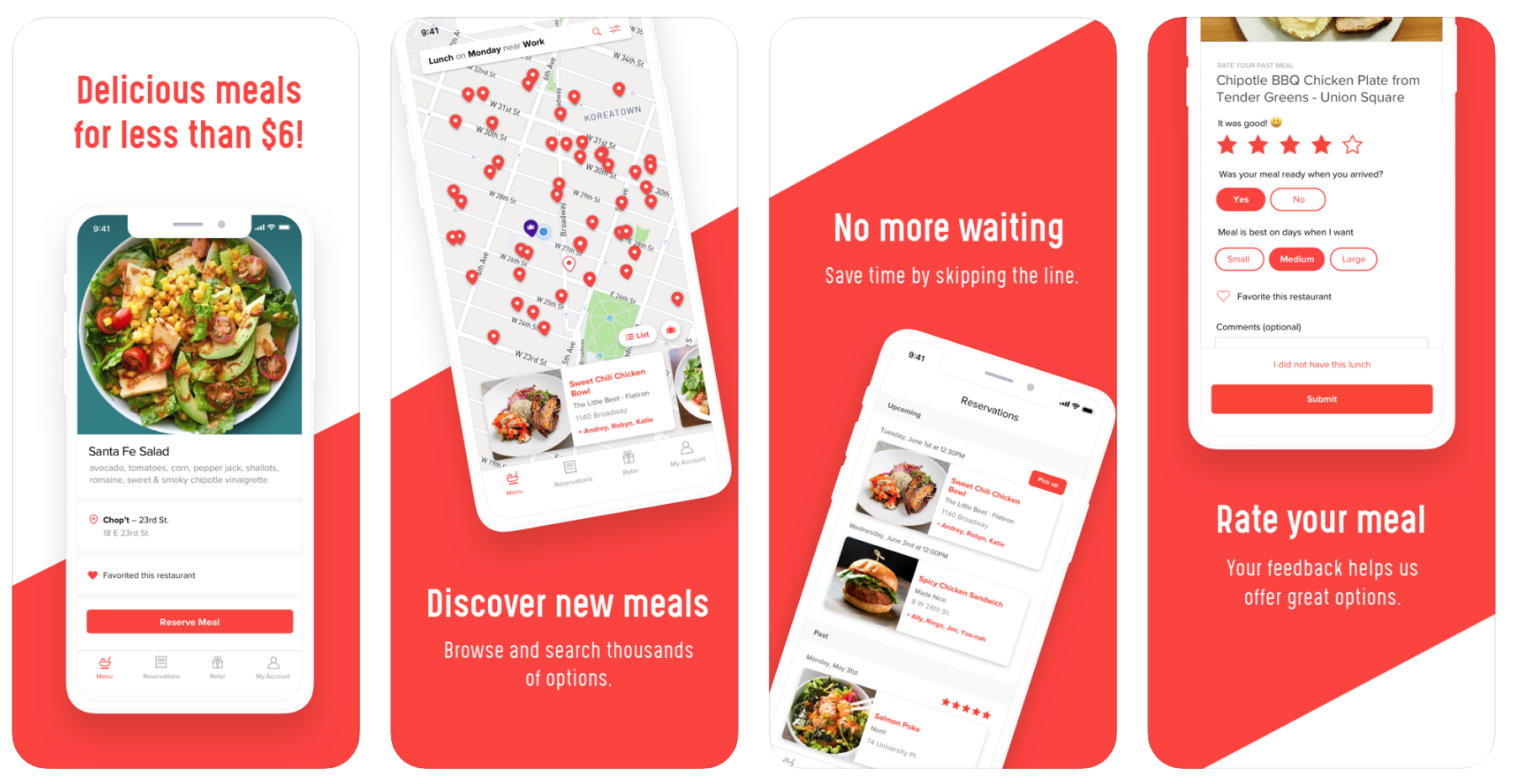
For the subscriber, the decisive number is the effective cost of meals collected. A cheap advertised meal can become expensive if meetings, travel or working from home keep you from using the plan. Consider a hypothetical $120 purchase: twenty collected meals cost $6 each; twelve cost $10. The same payment tells two different stories.
Plan terms deserve attention. MealPal’s U.S. credit plans assign different credit amounts to meals and generally renew after thirty days or when fewer than ten credits remain, whichever happens first. Most permit limited rollover. Its homepage says U.S. and Canadian taxes and fees are additional. The useful comparison is your total payment against lunches you expect to collect.
Before joining, inspect the restaurants around your actual work address. Check dishes against dietary needs, collection against meetings and the plan against attendance. Restaurant direct ordering and delivery apps offer different freedoms; homemade lunch offers different economics. MealPal’s bargain depends on accepting its particular constraints.
There is a lesson here for anyone building a marketplace: ask suppliers which customer freedoms are costly, then see whether customers will exchange those freedoms for a lower bill. That bargain needs density, repeat demand and reliable collection. MealPal has made a business from the distance between an office and a restaurant. For its customers, the final calculation begins with whether that distance is worth walking.
Follow the lunch trail
Explore MealPal · Corporate meals · Restaurant partnerships · Plan terms
Instagram · LinkedIn · X · Facebook · TikTok
Biggins on the early business · The grocery-box experiment · Watch Biggins explain the model · Listen: The Big Idea Box