An aircraft seat is an unusually expensive thing to carry around empty. Before a passenger settles into it, before the tray table acquires its cup of coffee, the airline has already accepted its weight. Multiply that weight across a cabin, then keep lifting it into the sky. A few kilograms become a business proposition. For Maziar Jahanshahi, co-founder, chairman and CEO of Singapore’s AirGo Design, that familiar chair belongs to a much larger story about bringing specialist technology into everyday use.
His earlier company worked on something people carried in their pockets. Scalado’s imaging software reached more than a billion mobile devices. Jahanshahi helped found it and served as chief legal officer. His contribution came from the commercial and legal side of a technical enterprise. The move from phone cameras to aircraft cabins looks abrupt until you consider what sits between an invention and the company willing to buy it.
The lawyer at the cafe table
Jahanshahi arrived in Sweden from Iran at 15. He went on to study law and business law at Lund University; his public education record lists 1996 to 2000. The university town became the setting for his first documented founding chapter. In 2000, he co-founded Scalado with Sami Niemi, Fadi Abbas and Pierre Elzouki.
While studying at Lund, he also contributed in conversation and writing to a Swedish government inquiry into diversity in higher education. Alongside fellow student Krisztina T. Csiki, he described the circumstances of immigrant students. The inquiry concluded in 2000, the year Scalado was founded. His university years included both a business beginning and participation in a public discussion about access to education.
The company’s origin has the appropriate stationery. An account of the founders describes friends sitting in a cafe, finding an idea and sketching it on a paper napkin. The napkin is an accommodating business tool: inexpensive, available and unlikely to demand a revenue forecast. The harder work begins when the conversation becomes a company.
At Scalado, the founders’ different skills mattered. Jahanshahi had studied the rules governing business while his colleagues brought other expertise. A phone-imaging venture needed more than an attractive demonstration. It needed a route into manufacturers’ products, with agreements governing how its technology could be used. His chief legal officer role put him in that less photogenic part of the enterprise.
Early in Scalado’s life, he and Elzouki also gave interviews for a Lund student study of strategic alliances. The researchers identified Jahanshahi’s role as investor relations. Their questions concerned how small knowledge businesses begin partnerships. It is a useful glimpse of the young company: before its technology reached a billion devices, its founders were already discussing the relationships through which a smaller business could work with others. The commercial questions arrived early.
Lund, Sweden
technology, IP and specialists
Singapore
A billion devices, then a carefully worded exit
Scalado made software for handling photographs on mobile devices. Its reach grew through the companies embedding that technology in their own products. A person could use its work without encountering the Scalado name. By the time Nokia announced its deal in June 2012, the software’s presence extended beyond one billion devices.
That number describes the company’s distribution, rather than a personal invention by Jahanshahi. It also helps explain the commercial setting in which he worked. The product had to function inside other businesses’ hardware and software. Licensing and intellectual property were part of the machinery that allowed it to travel.
Nokia’s announcement was precise: it planned to acquire imaging specialists, technologies and intellectual property from Scalado AB. Its annual filing records the acquisition on July 20, 2012. Lund was to become an important location for Nokia’s smartphone imaging software. A longstanding relationship between the companies had produced a new arrangement.
The remaining obligations did not disappear with the announcement. Scalado AB continued as a service and support business for existing customers. Jahanshahi was among the executives staying there at the time. An exit headline can fit on one line; the agreements underneath it tend to require rather more paper. His next venture followed that experience of building a technology business and negotiating its place in a larger industry.
The seat has two customers
AirGo Design was founded in Singapore in 2013. Jahanshahi’s fellow founders included his brother Ali, Alireza Yaghoubi and Mikko Alanko. Yaghoubi brought the aircraft-seat concept and materials expertise. Alanko brought commercial experience that included business development for Scalado in Asia. The new company had connections to the old one as well as an entirely different object to make.
Jahanshahi had publicly credited Alanko’s company with helping Scalado extend its reach in the Asian market. Their connection gives the founding team a practical history. Some of the people attempting to sell a new kind of aircraft seat had already worked around the problem of getting specialist software into large companies’ products.
The original seating idea belonged to Yaghoubi. He had returned to sketches during an uncomfortable long flight, and the concept received a national James Dyson Award in 2012. Jahanshahi entered a team whose technical starting point was already established. That distinction matters: a founding story becomes more interesting when the contributions retain their proper names.
There were also two audiences to satisfy. A passenger could appreciate more room; an airline had to justify the purchase and carry the resulting seat. Jere Tala, the company’s aviation commercial executive, recalled his first response to the drawings: “No way - it’s not possible.” Familiarity with an industry can make a new proposition look particularly improbable.
The team’s answer linked the passenger experience with an operating calculation. Reducing seat weight could make a different design interesting to the airline as well as to the person sitting in it. The seat would have to earn its place through engineering, price and production. A pleasing drawing still needed a workable business around it.
A chair becomes a materials business
AirGo developed CARBON, its full-composite aircraft seat. The company describes it as 50 percent lighter than conventional aluminium seating. Its current product specifications advertise configurations starting at six kilograms per passenger. Those are company product claims, and configuration matters. The useful point is the direction of the work: weight reduction built into the structure of an object airlines already need.
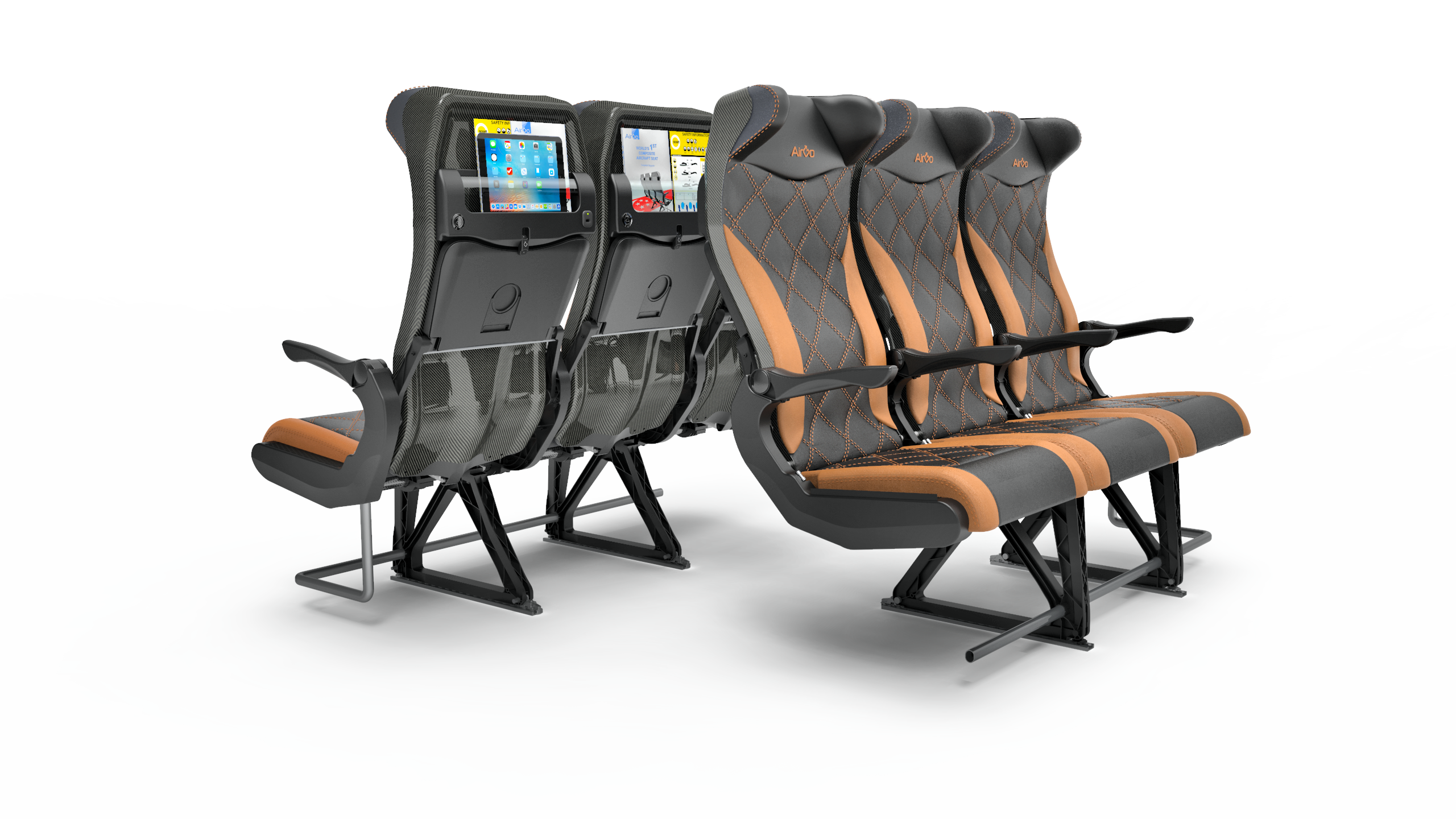
There was considerable work between the concept and a production part. By 2019, trial production of CARBON had begun and the team was concentrating on qualifying the composite material and the process used to make it. The schedule illustrates a feature of physical products that a rendering tends to conceal: a design must be reproducible.
AirGo subsequently expanded its focus beyond aircraft seating into metal replacement for other manufacturers. Reinforced thermoplastics offered a way to pursue lighter parts made through injection moulding. The experience acquired while developing a seat could be useful to customers with different components and different requirements.
For Jahanshahi, that broadened the commercial setting of the business. A company known for a cabin product could offer engineering and manufacturing work beyond that cabin. In 2021, he witnessed a partnership signing between AirGo and Malaysia’s UNITEN and its research arm, URND. The agreement addressed technology commercialisation and venture building in drone logistics, including intellectual-property licensing and joint development.
Software returns through the armrest
The material presented another problem. A reinforced plastic component can behave differently in different directions. The flow of fibres during moulding affects the finished part, so a standard material sample cannot tell an engineer everything about a complex shape. Predicting that behaviour is part of deciding whether a lighter component will do its job.
AirGo developed simulation software around this challenge. ATLAS-AI connects material behaviour with the engineering analysis of an actual component. The software chapter makes Jahanshahi’s career take an interesting turn. After a business built around imaging inside phones, he was leading one using software to help develop physical parts.
In June 2025, AirGo and Moldex3D announced a joint white paper on simulating injection-moulded fibre-reinforced thermoplastics. Its examples included a CARBON aircraft armrest and a reinforced pole extender. The objects were modest enough to recognise immediately. The questions underneath them involved fibre orientation, deformation and where a part would fail under load.
“Moldex3D (CoreTech System Co., Ltd.) and AirGo Design showing the way.”
Maziar Jahanshahi, public LinkedIn comment
The published armrest comparison reported 91.8 percent accuracy for the ATLAS-AI and Moldex3D model, against 59.2 percent for the conventional model used in that comparison. Those figures describe one case study. Their value lies in connecting a simulation with the behaviour of a tested part, giving a customer something more specific to examine than an attractive promise.
The work around the invention
Jahanshahi’s public endorsement of the collaboration was brief. The partnership itself supplies the detail: software, a manufacturing process, a component and a test. It is a fitting scene for this stage of his career. The company’s work now includes the tools needed to understand the materials behind its original seating project.
Across the two ventures, his role has remained connected to the business around specialist expertise. At Scalado, he worked as a co-founder and legal executive while imaging technology reached device manufacturers. At AirGo, he has helped build a company around materials engineering, with partners extending into manufacturing, simulation and university collaboration.
The progression gives a familiar object a longer history. Beneath a passenger’s elbow sits an armrest; behind its shape sit questions about how to make it, model it and sell it. Jahanshahi’s career has unfolded among people answering those questions. The result can be measured in grams, but getting there takes rather more than subtraction.