The paper check has an excellent publicist: habit. It requires no product demonstration, survives changes of management and can turn up years after an organization has announced its digital transformation. Max Eliscu has spent much of his working life dealing with the consequences. He founded a financing company, then a payments company, and kept encountering a familiar inconvenience: businesses could complete the work long before they could make useful sense of the money.
His career is a useful antidote to the tidy startup origin story. There is a young banker, certainly, and a decision to leave an established institution. But the interesting part comes afterward. Eliscu kept working around banks, invoices and suppliers for decades. The problem grew more specific as he got closer to it. Today, as founder and CEO of Viewpost, he is concerned with the payments that still become checks after everyone has already tried to modernize them.
That is a peculiar place to look for a business. It is also a revealing place to look for a founder. His subject is the uncooperative remainder: the customer a lending model misses, the invoice whose status nobody can see, the supplier who has yet to agree to an electronic payment. There is very little glamour in the remainder. There can be a great deal of work.
The customer outside the scorecard
Eliscu studied finance at Georgetown University from 1989 to 1993, graduating with honors. He then worked at Bank of America as a commercial banking officer. At 25, three years into his banking career, he saw an opening as financial institutions adopted credit scoring for smaller business loans. A process that made lending easier to administer could also leave some businesses without the working capital they needed.
In 1996 he founded LSQ Funding Group. The initial raise was $2.3 million. The opportunity involved receivables financing: helping a company turn invoices into usable working capital while it waited for its customers to pay. An invoice can record a perfectly real sale and still be rather poor company when a business needs cash. LSQ occupied that uncomfortable interval.
The early decision established a recurring pattern. Eliscu was interested in customers whose needs did not fit neatly into an existing process. He also saw banks as potential distribution partners. LSQ subsequently developed systems for working with large financial institutions, piloting an integration in 2007 and deploying that capability nationally in 2009. The young banker's departure became, in time, a way of working alongside the institutions he understood.
An invoice needs a tracking number
By 2010, LSQ was examining its own processes in anticipation of growth. That examination brought invoicing and payment difficulties into focus. In 2011 Eliscu created Viewpost as an LSQ Holdings subsidiary, initially funding it with $25 million in equity. His second company emerged from the practical experience of running the first.
The original ambition was broad. Viewpost would connect businesses so they could exchange invoices, send payments and understand what was happening between the two. Its early network offered a view of outstanding invoices and cash flow information. Eliscu treated the transfer of money as one part of a longer conversation involving approval, timing and the information needed to reconcile the payment.
“Time is wasted between transactions, and thus money is lost,” he said in 2014. It is a compact description of a surprisingly sprawling problem. A bill can be sent, received, approved and scheduled without the supplier having a dependable view of any of those stages. Each uncertainty invites another message or telephone call. The cost includes the time spent asking.
Eliscu later compared invoice visibility to tracking a package. The comparison suits his preference for ordinary explanations. A person waiting for a delivery expects to see where it is. A business waiting for money has at least as much reason to want an update. Viewpost's early proposition carried that familiar expectation into a less obliging corner of commerce.
- 01Invoice sent
- 02Buyer approves
- 03Payment scheduled
- 04Funds received
He kept the banks in the picture
For someone building financial technology, Eliscu has spent considerable energy explaining why banks belong in the solution. In 2016 he described their advantages as capital costs and customer trust, while identifying scale as a constraint on their ability to move quickly. His companies could build capabilities that a bank could then bring to customers.
The partnerships made that philosophy concrete. U.S. Bank and Fifth Third worked with Viewpost. A Bank of America agreement, made in December 2015 and publicized in 2016, allowed more than three million small business account holders direct access to enrollment through the bank's website. This was a distribution arrangement, not a claim that three million customers had signed up.
The practical audience included owners who spent the day doing paid work and the evening preparing the paperwork required to collect for it. Viewpost introduced a mobile invoicing application for them. Eliscu argued that straightforward invoicing tools should be accessible to smaller operations too; the application was offered free. A very small company's accounting department might be the same person who had just put away the tools.
In 2017, Visa announced an exclusive partnership with Viewpost to bring electronic business payments to its small and medium business customers. The design included single-use virtual account numbers and remittance details showing which invoices had been paid. The money and its explanation were meant to arrive together. For Eliscu, that pairing had been part of the point from the beginning.
The bill, the barbecue and the people
One application of the original network had an unusually tangible setting: Sonny's BBQ. In 2016, the restaurant business described using Viewpost Express to arrange earlier supplier payments in return for discounts. Sonny's said it worked with more than 12,000 suppliers serving over 113 restaurants across eight states. A restaurant meal depends on quite a crowd of businesses before it reaches the table.
The example helps explain why Eliscu's interest extended beyond speed. A supplier may want its money sooner. A buyer with cash available may accept a discount for paying sooner. Giving both sides visibility and a way to agree can make timing useful to each. The invoice becomes something they can act on, rather than simply something one side sends and the other eventually pays.
Building the organization to support those relationships required people with operating experience. In 2015 Eliscu recruited Dan Drees, previously responsible for treasury management sales and implementation at Capital One, as Viewpost's first chief operating officer. Eliscu singled out the chemistry of the senior team as an indicator of whether a growing company had a stable foundation. The work behind easy payments included hiring people who knew how difficult payments could be.
Permission to disappoint
His thinking about service contains a useful provocation. In a 2023 essay, Eliscu argued that companies should identify the things their customers value most, rank them, and deliberately put less effort into other demands. An organization attempting to excel at everything, he reasoned, risks delivering an undistinguished version of each.
He used examples from retailers, airlines and luxury businesses to explain the tradeoffs. He also recommended Harvard Business School professor Frances Frei's work on service design. The underlying idea is exacting: excellent service has to be built into how a business operates. It cannot depend on finding a succession of unusually heroic employees. Even heroes eventually require a day off.
That view gives some texture to Eliscu's public persona. He talks about empathy, communication and resilience alongside product fit. In 2017 he described innovation as requiring “a combination of curiosity and persistence.” His chosen industry supplies plenty of opportunities to practice the latter. Regulations, legacy technology and the difficulty of changing established payment behavior all slow adoption. A clever idea still has to survive contact with somebody else's accounting routine.
“a combination of curiosity and persistence”
Max Eliscu on innovation, 2017
The check file comes around again
By July 2026, Eliscu was describing a more focused approach to digital conversion. Instead of asking enterprises to reorganize their payment operations, Viewpost could receive the check file that would otherwise go to a printer. It could work on enrolling suppliers and converting eligible payments within existing workflows. The same long-standing interest in reducing effort now had a particularly practical point of entry.
The hospitality software company BirchStreet supplied another setting for this approach, embedding Viewpost technology in its purchasing and payments platform. In an interview about that work, Eliscu discussed real-time supplier enablement and payments delivered through enterprise applications. Reaching the supplier is an essential part of making the technology useful. A capability inside a platform needs a willing recipient at the other end.
In August 2026, Kyriba announced plans to embed Viewpost Check Optimization, with availability expected later in the year. The announcement emphasized keeping existing banks, payment providers and accounts-payable workflows. Viewpost would manage supplier outreach, enrollment and payment optimization. The arrangement returned Eliscu to familiar territory: bringing a specialized capability to customers through an established partner.
There is a consistent ambition here, expressed in increasingly practical terms. Eliscu wants the exchange between businesses to demand less administrative effort and yield more usable information. His companies have approached that ambition through financing, invoicing, discounts, bank relationships and supplier enrollment. The individual mechanisms have changed. The troublesome stretch between earning money and receiving it keeps providing another assignment.
Viewpost's own cultural phrases include a small acknowledgment of the labor involved: “It isn't easy to make things easy.” After three decades in this territory, Eliscu has assembled a career that gives the phrase some weight. The paper check persists. So does the founder working his way through the reasons people still send it.
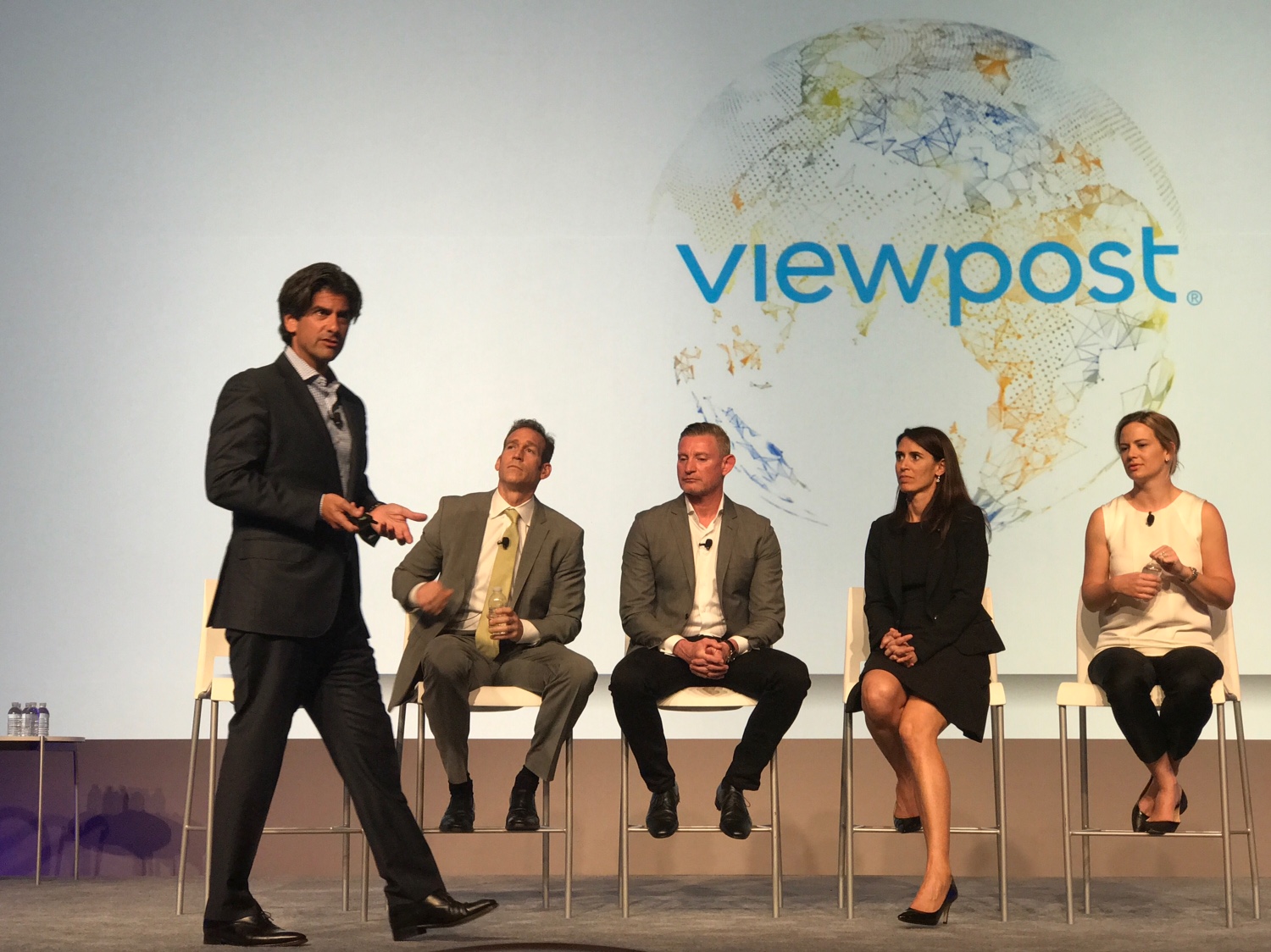
Event photograph: Russ Stark / Viewpost portfolio.