A grocery package is a small act of persuasion. It sits on a shelf, states its case and waits for somebody to put dinner in its hands. Maurice Markey has spent a considerable part of his working life on the other side of that encounter. At Sam’s Club, he helped lead the business of products carrying the retailer’s own brands. Today, as chief executive of Pro Food Solutions, he leads a food platform serving the U.S. military. Different customers, different routes to the table. In both settings, the promise has to survive contact with everyday life.
There is something pleasantly unforgiving about food as a business. A presentation can have an excellent afternoon. Dinner gets judged again tomorrow. The customer does not owe a product a second chance merely because the first launch meeting went well. Read Markey’s career through that practical test and the sequence of engineering, brand management, corporate strategy and operating leadership begins to make sense.
The promise on the package
In 2011, Markey’s Sam’s Club responsibilities covered a multibillion-dollar proprietary-brand portfolio spanning approximately 50 categories. Brand management, product development and quality all sat within his remit. That combination deserves attention. The person explaining a product’s appeal was also responsible for work determining whether the product deserved it.
At the Store Brands Decisions Innovation & Marketing Summit that year, his session concerned store-brand innovation. The job placed him at a junction between the customer’s expectations and the retailer’s own name. An independent brand can disappoint you on its own account. A store brand brings the shop into the conversation. The retailer is asking you to trust its judgment as well as its price.
Scope of Markey’s Sam’s Club proprietary-brand responsibilities in 2011. A historical measure of the role, not a current company figure.
The September 2011 introduction of Simply Right, Artisan Fresh and Daily Chef divided the proposition into distinct customer needs. Markey’s explanation emphasized dependable quality. His observation was direct:
“We realized that our members prioritize consistent, reliable quality above all other product attributes.”Maurice Markey, September 2011
That is a demanding way to describe a brand. Consistency is less photogenic than novelty. It requires the next purchase to justify the previous one. A new name and a handsome package can invite somebody to try a product. Whether they buy it again depends on a much longer conversation between expectation and experience.
There was room for a little glamour, too. In January 2010, Sam’s Club introduced Rue 33, a French-distilled vodka, in 241 locations. Markey was then vice president of private label brands. The launch put a premium spirits proposition inside the Member’s Mark offering. A warehouse club, usually associated with getting practical quantities home, was also making a claim about taste and occasion.
The historical announcement priced a 1.75-liter bottle at about $28. It is a useful detail because it makes the proposition concrete: a particular product, a particular size, a particular price. Brand strategy eventually has to fit on a shelf label. Whatever vocabulary surrounds the launch, somebody still has to decide whether the bottle belongs in the cart.
An engineer learns to speak consumer
Markey’s first professional work was in engineering at Goodyear. His academic preparation combined a Purdue industrial engineering degree, completed in 1989, with an MBA from Indiana University’s Kelley School of Business in 1994. The engineering concentration was manufacturing; the business emphasis was marketing and finance. Even on paper, the two qualifications sit comfortably beside one another.
Manufacturing asks how something will be made. Marketing asks why someone will want it. Finance keeps an interested eye on both. An executive moving among those questions has to understand how a decision in one department becomes a consequence in another. The package, the production process and the commercial proposition eventually meet in the same purchase.
His Kraft Foods career included leadership work in the United States and Asia. A Kelley brand-leadership conference scheduled him to discuss lessons from managing Kraft brands in Asia. The subject suggests a useful way to approach international experience: as something to explain and exchange, rather than simply another line in a biography.
A familiar brand name can travel more easily than a full understanding of its audience. The fact of selling across markets raises questions about habits, expectations and what consumers recognize as value. Markey’s conference appearance brought that experience back into an educational setting, where working managers and students could consider it together.
His attention to the customer also extended to the ordinary life of packaging. At a private-brand conference, he discussed how people keep interacting with a package until its contents are used up. It is an appealingly ungrand observation. The package continues its job in a kitchen cupboard long after the advertisement has stopped talking.
That perspective gives the everyday object a longer working day. It has to be recognized, handled and returned to its place. Design participates in the customer’s routine. For a brand executive, remembering that routine is a useful corrective to the temptation to treat the shelf as the end of the story.
At Designer Brands, Markey later served as vice president and head of strategy and corporate communications. The role joined decisions about the business with the work of explaining them. Footwear supplied a different product category, but the relationship among operations, customers and a recognizable commercial identity remained relevant.
Dinner has a destination
IMB announced Markey’s food-services operating partner appointment in May 2022. The platform brought together Alder Foods, Elite Brands and Richmond Wholesale Meat Company. Its work included suppliers to the Defense Commissary Agency and food operations serving the U.S. military. His move placed a career in brands and retail inside a business with a distinct institutional customer.
An operating partner’s title points toward the work inside the investment. In Markey’s case, the appointment concerned strategic and operational support for the food platform. There are suppliers to coordinate, businesses to understand and customers whose needs have to remain visible across a group of companies. The investment relationship adds another set of expectations to the operating job.
- PlanSupply strategy
- Find & makeSourcing and production
- Create & buyProducts and retail
- MoveLogistics and distribution
An editorial map of Pro Food Solutions’ published capabilities.
Pro Food Solutions describes capabilities spanning supply-chain strategy, sourcing, manufacturing, product development, retail and global distribution. Its published footprint includes more than 235 commissaries and activity in more than 80 countries. Those are company-wide figures. They describe the setting of Markey’s current work, rather than a personal scorecard.
The list of capabilities contains the less glamorous companions of a successful delivery: labeling, shipping and customs. They rarely get star billing. Yet a product intended for a distant customer needs each stage to work. A beautifully developed food item still has to arrive where it belongs. Geography does not make exceptions for an elegant marketing plan.
For the people buying and eating the food, the full chain may remain largely invisible. That is often the privilege of the customer: to experience the result without managing every step that produced it. The executive’s responsibility runs in the opposite direction. The small final encounter rests on a large amount of organized work.
The room that stays with you
Markey was a first-generation college student. His early encounter with Purdue came at a seventh-grade innovation camp, where his winning ideas included a video phone and sending rubbish into space. One proposal now sounds familiar; the other would have given waste collection an unusually ambitious travel budget.
At university, Kappa Alpha Psi became part of his community. He served as chapter president and met his wife, Tamara, through the fraternity. He has remained connected with alumni and helped establish an endowed scholarship emphasizing African American men at Purdue.
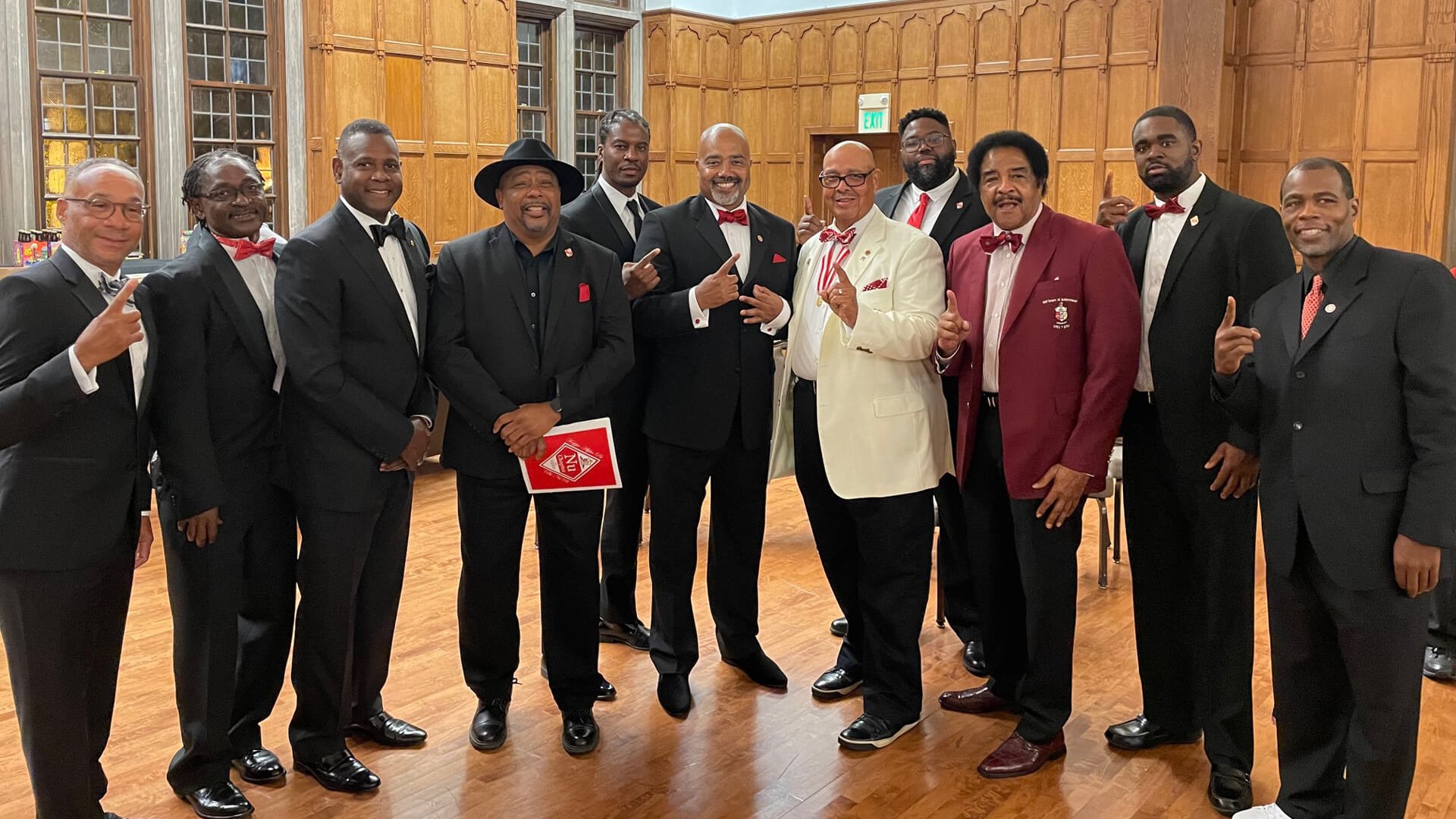
In the photograph, the group’s formal clothes coexist with smiles and familiar gestures. It is a companion image to an executive biography: people gathered around a connection that predates the present job title. Markey has described carrying lessons from chapter leadership into his professional life. His concise account of the fraternity’s purpose is worth keeping:
“Ours is a legacy of service.”Maurice Markey
Education has also remained a family concern. Tamara is a Purdue industrial engineering graduate who later became an educator and Indiana’s 2019 Teacher of the Year. A 2026 Purdue account traces her work in engineering student success. Their family includes Myles, Hannah and Gabriel. Careers have moved the family between places; the university connection has continued.
Recognition, and the work after it
Kelley recognized Markey with its Academy of Alumni Fellows award in 2022. The school also described his support for Purdue’s Algebra by 7th Grade initiative and Minority Engineering Program. That pairing gives the honor a useful context: professional experience accumulated over years, alongside attention to students still building their own foundations.
An alumni award fixes a moment in a career. The work continues around it. Markey is currently listed as chief executive on Pro Food Solutions’ leadership page, leading a business whose customers depend on the practical result. Products have to keep their promises. People have to have a place to begin. His career offers an argument for taking both obligations seriously, even when neither comes with much ceremony.
Continue reading
- Maurice Markey on LinkedIn ↗
- IMB executive biography ↗
- Pro Food Solutions ↗
- Purdue: the Divine Nine ↗
- Kelley’s alumni recognition ↗
- The 2011 store-brand launch ↗
- The Rue 33 introduction ↗
- The private brands summit ↗
- Packaging after purchase ↗
- Brand leadership at Kelley ↗
- IMB’s operating partner announcement ↗
- Kelley alumni awards ↗
- Purdue: the Markey family and education ↗