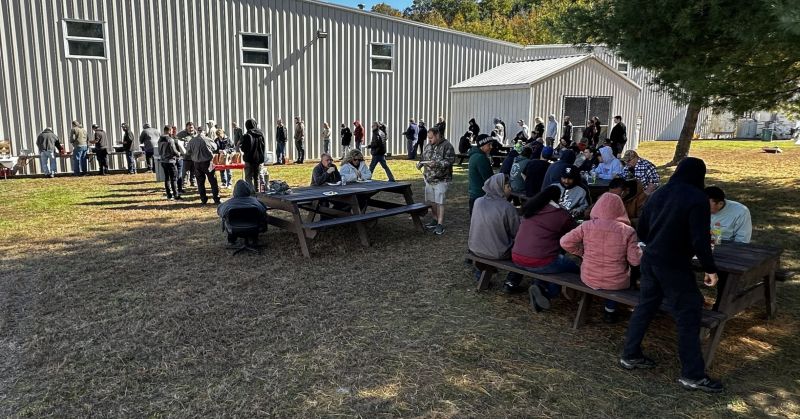
Matthew Ritchie’s team lost the cornhole tournament. He volunteered the information himself, adding that anyone who had seen him play would probably be unsurprised. For an executive discussing an acquisition, this was an unusually useful admission. Here was a company tradition still being observed, a new owner taking part, and a result that apparently required no flattering explanation.
The gathering was Columbia Manufacturing’s annual picnic. Collective Manufacturing Group had acquired the Connecticut business in April 2025. Months later, Ritchie was celebrating time with its employees and the continuation of its customs. There are grander ways to announce a philosophy of ownership. There are fewer ways to make it so easy to picture.
Ritchie, Collective’s co-founder and co-CEO, has made the future of established manufacturing shops his business. With his longtime friend and fellow founder Mark Hillenburg, he began Collective in 2024. Their proposition gives retiring owners a buyer willing to keep developing what they built. The company describes its horizon as permanent ownership. The picnic offers a small, human entry into a much larger undertaking.
A career measured in working factories
Before buying manufacturing businesses, Ritchie spent years helping run them. His aerospace career began with U.S. Air Force service from 2002 to 2006, including two tours in Iraq. He subsequently moved through manufacturing operations and general management. His education includes a bachelor’s degree in business from St. Leo College and a master’s degree in business from Northwestern University.
The civilian career crossed several kinds of work. At Lockheed Martin Gyrocam Systems, his roles included operations and Lean Six Sigma supervision. Barnes Aerospace brought continuous improvement and customer program management. General management followed at Bodycote and the machinery division of what became Hanwha Aerospace USA. Later came factory management at SKF, executive operations at Enjet Aero, and an interim operations role at Cambridge Technology.
These are jobs concerned with making a business perform repeatedly. A factory manager has to think about the relationship between the schedule and the work that will actually happen. Customer commitments, equipment, processes, and employee knowledge all meet there. The title can fit neatly on a business card. The responsibilities are considerably less tidy.
In 2021, Ritchie shared an aerial view of SKF’s Aeroengine North America campus in Falconer, New York. His accompanying description focused on the more than 450 people making aerospace bearing products at the site. The photograph took the long view; his commentary brought the reader back to the team. That emphasis helps connect his earlier operations career with the business he would later start.
Three names, three different beginnings
Collective’s first acquisition was Simson Kovacs in August 2024. Kessington Machined Products followed in November. Columbia Manufacturing joined in April 2025. When Ritchie publicly introduced the group after its first year, he presented those businesses as the opening chapter of a manufacturing organization with an extended horizon.
The acquisition sequence makes a compact graphic. The businesses themselves resist being reduced to matching boxes. Different processes, histories, and customer relationships came with each one. Common ownership would have to accommodate those differences while finding useful connections between the shops.
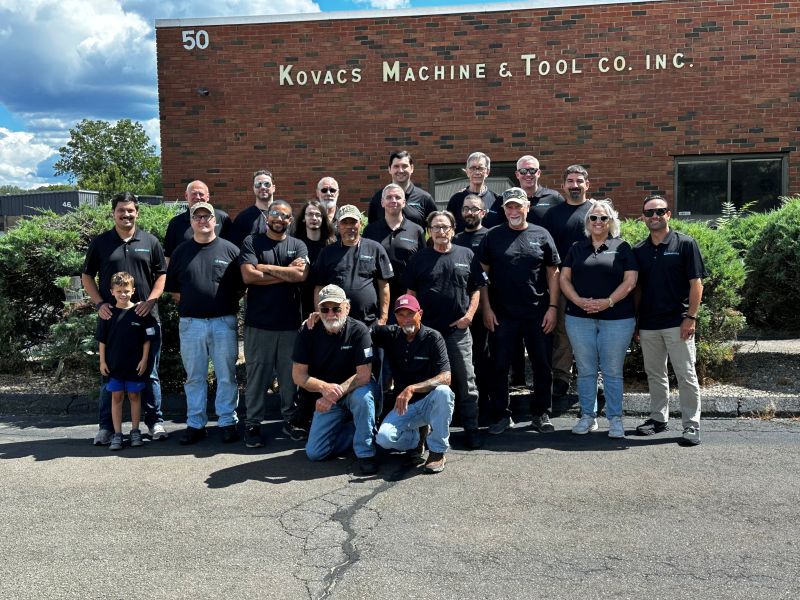
Simson Kovacs had already lived through a succession. Hungarian brothers Arpy and Vilmos Kovacs founded Kovacs Machine & Tool after immigrating to the United States. Three longtime employees later bought the business. Its history included aerospace work and a substantial power-generation specialty. When Ritchie celebrated an anniversary photograph, he singled out three generations of family members and the prospect of building for the next generation.
Columbia had another family history. David Bell Sr. founded it in 1980 after a career that began as a Pratt & Whitney machinist apprentice. He had returned to Connecticut with retirement in mind, then opened a manufacturing shop. The business grew into an operation producing complex turbine-engine components and assemblies. By the time Collective acquired it, its capabilities included both original equipment manufacturing and maintenance, repair, and overhaul work.
These histories give succession a practical meaning. The buyer inherits more than a date of incorporation. A shop’s way of solving problems, its relationship with customers, and its employees’ accumulated experience have developed together. Ritchie’s proposition asks that a change in ownership provide room for that experience to continue earning its keep.
Twenty-eight days later
At Kessington, continuity required a restart. The Elkhart business had closed in 2024. Collective acquired and reopened it through an Article 9 foreclosure, returning it to its original name. Its current history records a 28-day interval and the rehiring of 30 original employees.
Kessington’s history records the restart after its 2024 closure, with 30 original employees rehired.
Reopening turns an investment philosophy into an immediate operating problem. Someone has to restore the ability to work, and customers need a reason to trust the business again. The accomplishment is also a beginning. A reopened factory still needs orders, dependable production, and decisions that let it keep going.
Kessington’s work includes precision aerospace and defense components. Its processes range from machining and Swiss turning to grinding, honing, and wire electrical discharge machining. Such capabilities give the reopening significance beyond the building itself: an operating shop can again perform work that its customers need.
For Ritchie, this acquisition makes the ownership question unusually concrete. The central promise of Collective is that established manufacturing capabilities should have a future. At Kessington, the first requirement was to restore a present. There is a useful austerity to that achievement. Before a business can grow, it must be open.
The horizon behind the purchase
Collective is backed by Elmore Companies, a family office based in Bloomington, Indiana. That relationship supplies the financial context for Ritchie and Hillenburg’s ownership approach. The founders describe buying and holding shops over the long term, supported by capital intended for that purpose.
A long horizon changes the questions an owner can ask. Equipment investments, developing managers, and strengthening customer relationships all have consequences that extend beyond the next reporting period. Permanent ownership remains a declared intention, with the work of fulfilling it spread across years of decisions.
The partnership also brings different careers to the same table. Ritchie’s background runs through operations and continuous improvement. Hillenburg’s includes commercial leadership, finance, strategy, and company growth. The distinction is useful: acquiring a shop requires understanding its prospects and the practical work needed to realize them.
Hillenburg discussed their venture on the Machine Shop Mastery podcast, including reconnecting with Ritchie, finding the first acquisitions, developing internal leaders, and the group’s capital structure. The subjects fit together. A buyer needs a way to fund ownership, a reason for a seller to trust it, and people who can make the enterprise work afterward.
Progress has to fit through the shop door
Collective’s approach combines retained local identity with shared resources. The intent is to add systems, equipment, technology, and expertise to established capabilities. For Ritchie, the challenge lies in deciding what will help a particular operation rather than assuming that all three need the same treatment.
At Simson Kovacs, the changes described since joining Collective include collaborative robots, more unattended machining, and improved inspection capacity. That is a useful example of the relationship between preserving a business and changing its tools. Familiar people and customer knowledge can remain valuable while the production methods evolve.
The group has also described regular quarterly planning and leadership offsites. In its update setting direction for early 2026, the emphasis was on maintaining that cadence and aligning site leaders. The permanent horizon still has a calendar. Long-term intentions need work that can be assigned, reviewed, and carried into the next quarter.
Ritchie’s operating approach begins with listening to the people doing the work. That puts attention on obstacles before they become disappointing numbers. It also makes preservation selective and practical. Experience is useful because it can explain what needs changing as well as what deserves to stay.
A symbol, a gathering, a next chapter
Ritchie has shown a personal interest in the company’s identity. Collective’s logo refers to the base of a four-flute end mill and represents four stakeholder groups: founders, employees, customers, and partners. Discussing it, he wrote, “It may not be perfect but it is personal.” A tool reference is an apt choice for a business whose argument depends on understanding how things are made.
“It may not be perfect but it is personal.”
Matthew Ritchie, on Collective’s identity
His comments about the picnic and the anniversary photograph operate on a similar scale. They show what he chooses to notice: time with employees, family continuity, rituals that outlast a transaction. They also allow a little humor into an industry conversation usually crowded with capability lists and acquisition announcements.
Manufacturing ownership will ultimately be tested in the work. The first acquisitions give Ritchie a set of specific responsibilities, each attached to a place, a team, and customers. The established names remain important because each stands for a business whose next chapter must be made rather than merely announced.
For now, the opening chapter contains a reopened factory, three acquired businesses, and a picnic still on the calendar. Ritchie’s ambitions extend considerably further. His cornhole record may take longer to improve. The employees at Columbia have, at least, been given another tournament at which to find out.