On his forty-first birthday, Mark Hillenburg found a reason to talk about somebody else. Albert, known as Al, had been working at Kessington Machined Products for forty-one years. His first year there was Hillenburg’s first year anywhere. Hillenburg had spent time with him that week and shared a photograph, turning the customary birthday announcement into a small tribute to a working life. A birthday usually comes with candles. This one came with a machinist.
The detail suits the business Hillenburg is building. With his longtime friend Matthew Ritchie, he founded Collective Manufacturing Group in 2024 to acquire manufacturing companies and keep them for the long term. The ambition includes growth, equipment, and commercial discipline. It also includes people who can measure their relationship with a shop in decades. In Hillenburg’s account of Albert, staying was an accomplishment worth naming.
That gives his story an unusual center of gravity. Much of a business career can be described through arrivals and departures: a promotion, an acquisition, a sale. Hillenburg’s current work asks what happens between those milestones, when a founder wants to leave but the work needs to carry on. He has spent time on both sides of that question. His first shop was a family undertaking, close enough to home that home supplied the garage.
Seven hundred square feet of education
Hillenburg co-founded that machine shop with his father in his parents’ garage. His father was an experienced CNC machinist, with more than thirty years in the trade. The younger Hillenburg’s introduction to manufacturing was therefore personal and practical: a parent who knew the work, a small space, and a business they were trying to build together. The garage measured 700 square feet. There was little room for the distance that sometimes develops between a business and the people making its products.
His early experience included manual machines and a Bridgeport mill. In later conversations about manufacturing, he returned to the difficulty of learning machining firsthand. That matters to the arc of his career because he eventually moved toward sales, business development, and executive leadership. He began with the activity those jobs must support. The shop floor was part of his own education before it became part of his management vocabulary.
The family shop was followed by a series of manufacturing roles. His published career record includes business development at Adams & Westlake and MSP Manufacturing, then sales and leadership at Kessington Machined Products. He later led Blackland Aerospace, became chief executive of KIHM Metal Technologies, and served as president at Enjet Aero. Across those positions, his work moved into aerospace and advanced manufacturing, where commercial relationships and operational performance meet in the same delivery schedule.
There is a recognizable progression here, from making parts to finding work to leading companies. Each stage widens the field of responsibility. A business-development job brings the customer into the picture; an executive role brings investment and company direction with it. Hillenburg eventually returned to ownership with experience of those different demands. The garage remained an origin story, but the career that followed gave him more than one way to understand a shop.
- GarageMachining with his father
- CustomersSales and business development
- LeadershipAerospace manufacturing
- OwnershipCollective, founded 2024
A shop reopens after twenty-eight days
Kessington supplies a particularly concrete chapter. Founded in 1974, the Indiana manufacturer had spent decades making precision components for aerospace and defense. Hillenburg already knew the company from his earlier career there. In 2024, it closed. Collective acquired the business through an Article 9 foreclosure and reopened it twenty-eight days after the shutdown, using the name Kessington Machined Products. Thirty of its original employees were rehired.
A reopening is easy to summarize in a verb. The employees give it a more useful scale. Thirty people returned to a business that had stopped operating. For Hillenburg, a company from his own professional past became part of the group he was founding. The connection makes Kessington more than an interchangeable entry in an acquisition list. He had worked there before he became one of the owners responsible for its next chapter.
Its work today includes multi-axis CNC machining, Swiss turning, grinding, honing, and process development. Those capabilities describe a demanding manufacturing business rather than a sentimental keepsake. Keeping a shop alive means continuing to make parts that customers need, with the precision and repeatability they expect. The story of a familiar name returning to the door is inseparable from the less picturesque work of getting production moving again.
Kessington also makes the birthday tribute to Albert easier to understand. Hillenburg had chosen to recognize a long-serving employee at a company whose future had recently been interrupted. The contrast between a brief closure and a forty-one-year working relationship carries its own weight. A person’s experience can outlast ownership arrangements. Collective’s reopening put some of that experience back inside the business.
Retirement, with an invitation back
The Simson Kovacs story begins with a different kind of continuity. Hungarian brothers Arpy and Vilmos Kovacs founded Kovacs Machine & Tool after immigrating to the United States. Later, three longtime employees bought the business: Allen Cuccaro, Mike Frank, and Pete Albrycht. The owners added Simson Products, and power-generation work became part of the shop’s identity. Collective acquired the businesses in 2024.
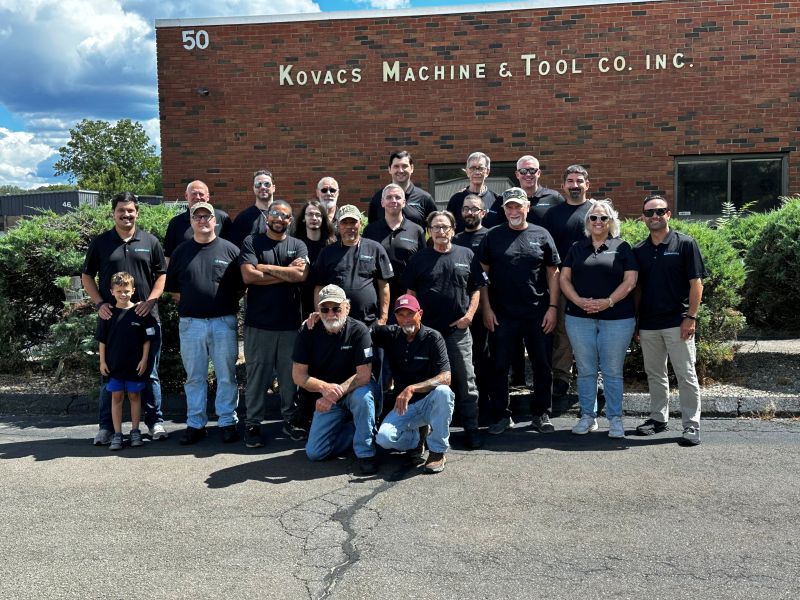
By the first anniversary of that acquisition, Hillenburg was describing a transition that had given the three sellers room to retire. Within six months, all three had stepped away from daily operations. A celebration brought them back together with the team. The photograph showed a gathering outside the brick building, with the old Kovacs name still visible above them. Retirement had changed their responsibilities without ending the relationship.
Hillenburg’s account emphasized that the sellers had received other interest. What Collective offered was a long-term approach to the business they had built. A year after the purchase, he described the former owners as friends. That is a modest word with considerable work behind it. A sale transfers control. Friendship after a sale suggests that the people involved still have reasons to be in the same photograph.
Cuccaro’s own description of selling adds a useful human scale. He had spent nearly fifty years around the business and acknowledged that the sale was frightening. He wanted the company cared for and continued checking in after the transition. In that account, a successful retirement does not require forgetting the shop. It requires being able to visit without having to resume running it.
Keeping the name, changing the equipment
At Simson Kovacs, continuity has come with new machinery and responsibilities. The shop has added collaborative robots for unattended production, improved inspection capacity, and expanded into aerospace work. Employees have moved into leadership roles. The business also gained equipment from sister companies. These are changes inside a familiar manufacturing operation, made with the aim of increasing what it can do.
That combination is central to Hillenburg’s stated approach. A legacy gives a business relationships and accumulated knowledge; investment gives those assets new uses. Preserving a company involves decisions about what to update as well as what to keep. The word stewardship can sound rather grand until it reaches a question about a machine, an inspection process, or somebody’s next job. Those are the places where an ownership philosophy becomes observable.
Columbia Manufacturing added another version of that question when it joined Collective in 2025. David Bell Sr. founded the Connecticut company in 1980 after a career that began as a Pratt & Whitney machinist apprentice. His intended retirement on a farm gave way to another manufacturing venture. The business grew into a 90,000-square-foot operation, with generations of his family involved. His grandson Jared Vajnar continues to work there.
For Hillenburg and Ritchie, such histories are part of what they are buying. Columbia’s turbine-engine work, Simson’s machining, and Kessington’s aerospace capabilities have distinct backgrounds. Bringing them into one group introduces shared support while leaving the task of serving their customers very concrete. The businesses carry names that existed before Collective. Their next investments must earn a place in those longer histories.
The calendar inside the long game
Collective is backed by Elmore Companies, a third-generation family business with a long-term acquisition approach. That connection matters because Hillenburg and Ritchie’s ambition depends on the owners and their capital agreeing about time. A stated intention to hold companies for the long haul needs financial backing that can work on the same basis. Collective presents Elmore as a partner in that approach.
Hillenburg’s January 2026 update also made clear that a long horizon does not mean a leisurely pace. Customer demand, he wrote, required growth of more than sixty percent across the group’s three businesses that year. That was a requirement and a forward-looking target, rather than a reported result. His emphasis was on execution: discipline, consistency, and returning to the work quarter after quarter.
The operating rhythm includes quarterly planning and leadership offsites. Hillenburg has facilitated those sessions at Kessington, using the Traction/EOS framework to review direction, measures, and ninety-day priorities. The contrast is useful. Ownership can be intended to last for decades while management still needs a plan for the next three months. A promise about permanence does not fill a production schedule.
The public update described a strong finish to 2025 and the decision to keep the planning cadence through busy periods. That supplies a less glamorous companion to the acquisition stories. There are meetings to attend, priorities to revisit, and issues to resolve. The anniversary photograph is the moment people see. The quarterly calendar records some of the work required to get there.
Growth required by customer demand across three businesses, as described by Hillenburg in January 2026.
Forward-looking targetA question to bring onto the shop floor
In a conversation with David Turner on Rapid Fire Manufacturing, Hillenburg offered a direct test for a workplace: “If you wouldn’t want your kids to work in your shop, something’s broken.” The question brings a personal standard into a business decision. It asks a leader to picture somebody they care about entering the environment they have helped create. It is difficult to hide an answer like that inside a spreadsheet.
His life outside work adds context without requiring a grand theory. A published biography describes time with his wife Cari and their five children, enthusiasm for Indiana Hoosier basketball, and an interest in cars. His LinkedIn profile also records service with Youth for Christ Southern Hills and his role in co-founding the NDIA Central Indiana chapter. Manufacturing sits alongside family, community commitments, and interests that extend beyond the next acquisition.
The business he is building gives him a practical way to connect those concerns. A retiring owner needs a future they can trust. An employee needs a workplace worth remaining in. A customer needs parts to arrive. Hillenburg’s model puts those demands into the same undertaking, with the intention of growing the companies over time. The intention is plain; carrying it out remains the work.
His birthday photograph returns the story to a smaller measure. Albert had stayed at Kessington for as long as Hillenburg had been alive. Hillenburg chose to pause and acknowledge it. After the garage, the executive jobs, and the acquisitions, the detail is still a person beside the work. A manufacturing business can change hands in a transaction. Giving people good reasons to stay takes considerably longer.
“If you wouldn’t want your kids to work in your shop, something’s broken.”
Mark Hillenburg, Rapid Fire Manufacturing