On April 4, 2024, Matthew Parkhurst sent lunch to the people he wanted as customers. More than 1,000 pizzas went out from neighborhood pizzerias in New York and San Francisco, packed in boxes bearing Antimetal’s name. The business sold software for reducing cloud bills. For a day, its most persuasive interface was cardboard.
Parkhurst was 26. Antimetal was coming out of beta, and he needed people to notice. The deliveries reached prospective customers, venture capital firms and technology personalities. Pizzas that could not be delivered went to drivers, who also received generous tips. There was a sensible piece of hospitality beneath the spectacle: even a failed delivery could leave someone pleased.
The bill came to about $15,000. Roughly 75 recipient companies subsequently became customers, contributing more than $1 million in additional annualized net revenue. That last qualification matters. This was a recurring revenue measure, rather than a million dollars collected before the cheese cooled. Parkhurst later tied the result directly to the launch. The lunch had purchased a hearing; the software still had to earn its subscription.
Before the pizza, a car lot
Parkhurst’s route to a software company began with a much more physical product. In 2016, he left school to sell cars. The work gave him his first experience in sales. A car is something a buyer can sit in, drive and show the neighbors. A service that trims an Amazon Web Services bill takes rather more explaining.
His later roles included leading sales and operations at Oxy and partnerships at Insurmi. Those titles place customer relationships and the machinery of running a business near the center of his career. The thread is useful when looking at Antimetal: its CEO came to the problem with experience getting people to consider an unfamiliar offer, then making the commercial relationship work.
He and Shreyas Iyer founded Antimetal in 2022, with Parkhurst as CEO and Iyer as CTO. Their early accommodation was modest. Years later, announcing a New York office, Parkhurst recalled the two of them “sharing a desk in my living room.” It is a more revealing origin image than the usual photograph of a founder pointing at a whiteboard. Two people had to fit their working day around the same piece of furniture.
The initial proposition was easy to understand once someone heard it: help companies reduce AWS spending. Cloud infrastructure can be purchased in ways that make financial sense at one moment and become wasteful later. Antimetal set out to automate the work of finding savings. In May 2023, the company announced a $4.3 million seed round led by Framework Ventures, with investors including Chapter One and IDEO CoLab.
A marketing budget you could eat
By the pizza launch, Parkhurst had to solve an awkward commercial problem. The prospective buyer could benefit from the product and still ignore the pitch. Rahul Sonwalkar, CEO of the data-analysis startup Julius AI, vaguely remembered an earlier Antimetal approach. It had not held his attention. The arrival of pizza prompted him to look the company up. Julius AI became a customer.
Parkhurst had considered other gifts. Branded merchandise seemed forgettable. Champagne cost too much. Pizza occupied a useful middle ground: affordable enough to distribute widely, welcome enough to get opened and recognizable enough to become a photograph. The campaign consumed almost the entire launch marketing budget. This was a deliberate concentration of a small budget on one event, with very little left to hide a disappointing result.
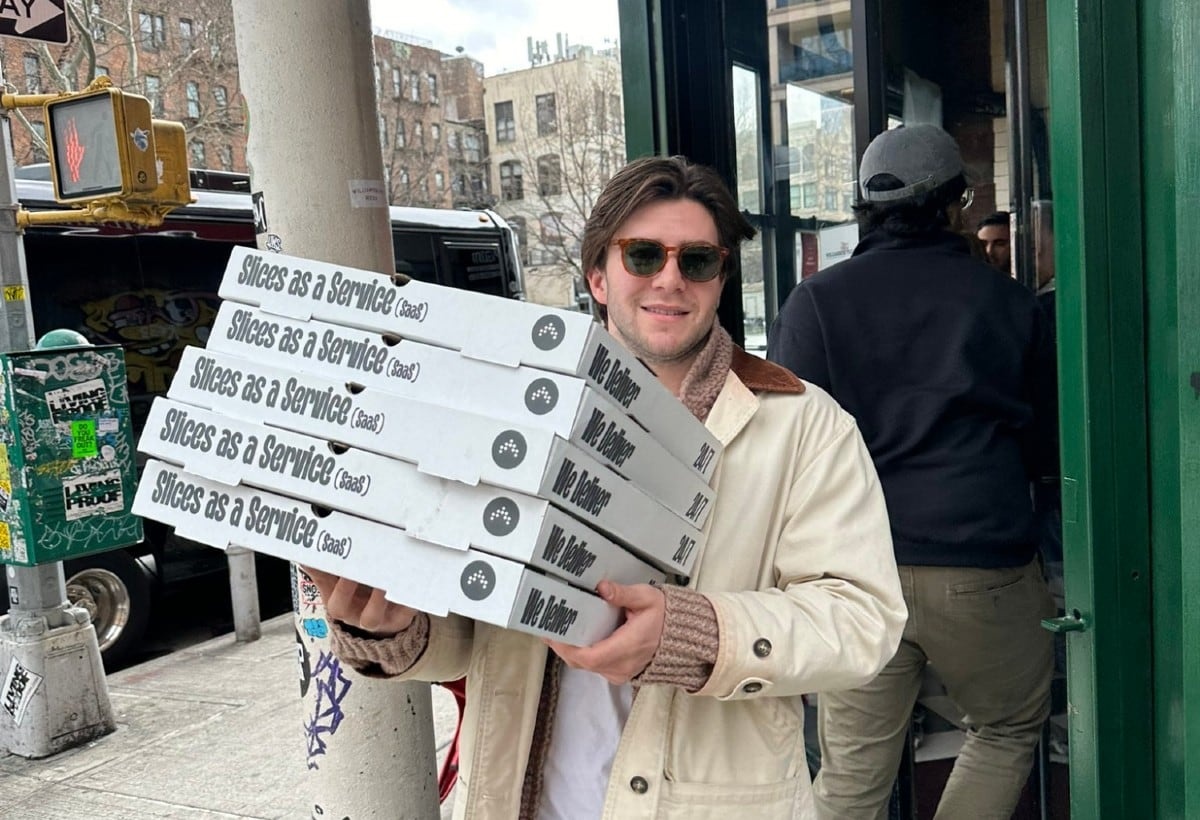
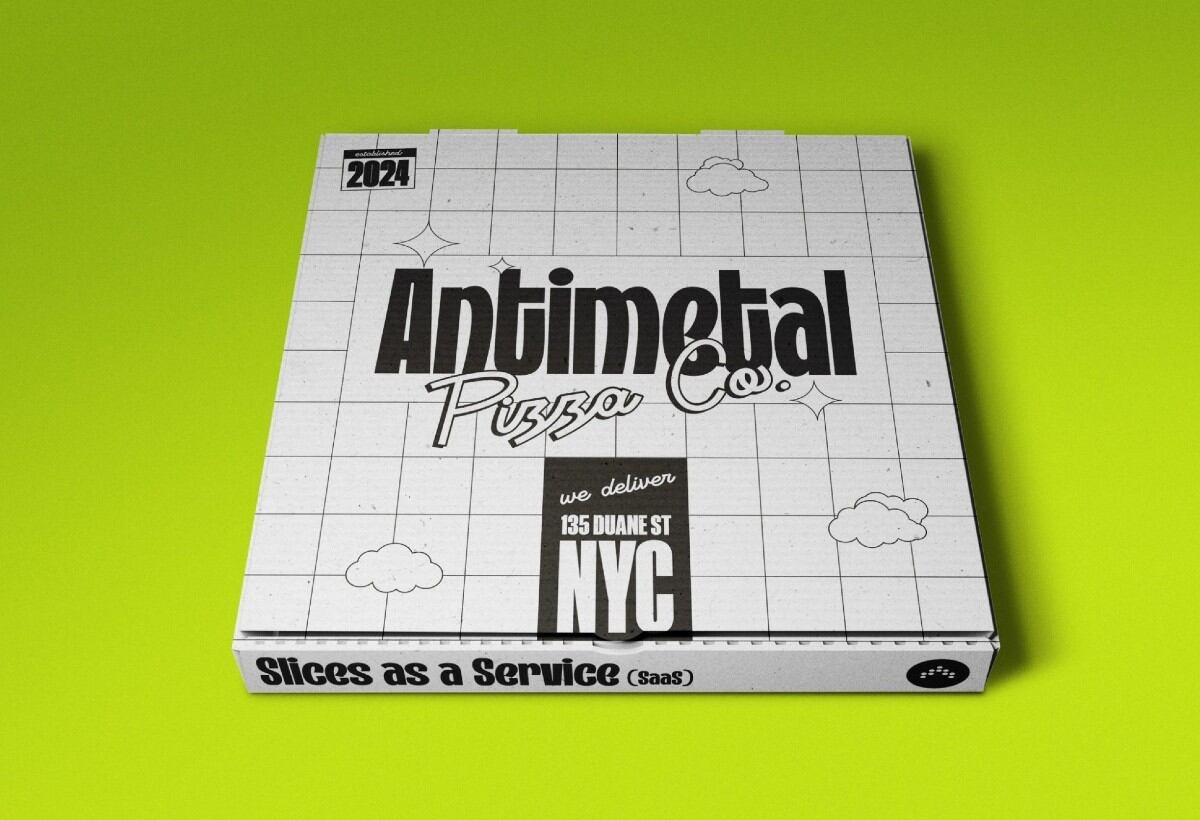
The packaging did some of the talking. “Slices as a Service” appeared on the boxes, a joke requiring almost no explanation to the software crowd receiving them. A technical category had acquired a lunch special. Parkhurst’s verdict afterward was concise: “Nobody was mad they got the pizza.” It is an unusually modest standard for a marketing campaign, and a useful one.
- Campaign spending
- ~$15,000
- Recipient companies that became customers
- ~75
- Added annualized net revenue
- $1m+
Reported in June 2024. Annualized revenue, not profit or cash collected at launch.
Then somebody sent a pizza back
The campaign developed a second life in recruiting. An engineering internship applicant named David delivered a pizza to Antimetal’s office with his résumé and a handwritten note. He explained that the gift was intended to get the team to look at his website. He had also submitted a pull request fixing two links in Antimetal’s documentation before arriving.
Parkhurst shared the application on X on May 1, 2024, promising an interview. The detail about the documentation matters as much as the delivery. David had studied the company closely enough to borrow its joke and had already contributed something useful. The application combined attention with evidence. Pizza opened the conversation; the small repair supplied a reason to continue it.
Parkhurst stopped short of treating effort as a complete hiring process. His response to the ensuing conversation made clear that there were other things to assess. That restraint adds something to the portrait. He could enjoy an inventive approach without pretending that enthusiasm settled every question. A founder can be susceptible to a good joke and still have an interview to conduct.
The problem waiting after deployment
As Antimetal grew, Parkhurst began describing a broader frustration. Engineers could increasingly get help writing software, while the responsibility for keeping that software running remained stubbornly demanding. In June 2025, Antimetal announced a $20 million Series A led by Sound Ventures alongside a beta platform for automating infrastructure management. Backers included Nat Friedman, Daniel Gross and the founders of Box and Dropbox.
Parkhurst summed up the accumulation confronting engineering teams: “More dashboards, more alerts, more tools.” Each addition could provide useful information while leaving someone responsible for assembling the whole account. His ambition was to reduce that coordination burden. The pitch had expanded from making a bill smaller to making a running system more understandable, then helping with the work that understanding revealed.
“Writing code is not the hardest thing anymore.”
Matthew Parkhurst · 2025
That sentence helps explain the change in scope. Parkhurst was arguing that the difficult part of software was increasingly its maintenance. Iyer described an approach that would connect repositories, monitoring, cloud infrastructure and ticketing history. Information previously scattered across tools and people could become part of a shared account of how a customer’s systems behaved. The promise depended on learning the particular environment, including how its engineers had responded to earlier problems.
The intended relationship was gradual. Customers could begin with read-only access, receiving analysis before giving the software permission to act. Broader authority could follow as confidence developed. For Parkhurst, this created a different sales problem from getting an email answered. Asking someone to consider a cloud savings tool is one thing; asking them to delegate operational work requires repeated reasons to trust the result.
- 01Read the billFind cloud savings
- 02Read the systemConnect operational evidence
- 03Check the resultReview, fix, keep watching
Trust has to survive the next morning
The company’s subsequent work gives that ambition a more practical shape. In June 2026, Antimetal described using its own agents across seven internal production services. It reported a reduction from about 3,000 error logs per day to about 720, with the lower level persisting over the following month. Every change went through an engineer’s review. This was an internal trial, with the limits and particular circumstances that implies.
One database problem returned after an initial fix. Continued observation caught it, and a further change addressed the remaining issue. That is a telling complication for a business selling automation: a plausible fix and a lasting fix can be separated by what happens after deployment. The account gives Parkhurst’s maintenance argument a concrete test. Success has to persist when the demonstration is over and the system is busy doing something else.
Antimetal also built an internal onboarding application called Anvil. Its team described automating much of the technical setup needed to bring customers live, while retaining human verification and judgment. For complicated onboardings, the company reported roughly 80 percent less hands-on work. Parkhurst’s organization was applying its own thesis inward: repetitive coordination was a candidate for software, and human attention should go where a decision actually needed it.
By August 2026, the team was publishing work on fitting substantially more operational data into an agent’s available context. Its approach stored repeated structures once while retaining changing values and references to original records. These are quieter developments than a thousand pizzas. They also concern the same practical question his company now has to answer: can a complicated service become easier for someone else to use?
In October, the team described another part of that work: grouping production alerts using evidence gathered during an investigation. Similar warnings can have different causes; different warnings can point to one failure. Reducing noise requires understanding enough to preserve the distinctions that matter.
More room, the same desk-sized question
There are other turns in Parkhurst’s career. He advised Brev.dev in 2024, the year NVIDIA acquired it. In March 2025, he was selected as a senior adviser at the General Services Administration. A financial disclosure recorded a leave from his CEO position during government service while he continued board duties. These episodes place him beyond the launch-day photographs, working across startups and a federal institution.
Yet his own office announcement returned to the shared desk. The change he chose to describe was one a reader could picture: two cofounders working in a living room, then a company with a New York office. He paired the larger setting with an insistence that the original spirit remained. The public anecdote makes growth tangible without requiring a valuation to do the explaining.
The pizza photograph offers another tangible measure. Parkhurst stands on a city sidewalk holding a stack of boxes, selling a service whose work happens elsewhere. He made an abstract proposition physically present. Now he is pursuing a product meant to make the continuing work of running software less burdensome. One brought lunch to the office. The other has to earn its place there, day after day.