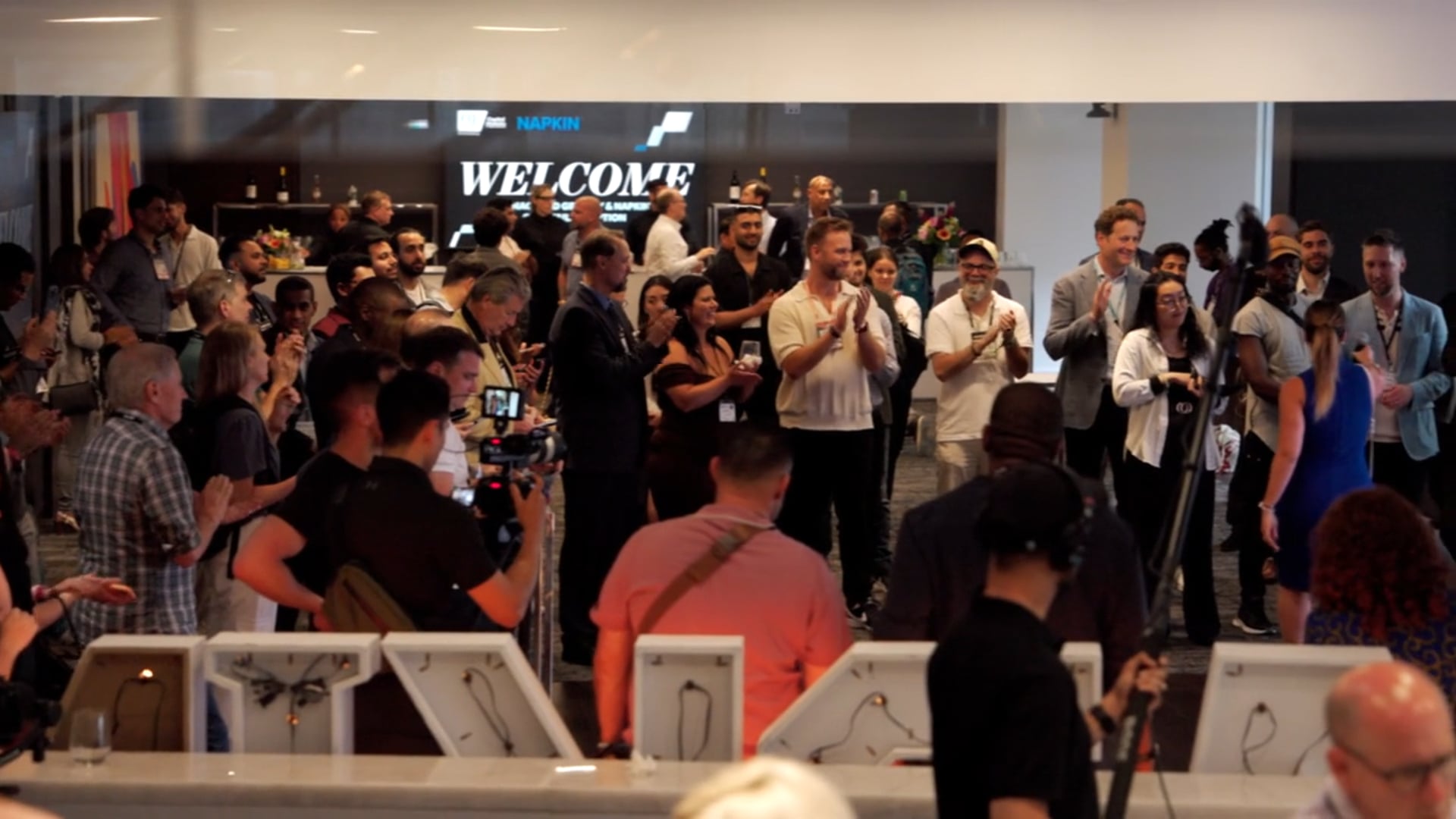
The cake was a stack of napkins. At a Toronto gathering in June 2024, Matthew Liberto and his co-founder, Grant Anderson, presented Napkin Deals to a room of entrepreneurs and investors. Velvet Lanes supplied the edible stationery. A company named for the place where an idea might first be scribbled had found an appropriately literal dessert. Even acquisitions people occasionally need something they can cut without due diligence.
Napkin and Canaccord Genuity hosted 400 guests that evening. Cameras recorded the presentation for a television project called Building a Billion Dollar Business. The title expressed an ambition; the room supplied something more immediate: people who owned businesses, people who financed them, and people trying to get the two acquainted.
Liberto has spent much of his working life arranging meetings between worlds that do not automatically meet. Concert audiences and performers. Travelers and distant communities. Cocoa farmers and foreign capital. Today, as Napkin Inc.’s co-founder and CEO, he works with business owners and potential buyers. The transactions have changed. The habit of putting people together has survived. In Toronto, it even came with frosting.
Before the balance sheets, a map
His early ventures were wonderfully literal, too. At 18, while in college, he started ESL Tours BC, an adventure travel business for international students. Western Canada was the destination; students arriving from elsewhere were the customers. He later ran Embrace Entertainment, producing concerts, festivals, and youth events. He also founded a marketing and web design agency, Idea Vessel, and a music label, The Love Label.
Those businesses required people to show up. A tour needs travelers. A concert needs an audience. A website needs a client who can explain what the business actually does. Liberto’s early working vocabulary was already full of invitations, schedules, and places to go. His subsequent move into international business had a practical beginning in enterprises that depended on bringing people into the same experience.
Then he asked his friend Sorin Mihailovici what a successful life would look like. Mihailovici imagined having enough freedom to throw a dart at a world map and take his family wherever it landed. Liberto encouraged him to try the travel part before waiting for the family part. A map went up in Mihailovici’s basement. A friend filmed with a phone. The dart landed at the North Pole.
This was an inconvenient answer to an innocent question. They had a small budget; the destination was expensive. They sought sponsors, offered to make a commercial at the North Pole, and linked fundraising to support for polar bears through the World Wildlife Fund. They raised $7,500. The journey helped produce Polar Faith and Travel by Dart. A hypothetical definition of success had acquired a departure date.
Under the professional name Matt Cook, Liberto became a co-creator and producer of Travel by Dart. The show’s premise lets chance choose the destination and leaves the humans to sort out the arrangements. There is a useful tension in that division of labor. A dart supplies surprise. Somebody still has to pay for the trip, make the calls, and bring the camera. Prime Video lists Cook and Mihailovici as producers of the first season.
- Bring people alongStudent tours & concerts
- Let the map decideTravel by Dart
- Connect the marketWest African cocoa
- Build the next connectionNapkin & business acquisitions
Cocoa, capital, and the cost of continuing
In late 2012, Liberto left a six-figure income to study ministry and economic development. West Africa became the next setting for his business work. Through Kingdom Venture Capital Fund, or KVCF, he helped build a fair-trade agricultural commodities operation. The work involved local cocoa farmers, foreign investment, and the long chain between producing something and getting it to a customer.
The scale was substantial: the enterprise is reported to have served more than 27,000 registered farmers and operations across 900 villages in Sierra Leone and Liberia. These are the figures attached to that earlier enterprise, rather than a count of his present employees. They describe a network spread across communities, where exporting a crop meant coordinating far more than a single purchase order.
The venture also encountered the unglamorous question that returns to almost every growing business: how to finance the next stretch. In his account of the period, KVCF could not recapitalize with the $2 million it needed for continued operations at scale. A proposed merger with Trade Link aimed to address operational and cash-flow problems. Freedom Farmers was established in neighboring Liberia in 2016, but further capital proved elusive.
This episode deserves a place beside the farmer count. Reach and staying power are separate achievements. A business can bring together a large network and still struggle to finance its continuing work. Liberto’s own account includes both the expansion and the frustration. That makes his later attention to financing and ownership easier to understand: the money needed to keep operating had already become a concrete problem in his career.
Two founders, several continents
Napkin brought Liberto into acquiring and growing existing companies. Anderson remained an important collaborator. Their association predates the current acquisition business: both had roles in KVCF and Idea Vessel, and both were executive producers and hosts of Christian Beer Network. A title that combines religion with a drinks menu is fairly hard to forget. Their partnership has moved through business, media, and international projects.
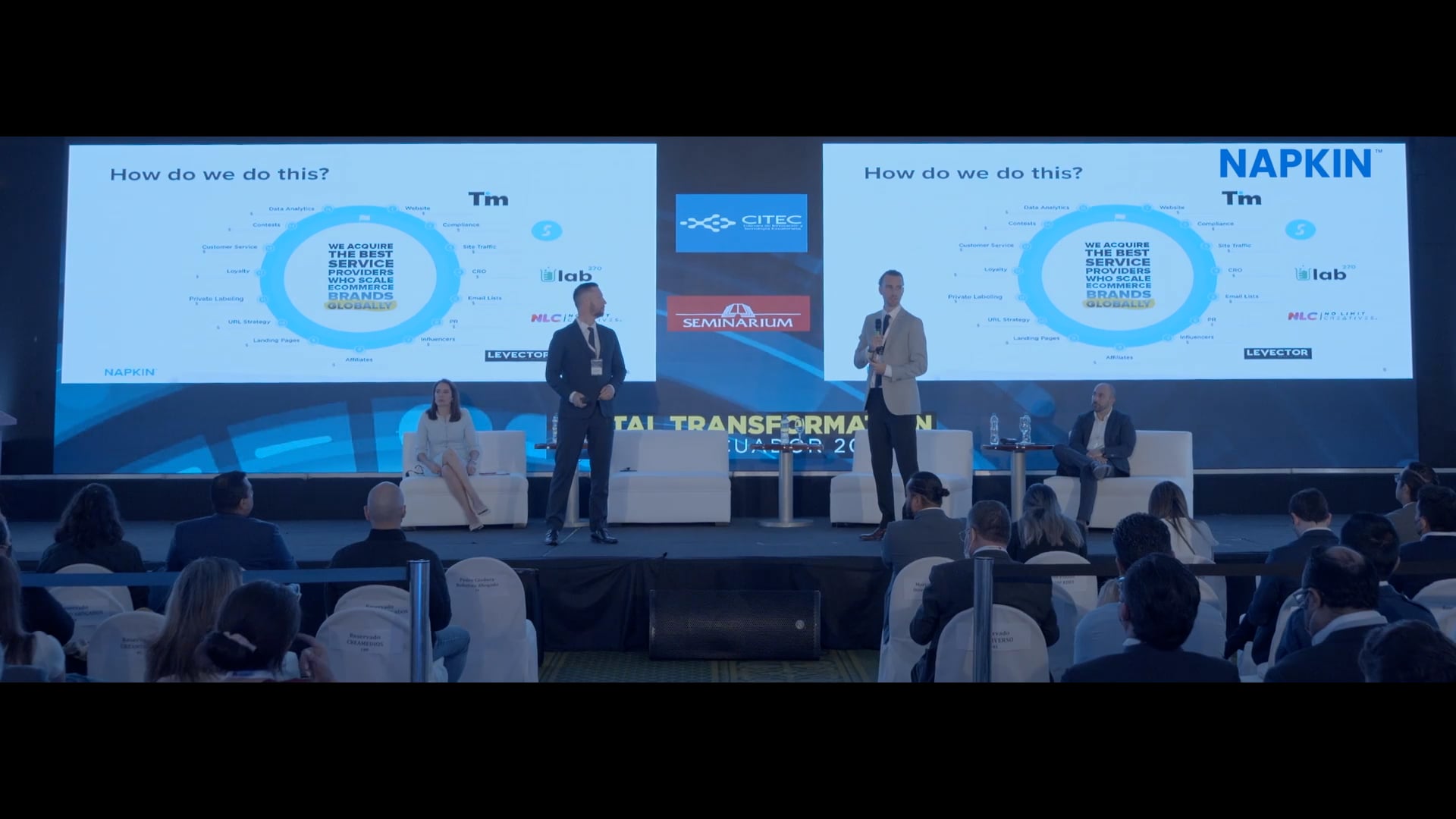
In 2022, they gave an opening keynote at the Digital Transformation Summit in Quito, Ecuador, as Napkin launched in Latin America. The event featured the acquisitions of production company Levector and advertising agency Tim. The setting suited Liberto’s background: film production, marketing, technology, and cross-border commerce were now being assembled inside the same organization.
Ecuador’s telecommunications ministry also recorded the founders’ participation in the country’s digital transformation gathering. In that company, their work sat alongside discussions of talent, technology, and exports. The geographic range was becoming a practical feature of Napkin’s operations, connecting teams and services across borders.
By the Toronto gathering in 2024, EmberTribe’s Josh Sturgeon was speaking about being acquired by Napkin. Chairman Asif Nasim, Anderson, and speakers discussing financing were part of the evening. Levector’s Jeff Karram traveled from Ecuador to film. The room provided a small picture of the larger business: operating companies, an ongoing partnership, financial relationships, and a film crew that had a job to do.
The company starts writing back
Liberto’s next experiment gives some of the colleagues names and faces without making them human. Napkin Deals describes an organization combining human leaders and advisers with AI personas assigned to business functions. Its public description separates 17 human leaders and staff, 21 human advisers, and 69 AI personas. The last group includes operating agents and advisory archetypes. Adding those categories together would obscure what they actually represent.
The idea grew out of Napkin’s own acquisition work. The company built an internal flow of opportunities, then turned it into a marketplace for founders, buyers, and capital providers. Screening, organizing information, and matching a business with interested parties became tasks for software. Human participants remained responsible for decisions and the transaction itself. This is Liberto’s proposed route to serving more owners through the work that happens before a deal.
He is also writing about the experiment while conducting it. How I Built a Global AI Organization is an ongoing book, offered online and as a download. The book page lists 39 chapters. Its sequence moves from the initial napkin and data schema through the first deal, the money layer, the newsroom, and deployment. Chapter titles admit interruptions: a reckoning, an accidental module, and a longest day.
The real-time format puts the writer in an unusual position. Most business memoirs can arrange the early uncertainty around a known ending. Liberto is making the decisions and documenting them before the conclusion arrives. He gives the reader a record of construction rather than the comfort of a finished success story.
His earlier documentary Enter India, filmed in 2015, explored a technology team’s work in digital exports. The connection to his agricultural ventures is explicit in his thinking: products can cross borders as physical commodities or as digital work. With AI, he is testing another way to organize that work. The product keeps changing; his interest in how people reach a wider market remains recognizable.
Even the bots get Friday off
The schedule contains an instruction that a conventional efficiency chart might overlook. Napkin says its AI workforce stops from Friday sundown to Saturday sundown for a Sabbath rest cycle. Liberto built the observance into the operating design because of his faith. The machines are following a rule chosen by the person who organized them.
Human team members remain available for urgent client communications during that period, while automated workflows are suspended. The company also uses the pause for reviewing logs, restarting agents, and updating systems. The arrangement makes a personal conviction visible in the machinery of an organization. A founder’s values can appear in a slogan. Here, one appears in the timetable.
Liberto describes his goal as building systems that can build companies. The details make the ambition more interesting than the slogan alone. His system has assigned functions, a human leadership layer, and an interruption every week. A busy organization has been designed with a recurring moment when much of its activity stops.
“I don’t build companies anymore. I build systems that build companies.”Matthew Liberto
AI workflows pause. Human support remains available.
A red pen for the next chapter
On July 15, 2026, Liberto participated in Napkin’s shareholder meeting alongside Anderson, Nasim, and other executives. The agenda included the previous annual report, current plans, and a new bond product. Ryan Persaud was identified as CEO of NapkinDeals.com. The distinction matters: Liberto leads Napkin Inc.; the marketplace also has its own leadership.
In August, Napkin Deals opened a founding beta to shareholders. Its feedback tools accepted written comments, voice notes, and screenshots that users could mark up directly. Suggestions were to be reviewed weekly, with contributors told when their requests shipped. For a founder who has moved between an audience, a farmer network, and a room of business owners, the invitation is familiar: come closer, and say what you think.
There is a neat progression from the basement map to the marked-up webpage. In one, a friend’s phone recorded the start of a trip. In the other, a user can draw on the product and send the result back to its builders. Liberto’s work still leaves room for other people to affect the itinerary. The next destination has fewer polar bears, more acquisition paperwork, and a red pen waiting beside the screen.