In his second week as a recruiter, Matt Tant was already learning how much work could hide inside an introduction. A Fortune 100 company needed a candidate. He spent hours researching and made hundreds of calls. Eventually, the search worked. The lingering question was why finding one person had required quite so much hunting.
The successful connection came through his college alumni network and its contacts. Here was a useful discovery for someone whose business depended on locating strangers: the person you wanted might already be known to somebody you knew. The value was sitting in a relationship. Getting to it had become an occupation.
Tant would write a business plan around the phrase “eBay meets recruiting.” It is a gloriously practical comparison. An online marketplace could make scattered knowledge easier to find and give its owners a reason to share it. Before there was a platform, there was a recruiter wondering about the bill.
A fullback with a telephone
A native Nashvillian, Tant graduated from Vanderbilt in 2005 with a degree in human organizational development. He was a four-year football letterman, a fullback, and later a member of the San Diego Chargers. His route into business began with a sport in which a considerable amount of useful work happens away from the applause.
There is a temptation to make every former athlete’s business career sound like an extended halftime speech. Tant’s record supplies a more particular connection. His university was both the place where he played and the network that helped him complete an early assignment. College had given him something he could use after the uniform came off.
The football details also resist a tidy victory montage. In September 2004, his three-yard touchdown helped put Vanderbilt ahead of Ole Miss. Vanderbilt still lost in overtime. A contribution can be real without settling the result. That distinction belongs in a founder’s story, too, where the neat ending usually arrives much later than the pitch deck suggests.
By March 2005, Tant was among the former Commodores working out for NFL scouts at Vanderbilt’s Pro Day. Later that month, he watched a spring practice from the sidelines. The next chapter would involve a different kind of prospecting: names, calls, introductions and the uncertain task of persuading people to consider a new job.
The customer on the other end
Joe Christopher knew recruiting from the buyer’s chair. A software executive, he had hired people and paid staffing firms to help. Tant understood the effort involved in finding a candidate; Christopher understood the expense and frustration involved in buying that effort. Their common ground was a process both had reasons to question.
They became acquainted when Tant sold IT services to a technology group led by Christopher. A sales relationship became a friendship and then a business conversation. The recruiting story gave their conversation a concrete starting point. What if a company could reach the person with the right connection more directly? What would the machinery for doing that actually look like?
The pair co-founded HCTech in 2010. Tant helped take that staffing business from an idea to more than 500 employees and through a major recapitalization. Relode therefore followed an earlier experience of building together. They had already encountered the difference between agreeing that a business should exist and making one function.
Relode was formed in 2014, with its marketplace launch following in 2015. The name condensed three verbs: research, locate, deliver. Even the branding sounded like an assignment. The ambition was to move work through a network, giving independent participants a way to offer something companies wanted and receive payment for it.
- 01 / ResearchAn employer defines a vacancy.
- 02 / LocateA network helps find a candidate.
- 03 / DeliverA useful referral moves toward a hire.
A schematic of the marketplace proposition, not a measure of hiring results.
An introduction becomes a transaction
The early marketplace let employers specify what they needed, including a location and timetable, and choose recruiters by considerations such as experience and price. Recruiters could work independently. It made a familiar service available through a different arrangement: more direct contact, an online process and less dependence on a conventional agency office.
That arrangement placed a question of incentives at the center of Tant’s work. Someone might know an excellent candidate without wanting a full-time recruiting job. A company might want access to that knowledge without knowing where to look. A referral reward gave both parties a reason to participate. The introduction acquired a price and a route to payment.
“Why does the middle man need to exist?” Tant asked in 2018. It was a sharp question for someone who had earned a living inside the industry. Yet the practical challenge lay in everything that followed the question: checking a candidate, coordinating a search and making sure an employer could see what was happening.
Relode used account managers to qualify and coordinate candidates, alongside a dashboard for employers. The distinction matters. Moving the initial connection onto a platform did not finish the work. An introduction opens a conversation; someone still has to establish whether the people on either end should work together. The business had to accommodate that less glamorous middle.
“Why does the middle man need to exist?”Matt Tant, 2018
Two ways of getting through a wall
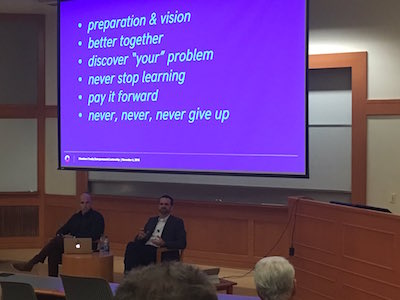
When Tant and Christopher returned to Vanderbilt for an entrepreneurship lecture in November 2018, they gave their partnership an uncomplicated description: “Better together.” Tant was the salesperson, accustomed to long stretches on the phone. Christopher was the engineer, comfortable with methodical investigation. Their account made room for a useful degree of mutual incomprehension.
Tant described learning by charging ahead until the obstacles made themselves apparent. Christopher preferred reading and inquiry. Neither approach requires much imagination to recognize. Most teams have met both people. The interesting part is whether each can accept that the other’s habits have a purpose, particularly when the work gets difficult.
For Tant, a technical co-founder made the marketplace idea buildable. For Christopher, a partner steeped in recruiting supplied firsthand knowledge of the transaction. That is the appeal of this pairing: each brought experience the other could not quickly acquire. Their collaboration gave the business a fuller view of the problem than either starting point offered alone.
The crowd needs somewhere to belong
The financing followed. Heritage Group and Frist Cressey Ventures backed Relode in late 2017. By November 2018, the company had more than 200 clients and 40,000 independent agents. Those figures describe a particular stage in the experiment, when a network built around paid recommendations had already attracted a substantial number of participants.
Participation, however, is a beginning. In a later account of building Relode’s virtual recruiter community, Warren Hawkins described simplifying onboarding, bringing rewards forward and developing spaces where participants could exchange advice. His account follows a narrower professional recruiter community, which grew from about 50 to 5,000 over six months in 2019.
Those recruiters used Slack channels and weekly calls. Experienced members explained what had worked; newer members could ask questions. That is a revealing development in a company whose pitch relied on the power of a crowd. Even a distributed network needs somewhere to gather. A login can establish access, while a helpful colleague gives someone a reason to return.
Tant also argued for more open hiring networks in his own writing. The principle was consistent with the marketplace: employers should look beyond the same limited channels for candidates. The operational detail makes that argument more interesting. Opening a network also creates a responsibility to make participation understandable and worthwhile for the people joining it.
Snapshot: November 2018. Historical figures, not current totals.
Seven years, then a different chair
In June 2022, Relode appointed Peter Clare as CEO. Tant stepped down and remained on the board at the transition. His public note expressed pride in what the team had accomplished over seven years and confidence in the incoming leader. It was a clear change in responsibility after the long stretch of being the founding chief executive.
A founder’s biography can become misleading when it freezes at the most familiar title. Tant co-founded Relode and led its early development; the CEO job subsequently passed to someone else. Both facts belong in the same account. The company’s history continues after the founding chapter, and the founder’s career continues beyond the chair.
Today, Smart Labor Management lists Tant as a co-founder. The company works with construction businesses, organizing the agencies they use, timesheets, invoicing and labor information. It pairs software with account management. The setting has changed, while the business concern is recognizable: the coordination surrounding work can become a considerable job of its own.
There is a modest pleasure in following that thread through his career. A candidate search, a recruiting marketplace and construction labor administration each turn on people getting information from one place to another. The recurring opportunity is in the handoff. A process feels simple to the customer only when somebody has taken responsibility for its complications.
Leave room for the band
The public trail has a lighter detail, too. Tant supplied a testimonial for Nashville band The Decades after a company party, praising the event and promising to book ahead. It is a small glimpse beyond the mechanics of recruiting: a founder arranging an evening in which the important connections could presumably manage without a dashboard.
His advice to students included finding mentors, listening and choosing collaborators with different strengths. That counsel fits the actual route better than a solitary-founder legend would. Alumni helped with a search. A customer became a co-founder. Independent recruiters supplied reach. A successor took the executive role. Other people keep entering the story at consequential moments.
The early recruiting assignment remains a useful place to leave him. Tant found the person he needed through a network that already existed. Years of company building followed from taking that ordinary occurrence seriously. Someone knows someone. The work begins with making the introduction useful enough that everybody involved wants to answer the next call.