Before Matt Rodak learned to underwrite risk, he learned to recognize a tired house. In northeast Ohio, the teenage Rodak ran a landscaping business whose customers included local real estate investors. The ordinary jobs were lawns and gardens. The memorable ones involved clean-outs and light demolition, with a few football teammates, a truck and a trailer pressed into service. He could watch the same address move from neighborhood drag to neighborhood prize.
The flippers were candid about their profits, which did nothing to cool his interest. But the money was only half the picture. Renovation produced an unusually visible kind of progress: an unlivable property became a home, and the block looked different when the work was done. Rodak later recalled that the first such transformation hooked him. He sold the landscaping business to help pay for college and arrived at John Carroll University with a plan to study finance and enter real estate development.
A graduation present called 2007
Timing, that impolite partner in every career, had other ideas. Rodak graduated in 2007 as the property market was beginning to fold in on itself. Real estate developers were not assembling welcoming committees for new finance graduates. He took a job with a large commercial property insurance company, initially as a production underwriter. The work combined business development with the less glamorous disciplines of pricing, structuring and deciding which risks deserved a yes.
The employer's philosophy was to engineer risk out of loss. For a future lender, this was a useful education in restraint. Rodak advanced into sales and marketing leadership for a middle-market group and worked on technology, customer-management systems and commercial processes. He saw how a large organization made decisions. He also reached a crisp conclusion about his place in it.
The biggest thing I learned was that I didn't want to be a corporate insurance executive for the rest of my life.Matt Rodak
A detour can be wasted time, or it can quietly stock the workshop. Insurance gave Rodak a vocabulary for downside, a respect for operating systems and practice selling a complicated financial product. When the housing market began to recover around 2010 and 2011, he returned to his old ambition with savings and started buying properties to renovate, sell or rent. Now he could inspect real estate finance from the customer's chair.
The invoice that became a business plan
Short-term renovation finance was built for a peculiar job. A traditional bank could take 45 to 60 days, an eternity when a buyer needed to close on a distressed property. Private lenders could move faster, but Rodak encountered high rates, heavy fees, inconsistent availability and paperwork that treated opacity as a feature. He was also putting money into peer-to-peer consumer loans and noticed the absurd contrast: an online platform could make unsecured personal credit legible while a loan backed by an actual house still felt improvised.
The opening was not simply cheaper money. It was a more dependable exchange between two wary parties. A redeveloper needs to know capital will arrive quickly enough to win and finish a project. An investor needs evidence that speed has not replaced judgment. Rodak's background happened to span both anxieties. He understood why the borrower was impatient and why the underwriter refused to be hurried into foolishness.
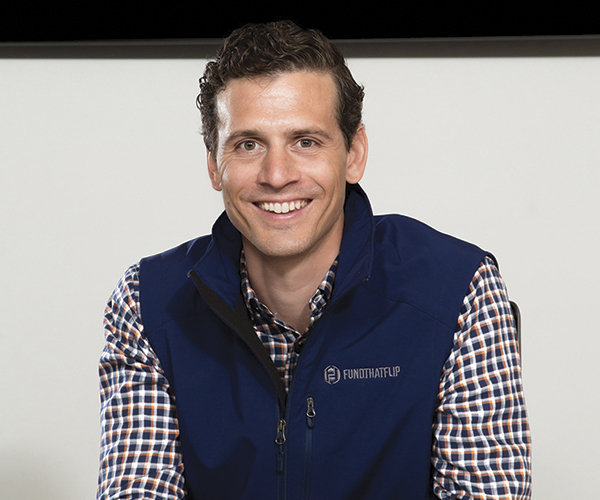
The 2012 JOBS Act opened new possibilities for online investment marketplaces. Rodak began forming the plan that became Fund That Flip, incorporated in 2014 and originating loans by 2015. He moved to New York and passed through Founder Institute New York, which he valued as a way to test-drive starting a company before abandoning a salary. The firm also joined Entrepreneurs Roundtable Accelerator. The pitch was focused: give experienced residential redevelopers fast, reliable short-term financing, then let accredited investors participate in carefully screened, property-backed loans.
Two customers, two kinds of urgency
Marketplaces are often described as matches, as if the hard work ends when two parties are introduced. In property lending, the difficult part begins there. Fund That Flip had to screen the borrower, test the project, structure a loan and still move at the speed of a competitive purchase. On the other side, it had to present enough information and discipline for an investor to make a reasoned decision. The company blended online applications and proprietary workflow with the first-position mortgages, appraisals, title reviews and borrower checks familiar to conventional underwriting.
Rodak also learned that this market traveled by conversation. Flippers compare lenders. Contractors, real estate agents, title companies and attorneys sit close to the next transaction. Do reliable work for one borrower and the result moves through a network faster than a grand advertising claim. His rule was to add value before asking to see someone's contacts. The sentiment is neighborly; the operating strategy is precise.
The company raised roughly $2 million in seed capital in 2016. Rodak set a test for what he called meaningful scale: exceed $100 million in originations over a 12-month span and do it with positive unit economics. Fund That Flip reached that marker in 2018. In 2019, an $11 million Series A led by Edison Partners gave it more room to build products and distribution. That year it ranked No. 42 overall and No. 4 in real estate on the Inc. 5000. By the 2020 telling of the story, the platform had originated more than $500 million in loans since 2015.
Capital for the company building capital infrastructure
The founder has to keep changing jobs
Growth forced a second kind of underwriting: which parts of the founder should remain in the company, and which should be replaced by a team? Rodak organized the journey into five rhyming stages. Aspire is the intoxicating era when the business is still an idea and reality has not sent an invoice. Perspire is the founder proving the work. Conspire brings other people into the effort. Inspire requires leadership through a shared direction. Expire is the danger at the end, when success becomes permission to coast.
It is a neat framework for a messy change. Early founders are rewarded for touching everything; later they can damage the organization by refusing to let go. Rodak described wanting to spend his time validating new products, getting them to market and then stepping aside so operating teams could make them work. The underwriter's instinct persists, but the object being assessed shifts from a single loan to the next useful capability.
When a good name becomes too small
Fund That Flip was an excellent instruction and, eventually, an incomplete description. The company moved beyond rehabilitation loans into new-construction and rental financing. It offered short- and long-duration investment products and acquired FlipperForce, a software suite for managing real estate projects. The original name kept pointing at one room after the company had built a house.
In September 2023, Rodak unified Fund That Flip and FlipperForce as Upright. The word came from an internal habit of talking about results moving up and to the right. More importantly, it gave the company enough space to describe lending, investing and software without dragging a footnote behind every introduction. Upright ranked No. 246 on Deloitte's 2023 Technology Fast 500, which listed 570 percent growth. In March 2024, the company reported $19.533 million in new investments across its offerings.
We do a lot more than fund flips.Matt Rodak, announcing Upright
Rodak's stated mission has remained tied to wealth creation and improved communities. It is a careful pairing. Property finance can look abstract on a spreadsheet, but its consequences have addresses. A successful renovation returns housing to use; a failed project does not become less physical because its model looked tidy. The teenage landscaper's first lesson and the underwriter's later discipline meet at the same curb.
There is humor in the founder portrait, too. In a 2024 conversation about his Cleveland connection and decision to leave corporate life, sleep was classified as a hobby. The joke lands because the serious version is familiar: a company that promises speed transfers some of the waiting to the people running it. Rodak has spent a decade trying to make capital arrive faster without treating caution as dead weight.
The stealable idea is smaller than a fintech platform and more durable than a funding announcement. Stay close enough to a problem to feel its cost. Learn the institution's reason for moving slowly. Then redesign the handoff so neither side has to pretend. Rodak found the first clue in a yard, the second in an underwriting office and the third while borrowing money himself. Upright is what happened when those clues finally shared a desk.