A truck can be introduced in an afternoon. Persuading someone to depend on it takes longer. Mathias Carlbaum has spent much of his working life on the second part: the awkward interval between a manufacturer’s promise and a customer’s willingness to put money behind it. Now president and chief executive of International, he has an American industrial name to look after and a technological transition to help sell.
There is a useful clue to his approach in a remark from December 2024: “The way to move forward is to bring the right products and earn respect.” The verbs do the work. Bring. Earn. In a business where the product must turn up tomorrow morning and do something expensive, respect has a fairly demanding attendance policy.
Carlbaum’s route to Lisle, Illinois, ran through Sweden, Spain and Brazil. It began with business school and a traineeship, then passed through sales, national management and global commercial operations. He arrived at Navistar in 2021 with experience of the many things that happen after an engineer’s drawing becomes a truck. His current assignment asks him to make those things fit together across a larger group.
A salesman’s education, in several languages
Born in 1972, Carlbaum earned an MBA at Umeå University and graduated in 1996. He joined Scania as a trainee the following year. His formation was commercial: selling vehicles and supporting the organizations that sold them. It is a useful background for someone who will eventually have to explain why a fleet should change the way it works.
His responsibilities expanded across Scania’s international operations. He served as vice president of sales and marketing for Latin America from 2008 to 2010, then managed Scania Ibérica between 2010 and 2014. In July 2014, he took over Scania do Brasil. A career that looks tidy in a biography involved moving between customers who worked in different languages and different economic conditions.
When he arrived to run the Brazilian business, he already spoke Portuguese. He also spoke English and Spanish. He had worked in Brazil before, so the language came with familiarity rather than a phrasebook bought at the airport. In 2015, Brazil was Scania’s largest national truck market. Carlbaum’s job placed him close to a substantial part of the company’s business.
It was also a difficult market. That year he discussed exports to Africa and Asia as a way of offsetting weaker Brazilian demand, alongside reductions in operating and infrastructure costs. The problem required a wider view than the domestic order book. When customers in one place bought less, a factory still needed a plan.
That episode offers an early version of a question that follows him into his American job: how do you prepare for the next opportunity while managing the business you actually have? The geography changes. The tension between investment and immediate demand remains stubbornly recognizable.
The American assignment
In June 2016, Carlbaum became Scania’s executive vice president for commercial operations. The appointment brought responsibility for a global sales and service network of 36,000 people. That number describes the network attached to the role at the time, rather than the size of the company he leads today. His remit had moved from managing individual markets to helping many markets operate.
In April 2021, he began leading Navistar’s post-merger management on behalf of TRATON. The acquisition closed in July. He became Navistar’s president and CEO in September, succeeding Persio Lisboa, and joined TRATON’s Executive Board in October. Integration was part of his job before the chief executive title arrived.
TRATON brought Navistar into a group alongside Scania, MAN and Volkswagen Truck & Bus. For Carlbaum, this created a particular translation problem. Technologies developed within a global group had to make sense in North American vehicles and for North American operators. Shared ownership provided access to resources; customers would judge what eventually reached them.
Discussing the electric-truck effort in 2022, he allowed himself an unusually plain expression of impatience: “I wish I could rewrite some of the history, that this would have started earlier, but we are where we are.” There is little room for ceremonial optimism in that sentence. It acknowledges a starting point and leaves the remaining work in view.
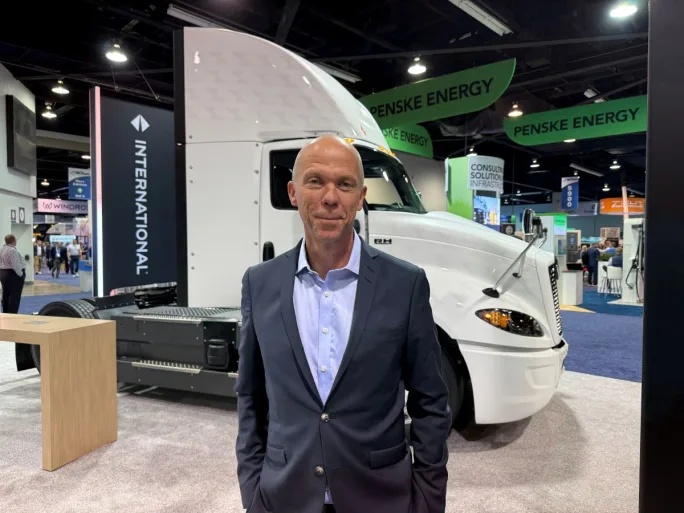
The S13 Integrated Powertrain became a tangible example of the group relationship. TRATON cited customer deliveries of the system, the arrival of its Common Base Engine in North America and investment in digital customer tools when it announced Carlbaum’s board renewal in March 2024. His appointment was extended through September 2029. The parent company was giving him time to continue the work.
An old name, with work attached
On October 1, 2024, Navistar became International Motors. A familiar badge became the corporate name. For a company selling trucks under the International brand already, the change had a pleasing economy: customers could use one name for the product and the business behind it. The announcement tied that simplicity to a broader change in the customer experience.
International laid out an offering that included parts, maintenance, financing, connectivity and charging alongside its vehicles. It also announced plans to bring customer tools and information together through My International. The ambition was to reduce the number of separate arrangements a customer had to manage throughout ownership.
A company can print a new name faster than it can reorganize a service experience. The distinction matters in Carlbaum’s case because his career has been spent close to the commercial machinery behind the product. The rename gives his work a visible marker. The quieter test is whether dealing with the manufacturer becomes easier.
In December 2024, he pointed to product introductions as evidence of the company’s direction: the S13 engine and T14 transmission, an updated HV model and the redesigned CE-series school bus. The bus was offered with diesel and electric power options. Different customers could encounter the company’s changes through very different vehicles.
That range helps explain the difficulty of his assignment. A school bus and a heavy truck belong to the same manufacturer’s portfolio while doing different jobs. A broad corporate strategy eventually has to become a convincing answer to each operator’s specific question. Familiarity with a badge gets the conversation started. The vehicle and its support have to finish it.
The future meets the fleet budget
Carlbaum has argued for battery-electric trucking while also discussing the supporting infrastructure and business case. In 2022, he described batteries as the long-term direction for commercial transport and acknowledged a role for hydrogen fuel cells in particular applications. His public position treated the transition as a matter of technology, market demand and the conditions in which customers could use it.
By ACT Expo 2025, International had introduced its eRH Class 8 electric tractor. Carlbaum’s discussion of adoption included a warning about expecting America’s charging infrastructure to be remade in only a few years. Vehicles and infrastructure would have to advance together. A purchase decision could hardly rely on half of the required system.
“Limited subsidies help. But sooner or later, new technologies must live on their own merits.”
Mathias Carlbaum, May 2025
The commercial phrase is total cost of ownership. It collects the expenses that continue after a vehicle is bought and asks whether the whole proposition works. Carlbaum’s emphasis on it gives his technological ambition a condition: the customer must be able to make the economics work. A demonstration can show possibility. A fleet has to plan a working week.
What comes with the truck?
International’s announced services strategy, grouped by the job each part performs. A framework, not a cost comparison.
His 2025 outlook also had to accommodate immediate weakness. In May, he described customers reluctant to commit to new equipment amid uncertainty about trade, freight and regulation. Production had been reduced, and he acknowledged workforce cuts, largely at the Escobedo plant in Mexico. Long-term development continued in a business facing short-term consequences.
That complication prevents the story from becoming a smooth procession of launches. Carlbaum must talk about what trucking could become while running a company exposed to what fleets will order now. His earlier Brazilian experience makes the predicament familiar, though familiarity does not make a cancelled order any more welcome.
The people behind the promise
On April 30, 2025, Carlbaum appeared at Stanford for an energy-transition seminar moderated by Jimmy Chen. The subject was decarbonizing trucking through technology and market development. It placed his work in a room devoted to the larger transition, where the vehicle belongs in a discussion about energy systems and how markets change.
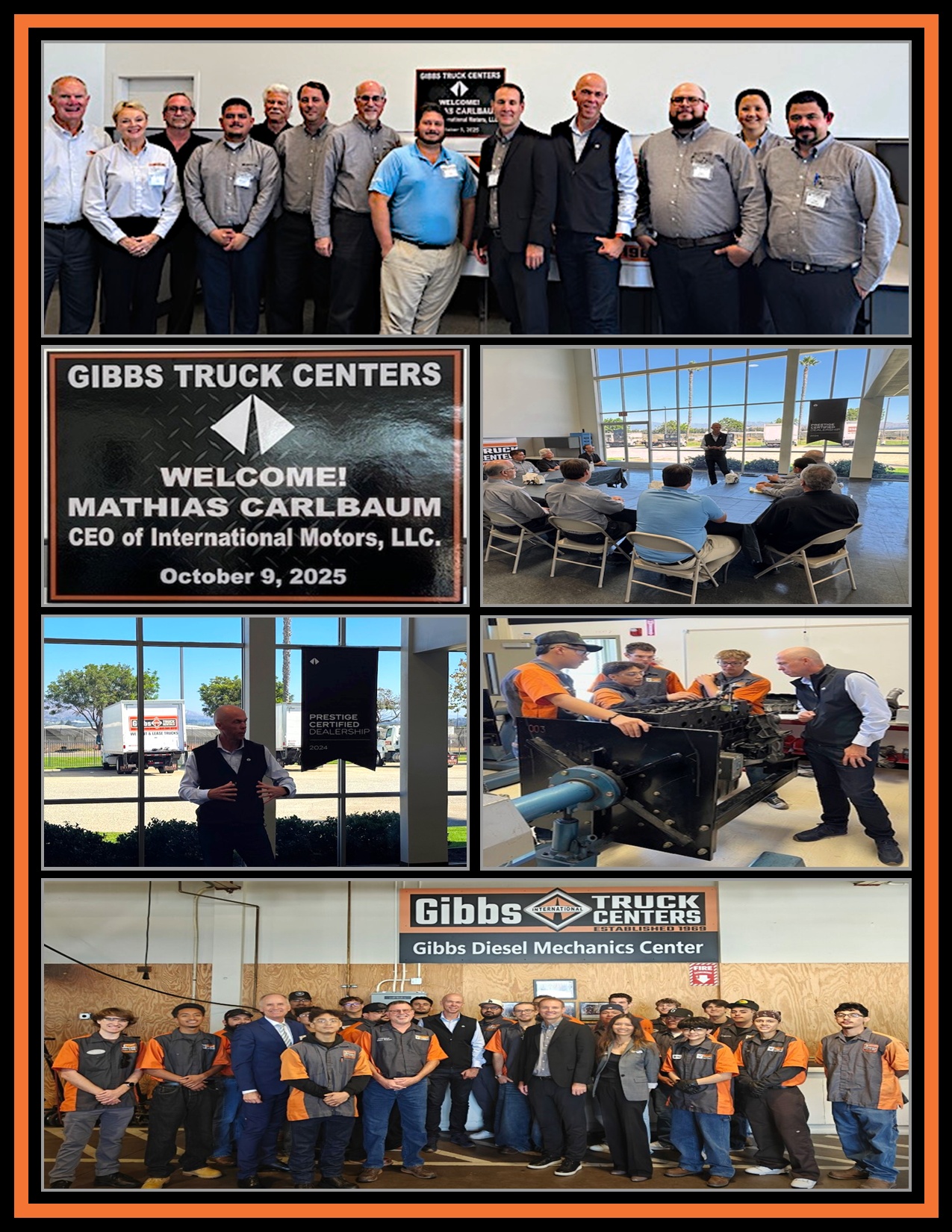
A California dealer offered another view. Gibbs Truck Centers’ January 2026 newsletter recorded his visit to its Oxnard operation and the Gibbs Diesel Mechanics Center at Ventura College. The two settings capture different ends of the same assignment. One considers the industry’s direction; the other trains people to keep its equipment working.
Meanwhile, the leadership structure continued to change. In January 2026, International appointed Catrina Mitchell-Adegbemi chief technology officer. Her responsibilities included leading research and development and representing International within TRATON’s R&D management team. The arrangement explicitly connected North American customer needs with development across the group.
In March, the company announced Sebastian Leger as chief procurement officer, reporting to Carlbaum from April 1. His responsibilities covered purchasing strategy, supplier relationships and alignment with TRATON. Earlier, Carlbaum had welcomed Ernest Evans as the incoming head of International Financial. Engineering, suppliers and financing each had a place in making the broader customer offering work.
These appointments give the strategy human names and practical responsibilities. Carlbaum’s job depends on people who develop the vehicle, obtain its components, arrange its purchase and support its use. His career began in the part of the business where a customer finally decides. After nearly three decades, that decision remains the point toward which his work travels.
International’s name is back on the door. Carlbaum has the task of making the promises behind it hold up on the road, in the workshop and on the invoice. The next chapter will be written partly in engineering plans and partly in fleet accounts. Trucks have always had a way of bringing an ambitious conversation back to earth.