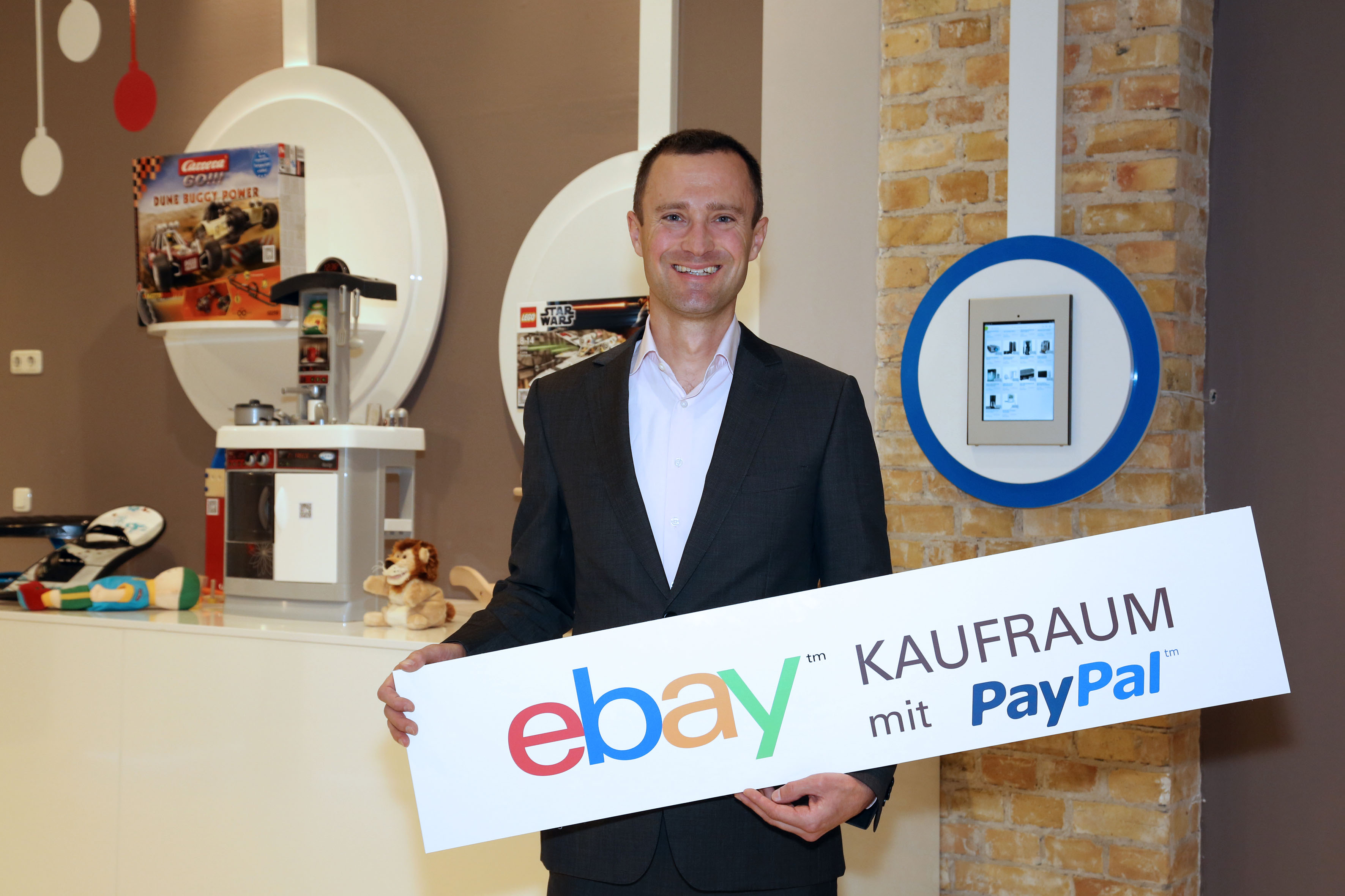
In December 2012, Martin Tschopp helped open a shop in Berlin where the merchandise could go home without the customer carrying it. The eBay Kaufraum occupied 400 square metres on Oranienburger Straße. Visitors could inspect Christmas presents, scan a QR code and order through their phones. An internet marketplace had rented a room to demonstrate that shopping no longer needed to stay in one.
The photograph has the cheerful awkwardness of a corporate Christmas experiment: Tschopp in a suit, a large eBay sign, toys on display behind him. It also catches a recurring concern in his career. A new technology becomes interesting when somebody can actually use it. The stage changes; the practical question survives.
Today he is CEO of Prosus Ventures, backing businesses across countries and industries. Between that Berlin shop and his current job came a rather different marketplace: Kiva, the nonprofit lending platform. His career connects commerce, access to capital and the work of making an organisation function after the excitement of its beginning.
An engineer goes shopping
Tschopp trained in mechanical engineering at ETH Zurich and later earned an MBA at INSEAD. His working life began in 1997 at McKinsey, in strategy and operations. He subsequently worked at Bain in San Francisco on investment analysis and private equity, and in strategic business development at DHL. The combination placed him close to both the economics of a business and the machinery required to run it.
He joined eBay in 2003 as a European strategy manager. His assignments included finance for Switzerland and Austria, strategic projects in San Jose, and, from 2007, developing classifieds businesses. He went on to oversee local classifieds in North America and the Asia-Pacific region. These were operating jobs, with actual markets attached, rather than a collection of theoretical exercises.
Classifieds and retail marketplaces share a basic invitation: someone has something; someone else wants it. The invitation is simple enough to fit on a noticeboard. Turning it into a dependable business is considerably more demanding. Tschopp’s progression through finance, strategy and general management gave him different views of that same transaction.
A car market, then a country
By 2009 he was leading mobile.de, eBay’s German vehicle marketplace. In April 2012, he moved to the leadership of eBay Germany. A year later his remit briefly expanded to the German Marketplaces group, covering eBay, eBay Kleinanzeigen, mobile.de and brands4friends. The role was explicitly temporary: he would return to the United States with his family and take another eBay assignment.
That succession of businesses matters more than a tidy upward arrow on a résumé. Cars, local classified advertisements and a general retail marketplace bring different sellers and different buying decisions. Tschopp had to work across them. He later became vice president and general manager of eBay Advertising, adding another business model to his experience.
The German operation was substantial. In late 2012 it reported 18 million active users, including 175,000 commercial sellers. More than 50 million items were available at any given time. Mobile shopping was already moving quickly enough that the company reported a purchase on the German marketplace every 1.3 seconds.
Those figures give the Kaufraum its context. Mobile commerce was moving beyond an interesting demonstration. The little shop made the mechanics visible: look at a product here, buy it on a phone, receive it elsewhere. A customer could cross several supposed boundaries without giving any of them much thought.
The customer refuses to stay in a channel
In a German retail interview, Tschopp described mobile technology as a second internet-driven revolution in commerce. He expected the boundaries between online and physical shopping to dissolve. A shop, in his account, could be wherever the customer wanted it. Retailers would need to reconsider how their different sales channels worked together.
He also resisted a universal prescription. Each business needed a strategy suited to its circumstances. Selling online required its own thinking about prices and assortment; simply treating the internet as another branch would miss the point. That is a useful qualification from an executive whose employer benefited when merchants came online.
His argument left room for physical shops. He described merchants using eBay alongside their existing businesses, and argued that customer preferences should guide the response to changing technology. The implication was practical: a retailer could preserve something customers valued while changing how they found, ordered or paid for it.
There is a recognisable continuity with his later investment language. Technology changes the available choices. A business still has to understand the people making them. The vocabulary has travelled from smartphones to artificial intelligence, but the task of matching a service to a particular need remains.
The marketplace changes its purpose
In 2015, Tschopp became CEO of Kiva. The platform connected lenders with borrowers seeking capital, including entrepreneurs underserved by conventional finance. He succeeded co-founder Matt Flannery. It was a move from a commercial internet business to a nonprofit with an established mission and the organisational demands of growing beyond its founding years.
A contemporaneous academic study described Kiva as having 109 employees and a ten-member leadership team. It also set out the role of partner organisations in administering loans and collecting repayments. A moving borrower story could attract attention, but the platform depended on a chain of people and processes working behind that story.
Tschopp’s Kiva tenure is described in his subsequent career biography as a period focused on establishing sound operations and finances. That responsibility gives the move its particular character. He was an experienced marketplace executive taking on an organisation where execution served a social purpose. Keeping it functioning was part of serving that purpose.
The chapter ended in 2017. Kiva announced his departure in April; he joined Naspers Ventures as chief operating officer that year. The bridge between the roles was experience in running organisations that connect people with opportunity, though the institutions and their financial arrangements were different.
Capital with an operating memory
At Naspers Ventures, and subsequently Prosus Ventures, his COO responsibilities included strategy, evaluating investment targets and supporting portfolio businesses with operating expertise. In November 2020 he became CEO. By then his background included vehicle listings, local classifieds, retail commerce, advertising and nonprofit lending.
For a founder meeting an investor, that range can make the conversation more concrete. A business model has to survive beyond the slide that describes it. His earlier roles provide a basis for discussing the practical work of reaching customers, supporting sellers and managing a growing organisation. This is the operator’s perspective he brings to venture investing.
“in a uniquely local way”
Martin Tschopp, describing the businesses Prosus Ventures seeks to back, 2022
His stated investment approach looks for technology addressing significant societal needs through solutions fitted to local conditions. Prosus Ventures’ activity during this period included Thndr, an Egyptian investment platform; ElasticRun, serving rural Indian shops; and the Latin American logistics company 99minutos. These are team investments, rather than a list of deals attributed solely to him.
The variety helps explain the emphasis on locality. An investment service, a distribution network and a delivery business may all use software, yet their customers need different things from it. In 2022, Global Corporate Venturing placed Tschopp third in its Powerlist. He was included again in the publication’s 2024 list.
The second meeting, and the third investment
Another part of his approach concerns the relationship before the cheque. In 2021, discussing colleague Banafsheh Fathieh’s work, Tschopp said alignment with founding teams was a central investment criterion. The team usually spent substantial time with founders before offering terms. He singled out Fathieh’s ability to maintain those relationships when travel restrictions interrupted the usual meetings.
It is a revealing choice of praise. He recognised the work of connecting with people, rather than only the completion of a transaction. A colleague’s recommendation on his own LinkedIn profile likewise describes a willingness to listen and give product and technology teams responsibility. These are attributed observations, but they put some texture around an otherwise institutional career.
In October 2025, Prosus backed Endowus for a third time. The Asian wealth platform had passed US$10 billion in client assets. Tschopp’s remarks stressed its advisory model, values and the relationship between technology and trust. Returning to an existing investment provides a different kind of endorsement from welcoming a new one: there is already a history to consider.
Eight francs, and a much larger question
A 2012 interview supplies a smaller starting point. Tschopp recalled earning his first money cleaning his school during the holidays, for about eight Swiss francs an hour. As a child he had wanted to be a pilot. He also spoke about family, curiosity about other cultures and the value of learning abroad.
Asked how he would spend €50 million improving Berlin, he chose education, including opportunities for young people to experience other languages and cultures. More recently, his public support for the Prosus Found-HER Challenge has framed funding women-led technology businesses as an economic opportunity. Both statements concern who gets the resources to participate.
The present assignment has grown more technologically ambitious. Prosus Ventures reported more than US$400 million committed and invested across over 40 closed transactions in FY25, including US$88 million in AI-related investments. Its current focus links venture backing to ecommerce ecosystems and the tools surrounding them.
That brings Tschopp’s story back to the Berlin shop. A QR code beside a Christmas present once required a demonstration. Today the investment questions include AI agents and the systems behind commerce. The technologies keep changing. His career remains grounded in the less theatrical work of helping an idea become a service people can use.
Continue the conversation
Career details, interviews and the organisations along the way.