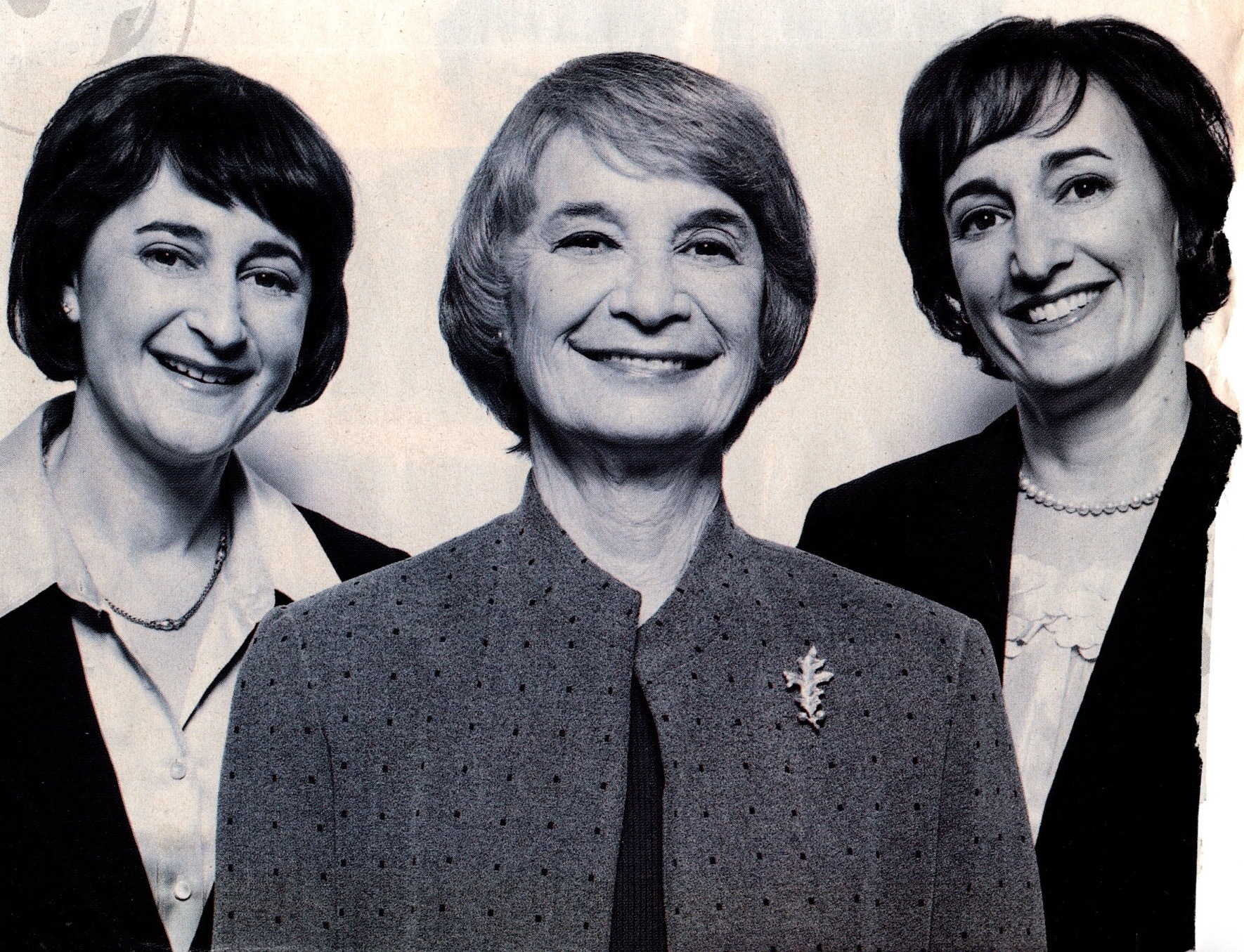
When Martha Goldberg Aronson graduated from Wellesley in 1989, her diploma carried her mother’s signature. Luella Gross Goldberg was chair of the college’s board of trustees, one of the two officials who signed the document. A parent could hardly ask for a more efficient arrangement for expressing approval.
The detail belongs to a longer family relationship with the college. Luella and her twin sister arrived from Minneapolis in 1954. Their daughters followed them to Wellesley. Martha’s sister, Ellen Goldberg Luger, also became a trustee. Decades later, Martha would take a place on the board herself. A diploma can mark an ending; in this family, it was also a promise of further committee work.
Aronson studied economics and graduated magna cum laude and Phi Beta Kappa. She earned All-American recognition in Division III tennis as well as Academic All-American honors. That combination of classroom and court is a useful opening to her story: a demanding education, regular competition, and commitments that required showing up again tomorrow.
Today she is president and chief executive officer of Merit Medical Systems. She took over in October 2025 from Fred Lampropoulos, who had led the company since founding it in 1987. The appointment placed her at the center of a succession after 38 years under one leader. Her route there had involved consulting, operating businesses, representing a company to investors, and helping other executives govern theirs.
An international assignment, with reservations
Aronson began her career at Bain & Company before joining Medtronic in 1991. Her first work there included corporate development and strategic planning. Marketing assignments and general management followed. It was an education inside a business, where a recommendation eventually has to become somebody’s responsibility.
The next substantial turn arrived by telephone. At home with two young children, she was asked about an international assignment. Her initial response was hesitation. There was unfinished work in her existing job, family support in Minnesota, and her husband Dan’s career to consider. An opportunity could be attractive and inconvenient at precisely the same time.
Dan encouraged the move, despite the interruption it would mean for his own work. She accepted. Over three years in Europe, she led across different countries and cultures. When the family wanted to return to Minnesota, she called Medtronic chief executive Art Collins. He offered her investor relations. A later move put her in charge of talent, on the executive committee.
That sequence complicates the usual picture of a career advancing along a carefully drawn line. She acquired experience by accepting a different kind of problem, then reconsidered when the family’s circumstances changed. The return mattered as much as the departure. The business benefited from her international experience; the family still had a say in where the next chapter would happen.
- ConsultingBain & Company
- 18 yearsMedtronic · 1991-2009
- Operating rolesHill-Rom → Ecolab
- President & CEOMerit · October 2025
The size of a decision
By the time she joined Hill-Rom in 2010, Aronson had spent 18 years at Medtronic. At Hill-Rom, she became president of North America, overseeing a business with approximately $1 billion in revenue. At Ecolab, her next employer, she led a global division with roughly $600 million in revenue and served on the executive committee.
An earlier European assignment had put her in charge of five businesses in Western Europe, with more than $450 million in combined revenue. Those figures describe the scope of her responsibilities at different points in her career. They also help explain why an executive search might value someone whose experience stretches across geography, functions, and organizational scale.
The jobs required different forms of attention. General management brings responsibility for the business as a whole. Investor relations requires explaining its performance to people outside it. Talent leadership turns the attention toward the people doing the work. An executive who has occupied all three positions has had to look at the same organization from several directions.
Aronson later spent years on boards, including CONMED, Methode Electronics, and Cardiovascular Systems. Merit’s 2026 proxy also records her work as chair and interim chief executive of Beta Bionics from 2020 to 2022. Governance and management repeatedly intersected in her career. She had experience asking the questions at a board table and taking responsibility for the answers inside a company.
The board seat before the first performance
Her willingness to arrive without being an expert extended beyond business. When Minnesota Opera approached her about joining its board, she had never attended a performance. She accepted because she cared about the arts and their place in the community. One can admire the candor: plenty of people would have tried to squeeze in an opera before admitting this.
Her board involvement had begun while she was still a student, on Wellesley’s Student Life Committee. After graduation came Friends of Athletics. The college’s athletics program recognized her service with its Honor Award in 2001. The long relationship included practical work supporting the institution, alongside the achievement of having competed for it.
In December 2017, she was elected chair of the Guthrie Theater’s board. It was another institution with a substantial history, an artistic identity, and bills to pay. Board leadership there meant serving a purpose that could never be reduced to the financial statement, while taking the financial statement seriously.
At the end of her chairmanship, her account of the 2018-2019 season emphasized education, access, and community programs. She highlighted a gala that had raised more than $1.2 million to help continue that work. The priorities were concrete: students seeing performances, teaching artists working in schools, and more people getting through the doors. Her successor as chair was James L. Chosy.
“Listen and learn before you start expressing too many of your opinions.”
Martha Aronson, on joining a board
A reputation for useful questions
Aronson’s corporate board work has its own revealing detail. At Hutchinson Technology, she pushed for marketing language that resembled the language of the intended audience. The company’s then-chief executive, Wayne Fortun, credited her with helping shape the approach. The intervention was less glamorous than inventing a new slogan and probably more useful.
It is easy for an organization to become fluent in its own terminology. Someone has to ask whether the people outside understand it, or care. Her contribution concerned that distance between an internal description and an external conversation. Marketing experience had given her something specific to bring to the boardroom.
CONMED appointed her to its board in February 2016. She later served as chair and lead independent director. When she resigned in July 2025 to prepare for Merit, chief executive Pat Beyer singled out her help during his own transition into the top job. Years spent advising another leader would now accompany her into a succession of her own.
A board biography can make such work sound like a collection of appointments. Looking more closely reveals different obligations: choosing how to describe a business, supporting a new executive, contributing to strategy, and knowing when another commitment requires leaving. Aronson’s resignation from CONMED made room for the work ahead at Merit.
Lampropoulos founded Merit in 1987. Aronson became CEO on October 3, 2025.
Taking over after 38 years
Merit announced her appointment on July 7, 2025, with an October 3 start date. Lampropoulos would initially remain chairman. The transition gave the incoming executive a defined beginning and the company a period to prepare. In January 2026, the founder also left the board.
In her public announcement, Aronson stressed working with Merit’s global team and building on the founder’s legacy. That choice of emphasis mattered. A successor inherits people who already know how to do their jobs, along with the habits and assumptions that have accumulated around those jobs. Introducing oneself is only the first part of taking responsibility.
By September 2026, she was describing a strategic review of the company’s platforms. The questions included where the business could compete, where its portfolio had gaps, and which products still belonged. Systems and processes also needed to develop as the organization grew. She expected a new long-range plan by the February 2027 results call at the latest, potentially earlier.
These were questions about the company’s next stage, with answers still being worked through. Her experience gave her several relevant vantage points: the operator’s concern for execution, the director’s concern for choices, and the investor-relations executive’s concern for explaining those choices. The appointment had ended the search for a successor. The work of succession continued.
The beginner still has a notebook
There is a smaller detail that brings the executive back into focus. Asked to bring an object representing herself to a leadership program, Aronson consulted one of her sons. His answer was a notebook, because she was always making lists. It is a pleasingly unceremonious portrait of authority. At home, the family notices the stationery.
She and Dan have three sons. Away from work, she enjoys water skiing and stand-up paddleboarding. Her connection to sport has survived the transition from college tennis to a career of meetings, travel, and board papers. The setting changes; there is still a reason to get outside.
Her Wellesley trusteeship provides another continuing thread. The college lists service beginning in 2018, followed by a new term beginning in 2022 and running through 2028. The graduate whose mother signed her diploma returned to help oversee the institution that educated them both. The relationship has outlasted any individual job title.
Aronson’s career contains substantial responsibilities, but its most revealing moments are recognizable ones: weighing a move with a spouse, entering a room where others know more, deciding what experience can contribute, writing down what needs doing. Becoming chief executive made those decisions more consequential. It left plenty of room for the habits of a willing beginner.
Follow the conversation
More on the decisions, institutions, and people in this story.