The sweater was a dare to himself. Across its front, Mark Kashef had printed a line that would be difficult to explain if the next venture fizzled: “43rd time’s the charm.” He ordered it in several colors and wore it in his early YouTube videos. Anyone watching could see the number. Kashef could see it too. After 42 business attempts since high school, a public declaration had a certain utility: it made another quiet exit harder.
The venture under that sweater began with a less cinematic object, a Fiverr listing offering to write prompts for $10. Kashef posted it days after ChatGPT arrived in late 2022. The first month brought little traction. Then more people learned the name of the tool, and buyers began to arrive. Some orders took him four or five hours. The hourly rate was not a conversation he would have wanted with his finance professors.
By 2025, the business that grew out of that listing, Prompt Advisers, had passed $1 million in annual revenue, according to Kashef’s account in an Entrepreneur interview. Today its work spans consulting, workshops and selected custom development. The distance between ten dollars and seven figures is the obvious hook. The more interesting part is what happened between them: a finance student taught himself to code, got turned down repeatedly for data science jobs, learned to sell, refunded an expensive mistake, and eventually decided that teaching clients could be as valuable as building for them.
The exam he did not want to study for
Kashef once pictured a career in investment banking. In Canada, the destination was Bay Street. He studied finance and, by his account, was preparing for a corporate finance exam in a coffee shop when the thought came: surely people would not be performing this calculation by hand a decade later. He started buying books about artificial intelligence instead of concentrating on the formulas.
Luke Dormehl’s Thinking Machines was the book that stuck. Kashef followed its account of affective computing to Rana el Kaliouby and Affectiva, a company working with computer vision and emotion recognition. He says he began picturing a future in AI that felt more personal than the banking career he had planned. One book became many. For roughly two years, he returned to the coffee shop with a notebook and taught himself Python from the beginning.
His account includes a nice measure of how quickly the field changed. Before fluent chatbots were ordinary, he strapped two laptops together and spent days training a recurrent neural network on Shakespeare. The reward was one proper sentence, after careful prompting. When ChatGPT produced paragraphs on command in 2022, he recognized the gap between that old struggle and the new tool.
He finished the finance degree and worked in management consulting before earning a Master of Management in Artificial Intelligence at Queen’s University’s Smith School of Business. The credential helped him change direction, though it did not hand him a job. He says it took around 80 interviews to land his first data science role. A meeting with el Kaliouby in 2019 gave him a simpler form of encouragement: keep going. He kept their photograph.
“Nobody photographs you becoming obsessed.”Mark Kashef, on his years learning Python
A business mind looking for its subject
Kashef’s early career ran through data science at RVezy, where he worked on models for an RV marketplace, teaching at the University of Ottawa and Lighthouse Labs, and a business intelligence role at Amazon. He also kept starting businesses. The list he gives includes clothing brands, dropshipping, dashboards for small companies and, improbably, a handyman company. He jokes that he could barely fix things himself. He had met newcomers to Canada doing porch work and tried to build them a steady operation, complete with payroll, shirts and advertising.
That venture made some money. It was not the combination he was searching for. Kashef describes the missing ingredients as passion, competence and authority. He could organize a business and win customers. The question was which work he wanted to repeat for years. His 42 attempts made for an expensive education in that question, with each small enterprise teaching a bit about offers, operations and the disappointment of a market that does not care how much effort went into a logo.
When ChatGPT launched, he had both the technical context and the appetite to test an offer quickly. He put the prompt service on Fiverr while still employed at Amazon. It was early enough that “prompt engineer” was a term many buyers had barely heard. The first month was quiet, then demand began to compound. Kashef says the gig eventually ranked first for that search term on Fiverr and drew tens of thousands of monthly impressions. He raised prices from $10 to $50 and then to hundreds for more involved work.
The small orders were a rough apprenticeship. Buyers sometimes disputed charges. The tools had short context windows and little of the memory or automation that later became common. He protected his review score while trying to make the outputs useful. The listing sold prompts, but the real exercise was learning how a business described a problem, how much guidance it needed and where an AI demonstration fell short of a working process.
The deal he gave back
Around his fourth month, Kashef won a $10,000 project. He celebrated and then looked for developers to deliver it. They told him the work would cost about $20,000. He spent weeks trying to solve the mismatch before refunding the client. It was a painful correction for a new founder: demand had been proven, but the proposed delivery was priced for an imaginary world.
He kept the useful part of the experience. A buyer had quickly decided the problem was worth solving. Kashef had to learn the real cost and sequence of solving it. “Fix the order, keep the market,” is how he later put it. The line is short enough to fit on another sweater, although it probably would not sell as well.
Prompt Advisers expanded beyond writing prompts. Kashef’s work moved into AI implementation, training and advice. He did this while holding a full-time data science management job. In Entrepreneur, he described working on the business before dawn and again after his day job. He waited until the end of 2025 to leave employment. His explanation was ordinary and persuasive: once a business has a partner and staff, payroll makes optimism less useful than dependable demand.
Business mix is based on Kashef’s June 2026 interview: roughly 70% consulting and education, 30% custom development at that time.
One interview, then a partnership
The road from Fiverr to a public teaching career also passed through other people’s cameras. Kashef appeared in an interview with AI entrepreneur Liam Ottley while both were in Dubai. Taha El Harti watched it and drove to meet him. El Harti had just begun a podcast; Kashef became his first guest in October 2023. During the recording, El Harti urged him to start a YouTube channel. Kashef followed the advice.
The relationship did not end with a recording. El Harti became his business partner, and the two built Early AI-dopters, a learning community centered on applying AI tools. Kashef’s videos brought his explanations to a larger audience; the community created a place for courses, coaching and live builds. His site lists more than 80,000 YouTube subscribers and more than 1,300 community members. Those figures are snapshots, useful for scale rather than a permanent scoreboard.

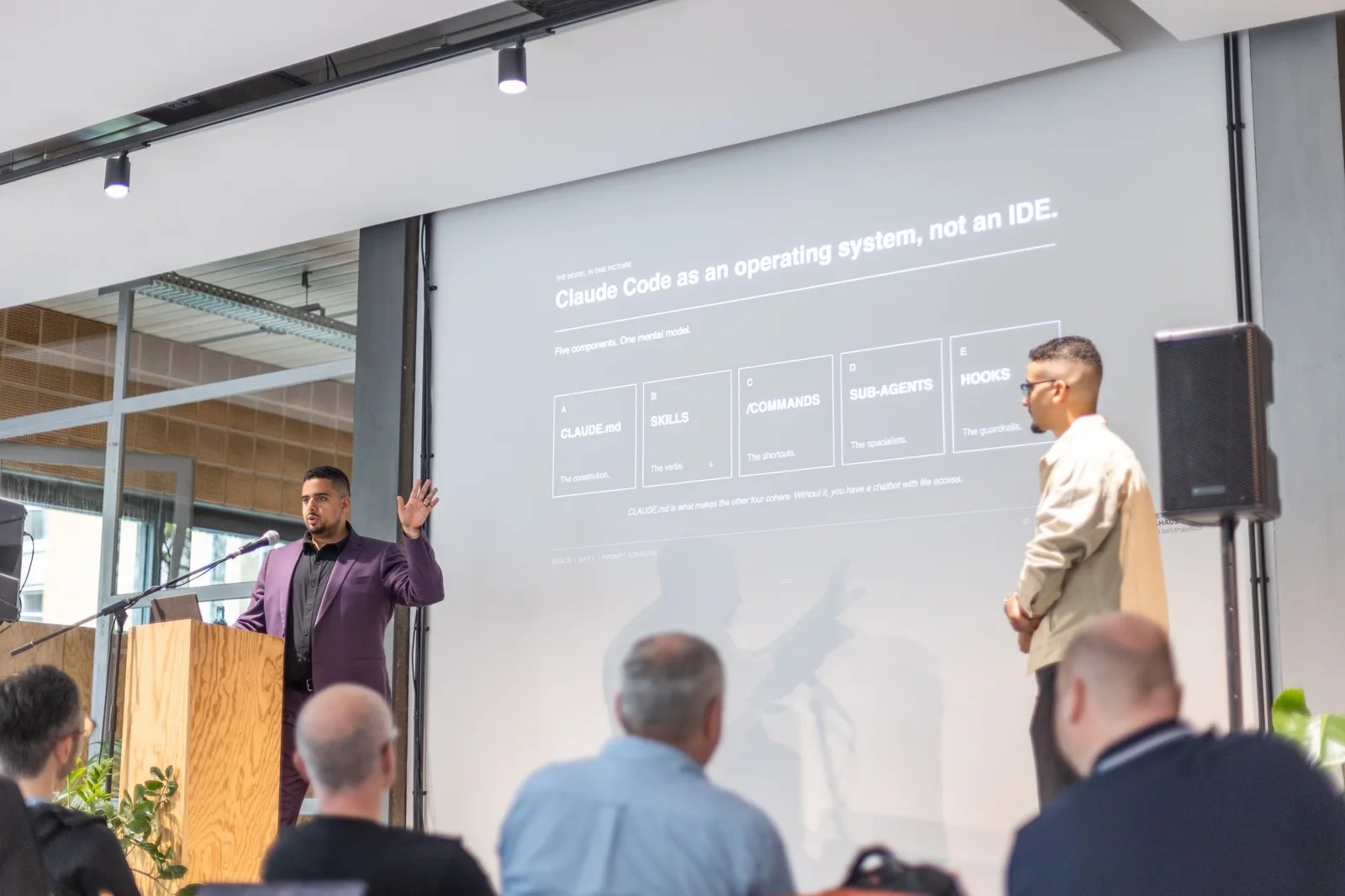
In 2026, they shared a stage at an Early AI-dopters event in Berlin. The image makes a tidy ending for the podcast anecdote: one man watched a video, drove to meet its guest, suggested a channel, and later stood beside that guest at their own event. It also shows the kind of work Kashef increasingly wants to do. He is teaching people how to use systems rather than remaining the person who must operate every system for them.
The least glamorous AI advice
Kashef’s current advice to companies is less dazzling than the sales pitches that surrounded early generative AI. Clean up the back office. Make systems talk to one another. Write down the procedures and understand the rules that apply to the organization. Only then is it sensible to ask what AI can do with the work. He says his clients increasingly want help learning to solve their own problems, with custom development reserved for particular needs.
The change has altered Prompt Advisers’ business mix. Kashef said custom development accounted for most work in 2023 and 2024. By mid-2026, he said, consulting and education made up about 70%, with custom development around 30%. A seven-figure revenue year in 2025 did not mean every part of the operation was equally attractive: he said changing project scopes had squeezed margins and pushed the company to hire and retrain developers. Teaching and advising offered a different way to help clients while limiting the number of builds that would need constant revision.
The teaching extends beyond client rooms. Kashef has led live courses through O’Reilly, appears on Microsoft Learn, and publishes videos about AI workflows and tools. He has also announced a forthcoming book, Thinking in AI. The title deliberately echoes the book that redirected his attention in a coffee shop years earlier. That symmetry is neat, but the story is stronger in its untidy details: the five-hour ten-dollar orders, the refunded contract, the long wait before leaving a salary, and the sweater that made another attempt visible.
Forty-three is an appealing number because it gives the story an ending. Kashef’s work suggests something more ongoing. The tools change; clients arrive with new questions; a course recorded one month may need revision the next. A founder who made a habit of starting over has built a business around helping other people adapt. The sweater did its job. He kept showing up.