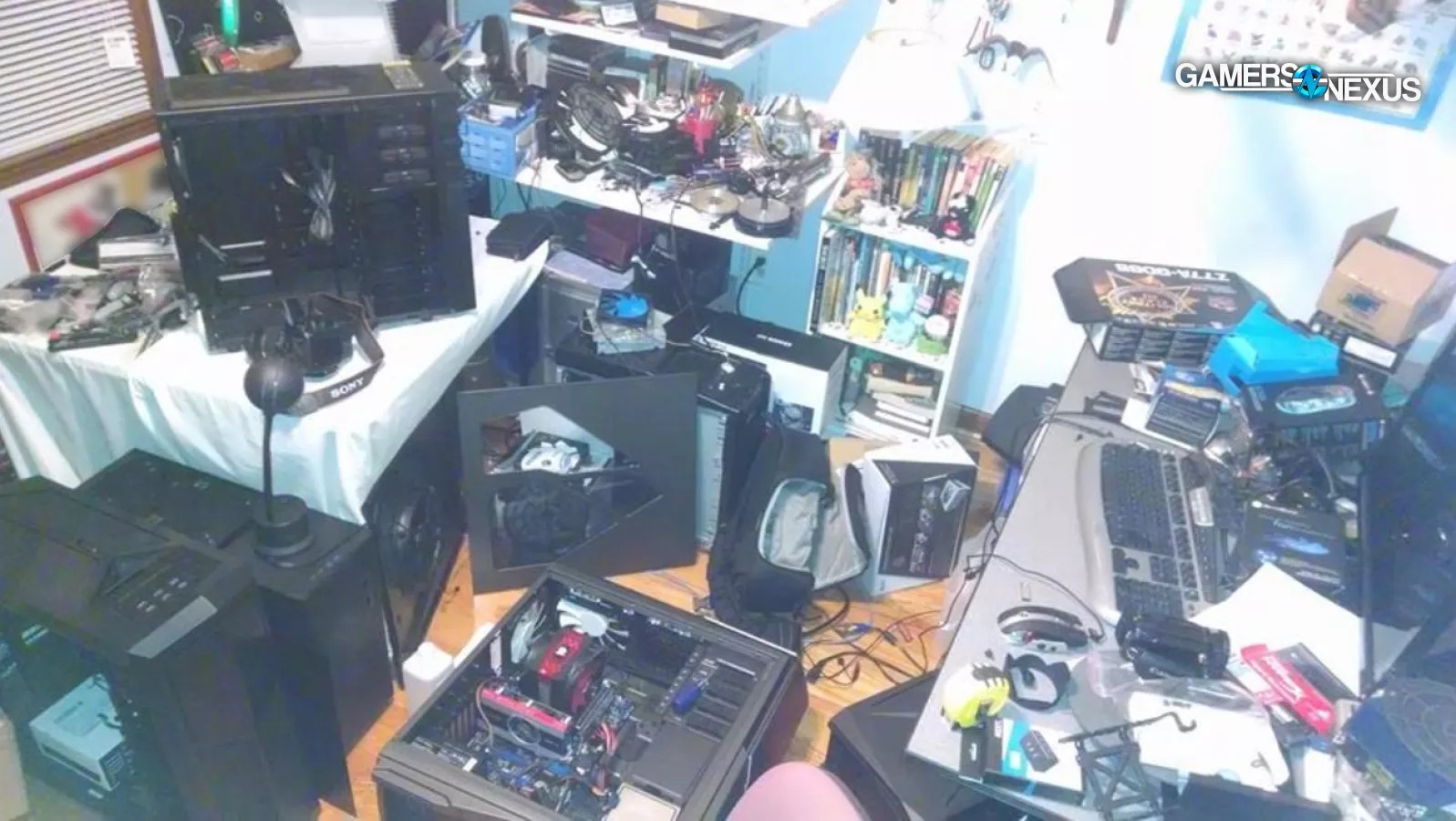
In an old photograph of the room where GamersNexus began, nearly every horizontal surface has been claimed. A computer case sits open on the floor. Boxes rise beside a keyboard. Cables wander across the small desk with the confidence of ivy. Steve Burke later measured the childhood bedroom at roughly ten feet by ten feet. The picture makes it look smaller. It also looks like a place where the next question could easily take over the afternoon.
The present-day GamersNexus is a hardware publication with video reviews, written benchmarks, a testing operation and field reporting. Burke is its founder, editor in chief and familiar on-camera host. In 2008, though, the project was a website about games. He wrote reviews, studied trailers, interviewed developers and put videos online largely to accompany the articles. He did not set out with a blueprint for a laboratory. The route from a game trailer to a CPU chart was a succession of interesting detours.
A website before a channel
Burke learned some of the web’s mechanics early. His father enrolled him in a Microsoft FrontPage class when he was about twelve. Years later, the elder Burke made the original GamersNexus logo in Microsoft Word. The mark has been updated, but its basic G and N design endured. This is an unusually affectionate origin for the emblem of a publication now associated with measurement instruments and dense charts: a family contribution made in software more likely to host a school newsletter.
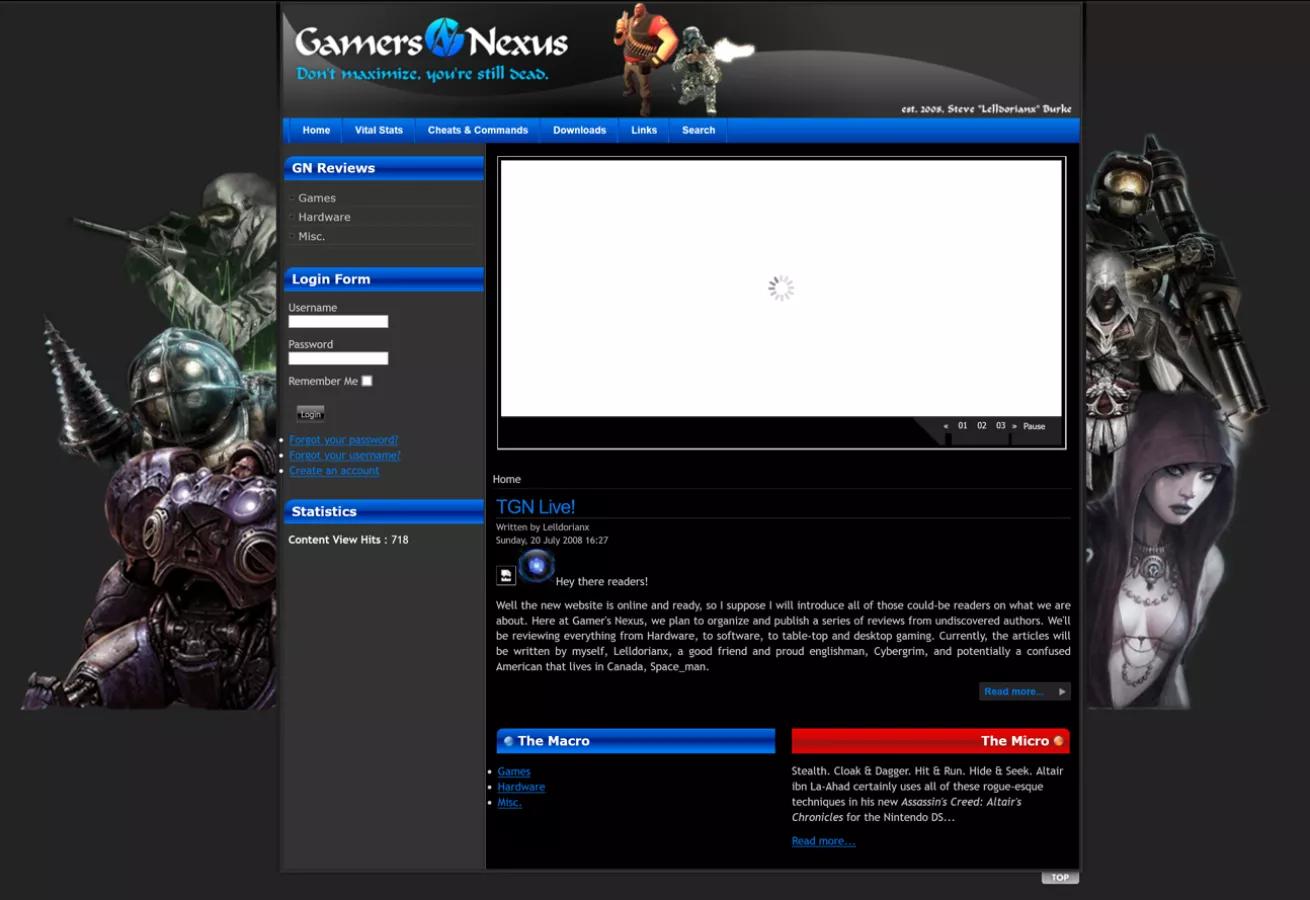
The site itself was a place to write. Burke has recalled game reviews, trailer breakdowns and interviews with independent developers during the Steam Greenlight era. A YouTube channel arrived in 2009, but the articles remained the main event. Video was useful for showing a trailer or supplementing a piece. It was not, at the time, the destination. If the earliest pages look like the internet of their era, that is because Burke was building in public, one skill and one post at a time.
Around 2010, PC build guides began to find readers. Burke had already been assembling computers; now he was explaining the choices in writing. The shift made sense. A component recommendation demands reasons, and reasons demand comparisons. Case reviews pushed the format further. Airflow, construction and the fit of a panel are easier to show when the camera can follow the hands. The videos grew from the work rather than replacing the question that produced it.
The convention that widened the room
A trip to the Penny Arcade Expo around 2010 helped Burke see what he wanted from the work. He later said he came home wanting to keep doing convention reporting. It took roughly two more years for him to leave college and give the project his full attention. Conventions supplied interviews, but they also supplied introductions to people in the hardware industry. The crowded bedroom could now connect to factories, engineering teams and other reporters.
For years he was chiefly a writer. In a 2025 interview, Burke estimated that writing remained his serious focus until about 2015. The business developed alongside odd local web jobs and the gradual rise of video. There is a pleasing lack of cinematic destiny in that sequence. A site about games picked up readers for build guides. Case reviews looked better on camera. Viewers asked questions. The answer required another test. Each small adjustment made the next one possible.
“We benchmark everything else. Might as well benchmark what the viewers say.”
That line came from an experiment that began as an argument about thermal paste. Viewers repeatedly debated how much paste belonged on a CPU. Burke’s response was to put an extravagantly large amount on one and test the effect. On camera, the gag was visual: a nearly emptied tube where a small application should have been. Beneath it was a familiar GamersNexus move. Turn an assertion into something measurable, then show the result. It is a good joke with a spreadsheet hiding behind it.
The number after the number
Testing hardware is a peculiar form of storytelling. A chart presents a neat order; the machines producing it often resist one. Software changes. A run behaves strangely. Labels get transposed. GamersNexus has published a detailed account of its CPU chart process: the test lead sets a procedure and matrix, technicians run and rerun tests, other staff check questionable data, and Burke performs a final review against archival results. Several people look at a result before it is published.
How a CPU result travels
The process has an obvious practical purpose for anyone buying a costly part. It also explains Burke’s editorial temperament. The interesting result is often the one that needs another pass. A number is more useful when its conditions are visible, and a mistake is easier to address when there is a public record of how it was corrected. GamersNexus maintains an errors and corrections page, including explanations of the impact and the response. That is unglamorous work. It is also how a publication asks to be trusted.
The team’s tools became more elaborate as the operation moved out of the house and into office space. Burke has discussed his interest in thermal chambers, acoustic testing space and automated fan testing. The equipment is attractive to a reviewer for the same reason a new lens is attractive to a photographer: it makes a previously vague distinction visible. Yet the point is still the question, not the machine. A sophisticated rig can produce a precise answer to a poorly framed test. Burke’s published methodology spends as much time on checking and interpretation as on collecting readings.
Why the writing came back
Growth created a less photogenic problem. Burke had maintained the original website himself, adding to its content system over years. As video production accelerated, the site became difficult to keep current. Publication there slowed around 2018 to 2020. In his telling, it was a practical choice: the team had more video work than its old publishing workflow could carry. A channel that began as a supplement had become the business’s central outlet.
Then Wendell of Level1Techs approached Burke about rebuilding the site. Burke wanted the written work back, too. The renewed GamersNexus website made room for searchable reviews, archived benchmarks and consolidated methods. Video can demonstrate a process beautifully; an article lets a reader find a particular number six months later. The return also reconnected the operation to its first medium. Burke wrote that the old site held memories of his father’s encouragement, including the FrontPage class and the original logo. The technical archive and the personal archive happened to occupy the same address.
That combination gives the relaunch its charm. A publication devoted to comparing tomorrow’s hardware made a deliberate investment in yesterday’s pages. There is no contradiction in a fan curve next to a childhood memory. Both reward keeping a record. A result can be revisited, and so can the path that led to it.
From the bench to the market
By 2025, the questions were carrying Burke well beyond a PC case. For a viewer-funded investigation into the trade in restricted AI graphics processors, the GamersNexus team spent three weeks in Asia, including time in China and Taiwan. They spoke with traders, repair-shop operators, middlemen and users, tracing how valuable chips moved through a complicated market. The work produced a long film, a written report and a timeline of export restrictions. Burke was credited as host, writer and lead editor; colleagues handled research, cameras, graphics and editing.
The reporting has the same structure as an equipment teardown, though the parts are people and routes. Each interview opens another connection. Each claim asks for a document or another conversation. Burke’s work now ranges from a cooler cold plate to international supply chains, but the method is recognizable. He has said the goal is to tell a good, fair story. That requires room for a result to surprise the person who set out to find it.
The group still reviews ordinary hardware. In September 2026, Burke was credited as test lead, host and writer on a Corsair case review. The month before, the site updated its CPU Mega Charts. Those assignments matter to the larger story because they keep the operation rooted in the daily business of testing. The field investigation draws attention; the repeated case and processor reviews keep the measuring habits exercised.
The next question
There is a small comic thread running through Burke’s career. The first logo came from Word. A beloved lab began in a bedroom crowded with boxes. A debate about paste became a benchmark and a meme. His cat Snowflake once seized a script during a discussion of Nvidia and received the joking title of senior AMD analyst. These details do not undermine the serious work. They make its scale legible. A team can be rigorous without pretending it arrived fully formed.
Burke’s stated interests point toward more testing capability and more written preservation of technical knowledge. That is a fitting direction for someone who began with a homemade website and kept following the evidence into new rooms. The central habit remains remarkably plain: see an assertion, ask how it could be checked, and make the answer available to someone else. The lab is what grew around that habit.