The luggage weighed about 90 kilograms. There was a car to sell, a cat to move and an office lease waiting on the other side of the flight. In October 2024, Liam Ottley left Dubai for Auckland, reversing the usual direction of an internet entrepreneur's success story. He had spent years trying to make work portable. Now he wanted his colleagues in the same room.
He had earned the right to make that choice, at least by the measures the internet likes to count. His videos about building AI businesses had found a large audience. Morningside AI was doing client work, and the education operation around his AI Automation Agency model had grown with the channel. He had lived the promised life of the laptop business: remote meetings, a loose itinerary, photographs from enviable places. Yet the next chapter required a commute.
The move is a useful key to Ottley's career. His public work has always treated a new technology as an invitation to act: try a tool, sell a service, show the result, teach the method. The more interesting part is what happened when those actions needed an organization behind them. A portable business could reach people everywhere. Building with a team, he decided, worked better from somewhere.
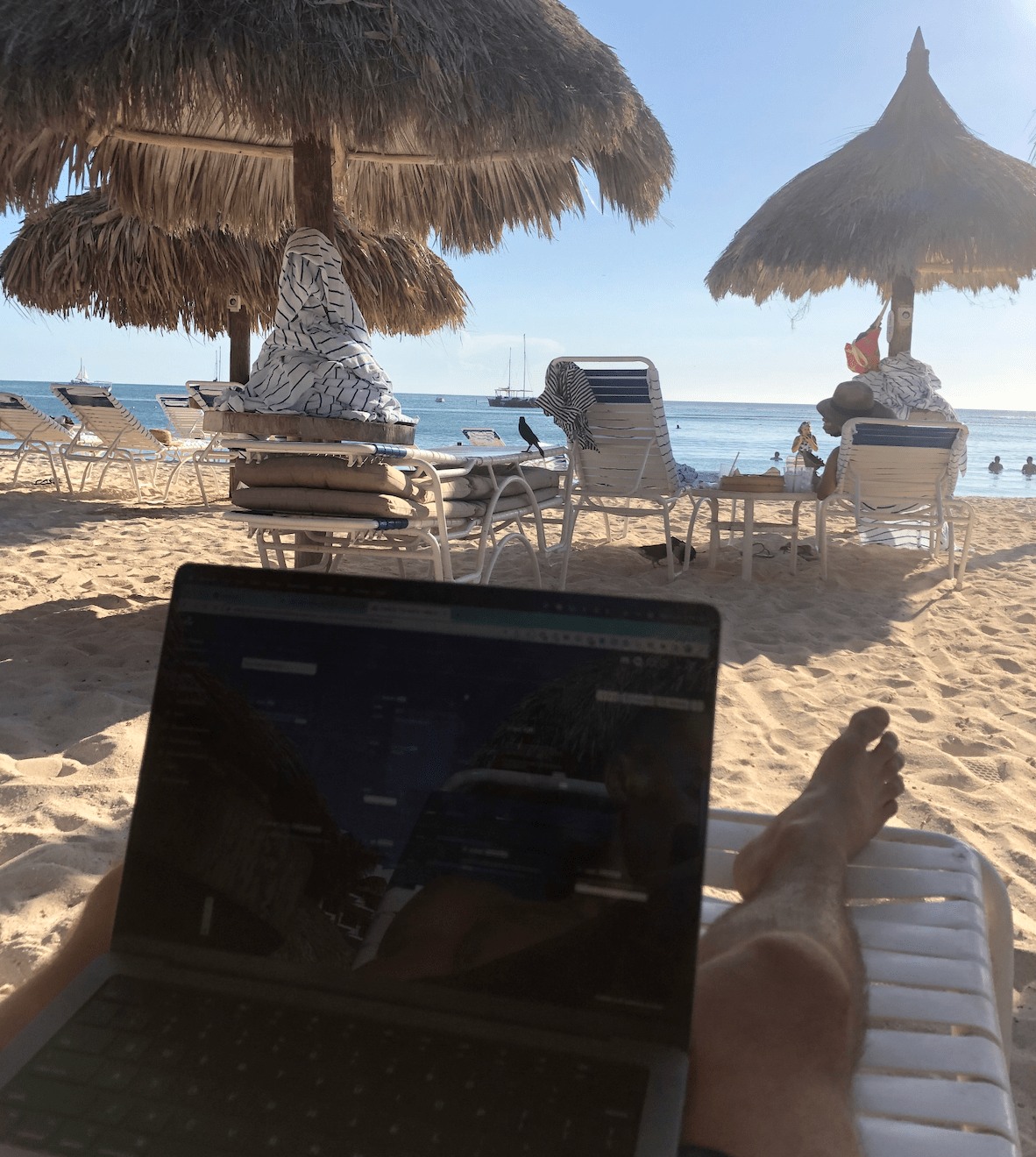
The beach had a return ticket
Ottley says he began chasing a location-independent business in 2018. By 2020, he was studying at the University of Auckland while building online businesses; he completed two semesters there. He later worked across countries and time zones, eventually settling in Dubai. By 2024 he counted 30 countries and more than 100 cities in his travels. The figures read like an airport departure board. The decision that followed was considerably less cinematic: take the team home.
He described the reasons plainly. Conversations across time zones were slow. Brainstorming through calls could not replace people working beside one another. He wanted deeper ties with friends, family and colleagues in New Zealand. His team also had a New Zealand center of gravity. Auckland offered a market for AI consulting and a familiar place to make the company more durable.
The return was thoroughly physical. Ottley wrote about selling his car, moving his belongings and arranging transport for his cat. Morningside AI leased space for 15 people and began bringing colleagues together. In the office, the routines were mundane enough to feel almost subversive for an online founder: driving through traffic, getting to a desk, seeing the same people tomorrow. A photograph of his new workspace looks more like a company than a travel feed.
“I’ve traded the excitement of constant travel for the depth of community.”Liam Ottley, writing about his return to New Zealand
It would be easy to turn that into a moral about office life. Ottley's version is more specific. He had used movement to build independence and a public identity; those were useful. At a different size, the company needed a place to make knowledge pass between people quickly. He was betting that gathering the team would produce better work than another attractive view from a laptop.
The channel and the client
The business had started with a different kind of gathering: people finding Ottley on YouTube. As generative AI drew new attention in 2023, he documented experiments with tools and ways to sell implementation services. Morningside AI supplied the problems and lessons. Videos translated them into a model that viewers could recognize, the AI Automation Agency. The phrase became a teaching product, then an accelerator for would-be agency founders.
That sequence made Ottley unusual in a crowded field of AI explainers. He could point to an agency working with clients while showing others how an agency might be built. His public advice was a form of distribution for the service business; the service business gave the advice its material. He has described moving from consulting to development services, education and software ideas as demand became clearer. The loop was productive, but it carried tension. The person drawing the audience also had to spend time running the company that gave the audience a reason to listen.
One of his posts from Dubai catches the problem in miniature. Rain was falling outside while he worked on Morningside's own systems. He wrote that content creation drove leads, yet building systems was the work he enjoyed most. The admission is revealing because the camera had become central to the company. Each video could bring a client or student, but each hour on camera was an hour away from a difficult implementation. Ottley wanted more time in the code and the operation.
His own account of the early operation includes mistakes he did not hide. He hired highly rated developers through Upwork and found that communication and delivery needed more management than expected. His team also spent time writing full proposals after initial sales conversations, only to discover some prospects were curious rather than ready to commission work. The corrective step was a paid exploration stage: a deeper look, a prototype and a feasibility report before a larger project. It is not an exciting phrase for a thumbnail. It is the kind of process that determines whether an agency survives the excitement of its first deal.
He later regretted treating video production as something to squeeze between everything else. By late 2024 he said the channel had passed 260,000 subscribers, while the production process still ran on last-minute effort. That is an oddly candid picture of growth: a polished distribution engine resting on a calendar that needed repair. He also wrote about pursuing far-fetched opportunities too long and about learning to collaborate with other AI creators rather than regard every similar channel as a rival.
A bigger room, a harder question
Auckland gave Morningside AI a base for a broader pitch. It now describes a three-part approach: identify useful AI opportunities, develop systems and help teams adopt them. Morningside AI lists work across multiple industries, including sports organizations, and reports more than 48 client engagements. Those are the company's figures. What matters to Ottley's story is the change in unit of work: from demonstrating a chatbot or teaching an agency offer to changing how a client organization operates.
That shift asks more of both the consultant and the client. A quick demo can prove that a model responds to a prompt. A working system must fit the records people already use, the decisions they actually make and the habits they return to after the consultant leaves. Ottley's newer work puts this less glamorous territory at the center. His AI Makeover project promises to work inside a company for seven days and film the process.
The format sounds like reality television for software. It also puts a clock on a notoriously open-ended subject. After four in-person makeovers in 2026, Ottley said two or three days of a seven-day visit could go into creating a centralized database. The image of a week-long transformation may suggest instant agents whirring into life. His reported allocation suggests a more familiar scene: finding the information, arranging it and getting the team to use it.
That friction is precisely what could make the series useful. Ottley's first videos offered a path into AI services for people outside established technology companies. AI Makeover turns the lens around, asking what the receiving company must do to make those services stick. He is still an educator and a marketer, of course; the project invites viewers to watch real transformations. The camera's presence does not eliminate the hard parts of implementation. It gives him a reason to show them.
What stays when the week ends
Ottley's public persona can move quickly between roles: founder, instructor, interviewer, operator. He has interviewed builders from his community, gathered agency founders at in-person events and continued to publish tutorials for viewers learning the business. His partner Josh Brown appears in his account of building that community. The network matters because the business model he popularized depends on people capable of selling and delivering work, and because Ottley's own company grew beyond one person with a camera.
There is humor in the arc if you let the details do the work. The aspiring digital nomad reaches the point where he can choose any desk in the world and chooses one near Auckland traffic. A founder who built reach with videos admits he would sometimes rather be building the system than explaining it. The seven-day makeover spends a remarkable share of its running time on data organization. None of those details diminishes the ambition. Each gives it a shape that a viewer can actually understand.
His stated aim has widened from helping people start AI agencies to helping existing companies use the technology. That is a much less tidy promise. It has employees, files, deadlines and the stubborn fact that people develop their own ways of working. Morningside's current language emphasizes adoption alongside development. The week-long filmed project will be most interesting where those two collide: a clever system meeting an ordinary Tuesday.
Back in 2024, Ottley wrote that the move to Auckland was a bet on a better life and a stronger organization. In one sense the bet was already familiar: take what he learned in public, test it in the company and tell the audience what happened. This time the experiment came with a fixed address. The cat had made the trip. The office door had a name on it. The question, for Ottley and for the businesses inviting him in, is what will still be working when everyone goes home.