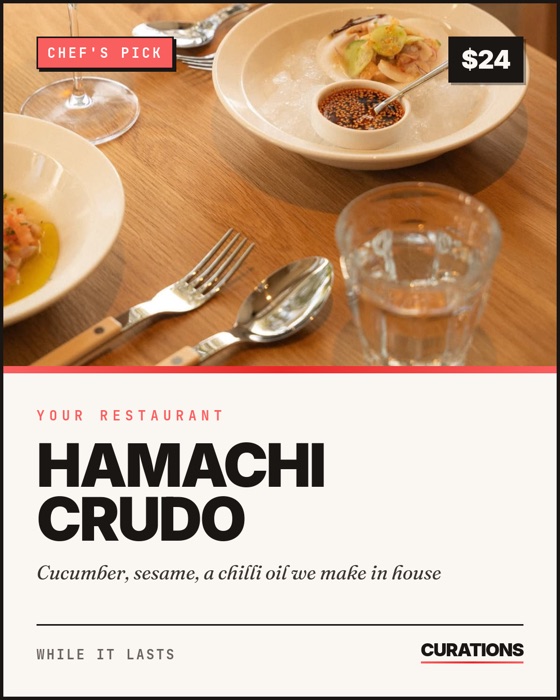
A plate of hamachi crudo has acquired a second job. In a sample post on CURATIONS’ website, it is lunch, certainly, but it is also a small publishing system: photograph above, price in the corner, dish name below, a line about cucumber and sesame. The template says “Your Restaurant.” Put another kitchen into the frame and the machinery is ready to work again.
That modest object explains this Los Angeles agency more clearly than the phrase Human × AI. Somebody must decide what deserves attention. Somebody must make the thing. Then somebody must put it where a potential customer will see it. CURATIONS sells work across all three stages, with an unusual addition: it publishes a local outlet of its own.
CurationsLA covers the city’s restaurants, openings and cultural life. The agency says it attracts more than 120,000 readers a month. Read that as the publisher’s audience claim, rather than a count of agency customers. What matters to the business model is the relationship: the people making the campaign also operate a channel that can carry it.
The agency has somewhere to put the story
Consider the predicament of a restaurant owner buying publicity. A pitch can be thoughtful, accurate and beautifully timed, and still depend on an editor’s appetite. CURATIONS’ PR offer includes story development, outreach, press materials and interview preparation. Its local publication adds another route to readers when outside coverage does not materialize.
For a buyer, those routes deserve separate columns. A feature in the agency’s own publication supplies distribution; an independent journalist’s decision supplies a different kind of endorsement. Both can be useful. Treating them as interchangeable would make the monthly report harder to read. CURATIONS makes ownership part of its sales argument, so the distinction can be made before the work begins.
Two routes to attention. Different kinds of proof.
The publication’s partnership page extends the idea beyond restaurants to independent shops, cultural venues, community groups and local services. It offers newsletter and social features, event promotion and website links. Geography does real work here. A concentration of Los Angeles readers is a more plausible asset for a neighborhood opening than for a business whose customers live somewhere else.
A monthly price, with the arithmetic visible
The restaurant partnership is listed at $2,000 a month, with a three-month minimum and no setup fee. Its advertised scope includes four social posts a week, local search work, quarterly photography, delivery-platform setup, review responses and weekly CurationsLA features. Three months at the published rate means an initial $6,000 commitment.
The bundle is sold around a recurring operating need. A restaurant has hours to maintain, dishes to photograph and guests to answer long after opening night. CURATIONS separately lists an opening program from $9,500 and retention work from $1,200 a month. The distinction gives an owner a useful question to bring to the conversation: are we preparing for a date, maintaining a presence, or trying to bring people back?
Outside Los Angeles, the agency says photography may require travel or a local photographer quoted separately. That is a revealing boundary. A workflow can travel through a browser; the person taking a picture of tonight’s special has to get to the room. Buyers elsewhere should price that practical difference alongside the reduced relevance of an LA publication.
Molly and Lucy are not on the payroll
The agency gives its eight AI personas names and specialties. Molly Towns handles hospitality; Lucy Mills handles editorial; Peter Melrose covers public relations. Oliver Wright is the concierge. The names give a visitor a way to address a particular function without having to think in software categories.
CURATIONS says a human writes the brief, AI helps draft and reformat the work, and a human edits and approves what leaves the agency. That division is more consequential than the names. It locates responsibility at the beginning and end of production. A restaurant’s tone, an awkward review reply or a claim in a press pitch still needs somebody willing to put their judgment behind it.
The AI consulting service turns this internal arrangement into a client purchase. The published $6,000 engagement runs four to eight weeks and includes an audit, prompt library, workflow documentation, training and a one-page policy. Ongoing monitoring is quoted separately. The deliverables concern how a team works, including what information can go into which tools and who approves the output.
“Ask us what we scrapped.”
CURATIONS, on its AI consulting page
That invitation is a good buying question. The agency says experience prompted additional guardrails. A prospective customer can press for the actual discarded workflow, the reason it was discarded and the rule that replaced it. A prompt library becomes more useful when the person receiving it understands where the shortcuts end.
The logo is one purchase. The rules are another.
CURATIONS separates a standalone logo, starting at $4,500, from a full identity, starting at $12,000. The latter includes naming, typography, color, a brand book and voice guidance, with a stated six-to-twelve-week schedule. Its brand books also include AI prompt templates. The aim is to carry decisions forward into work made after the original designers have finished.
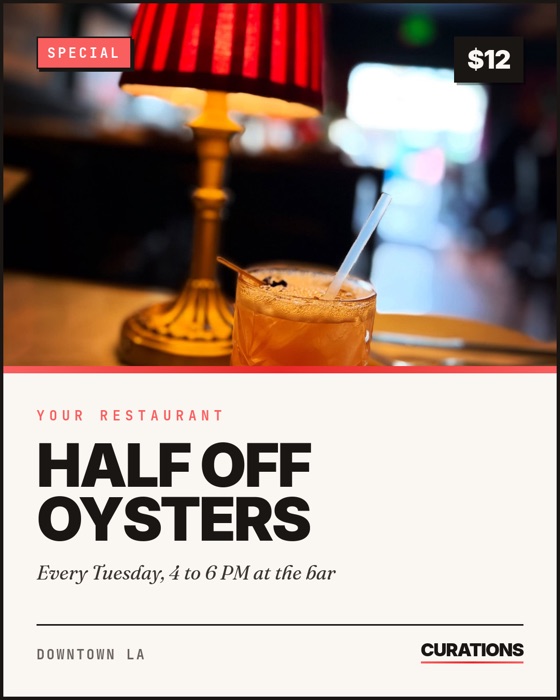
Social Studio makes that idea tangible. A client can enter copy into branded templates and download graphics sized for a feed, a Story or a TikTok cover. The crudo demonstration is an example of the output. Its appeal is partly administrative: the person announcing a new dish should not have to reopen the debate about typefaces.
For creators, the agency offers a related collection of tools: newsletters, sponsorship materials, visual identity and systems for adapting longer pieces into shorter posts. Media kits and pitch templates help organize the commercial side of an audience. These are agency services with reusable components, purchased alongside an existing creative business.
Campaign work has its own economics. CURATIONS lists concepts, art direction and an asset set from $8,000, with production quoted separately. Its process calls for a customer observation before concepts are developed. A reader can borrow that discipline immediately: write down the particular thing you believe about your audience before commissioning the pictures. If the sentence could belong to any business in the category, the brief needs another pass.
Show the workshop
The agency also publishes HUB, a free AI learning wiki. It offers beginner material, technical guides and branding exercises, organized into learning levels with plant-growth metaphors. A visitor can work through the material without becoming a client. That gives CURATIONS a second public surface: one publication shows its editorial output; another exposes some of its thinking.
One HUB exercise, called Brand Archaeology, asks people to look for identity in actual decisions and internal language. It suggests examining recurring phrases, disagreements and moments when a founder refused a compromise. As an editorial method, that is more promising than asking a room to choose three adjectives. The evidence comes first; the positioning follows.
CURATIONS applies a similar show-the-work impulse to its own website rebuild. Its case study reports more than twelve rebuilt core pages and twenty machine-readable alternates. It describes organizing discovery information before visual polish, then building reusable service pages and adding restrained motion. These are implementation counts. They tell a prospective customer what was built, rather than how much extra business it generated.
The planned next classroom is PROJECT STEAM, a paid apprenticeship for Southern California high school juniors and seniors. The published schedule puts applications in the first quarter of 2027, immersion in summer and a showcase in fall. The proposed model is twelve weeks at ten to fifteen hours a week, involving client work, mentors and AI tools. It remains a plan for a future cohort.
For now, the commercial proposition is concrete enough to inspect: buy a defined piece of agency work, use systems that can be repeated, and, where an LA audience matters, add a publication already addressing that audience. The crudo post is a small expression of the arrangement. The next dish gets a new photograph. The publishing system is still there.
Explore the work
Visit CURATIONS, inspect the restaurant program and brand identity offer, or read CurationsLA. Browse the HUB cookbooks, the website rebuild and PROJECT STEAM.