At 14, Marina Mogilko wanted to learn English in Britain. The price of a language course was one hurdle; the fee for someone else to arrange it was another. So she wrote to schools, assembled the documents and handled the travel details herself. It took time. It also gave her an unusually close look at a small industry built around people who did not know where to begin. Years later, the teenager who had learned to work around an intermediary helped build a business that made the intermediary less necessary.
This is a useful place to start her story, because the present-day version can be hard to hold in one frame. Mogilko is a LinguaTrip co-founder, a YouTuber with separate audiences for language lessons and Silicon Valley life, an angel investor and the host of an interview podcast. The activities look scattered on paper. In practice, they share a question: what would help a newcomer find their way into a place whose rules feel obscure?
The place has changed. First it was a British language school. Then an American university application, a California startup office, and now a conversation with someone building new technology. Her method has remained pleasingly direct. Find the process. Learn the vocabulary. Explain the useful part to the person standing outside.
The paperwork was the first product
Mogilko grew up in Saint Petersburg, where English offered a route beyond the immediate horizon. She understood the appeal of studying where a language was spoken because she had done it herself. She also understood the nuisance. Booking a school, arranging accommodation and navigating documents could be an expensive obstacle course. There was nothing romantic about filling in forms, but there was an opening for someone willing to make the forms less forbidding.
In 2011, she and her classmate Dmitry Pistolyako began MP Education, an offline service for language trips. They received customers in a Saint Petersburg office. The idea was modest and tangible: help people do what Mogilko had once figured out for herself. By 2013, the co-founders were working on a website that would let people book courses and accommodation from home. Developer Dmitry Kravchuk joined as a third co-founder. The business that became LinguaTrip was moving from advice across a desk to a platform that could serve people elsewhere.
The route, in four stops
- Age 14Arranges her own British language courses
- 2011Starts the study abroad service
- 2015Builds LinguaTrip in California
- 2025Expands Silicon Valley Girl into a podcast
There was a near miss before the California chapter. In her account of the company's early years, Mogilko said that LinguaTrip almost ran out of money in 2014. Pistolyako took a regular job and put his salary back into the business. That is the sort of detail that disappears when a startup history is compressed into a string of funding rounds. It matters because it explains why the next choice was so consequential.
That year LinguaTrip joined the SumIT accelerator in Saint Petersburg. In 2015, the team was accepted into 500 Startups in the United States and received a $100,000 investment. Mogilko had also won admission to American graduate programs with full financial support. She could pursue a degree, or follow the company. She chose the company, reasoning that an offer from an accelerator might be harder to repeat. LinguaTrip launched its platform in the United States that year. The aspiring student had become a founder who could help other students travel.
A camera for the lonely parts
During the same period, Mogilko was preparing for the GMAT and TOEFL and working out how American admissions worked. She felt isolated in that process. Her response was to make a Russian-language YouTube diary about it. The first videos were not a polished empire in miniature. They documented the kind of ordinary details that become unexpectedly important when a person moves: getting an apartment, buying a first car, discovering what life in Silicon Valley costs.
The diary revealed another form of demand. People who had never met her wanted an explanation from someone who had just walked the route. Her company could help a customer book a course; her videos could give that customer confidence to consider the journey at all. The camera made practical information feel like a conversation with a friend who happened to have kept the receipts.
She then made an English-language channel, Linguamarina, centered on learning English. A third channel, Silicon Valley Girl, followed in 2018. The separation was deliberate. Russian viewers were following her move and business life; English learners wanted lessons; friends in America were more curious about the price and peculiarities of California and about entrepreneurship. One name and one feed would have forced those interests into an awkward queue. Three channels let each audience find the door it had come for.
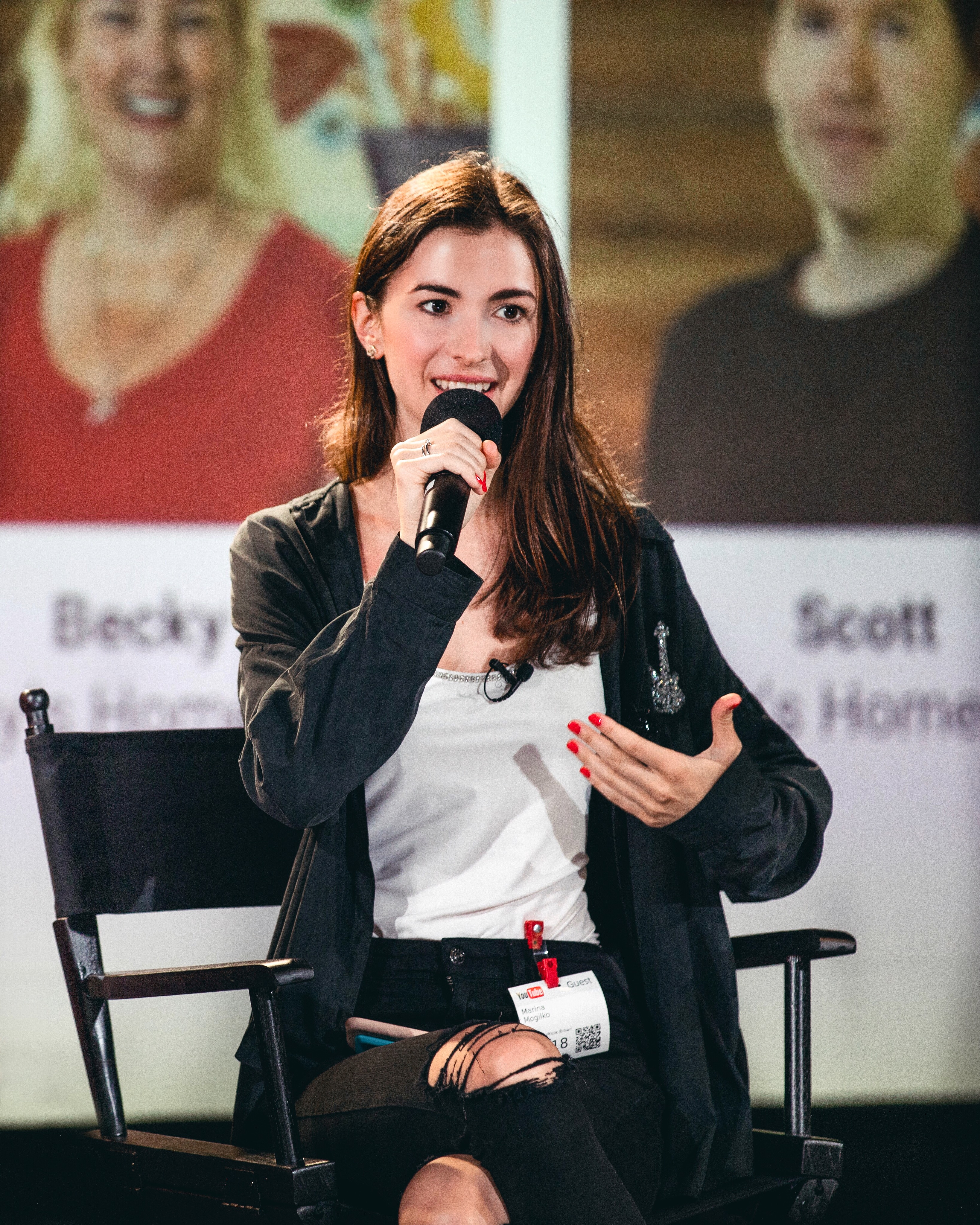

The division also says something about her as a creator. She treated an audience less like an anonymous crowd and more like several groups with distinct questions. Her most durable subject was never simply English or Silicon Valley. It was the first-person account of entering something unfamiliar, delivered by someone who remembered what it felt like to be new.
What a minute can carry
Short videos brought another change. Mogilko and her team began cutting material for TikTok, Instagram Reels and YouTube Shorts, then experimented with videos made specifically for those formats. Ordinary California scenes traveled remarkably well. A grocery trip could turn into a miniature economic report. A mundane bill could become an absorbing comparison for a viewer somewhere else. The subject was rarely glamour; it was the price tag on daily life.
In 2022, she described the contrast between these quick clips and her longer lessons. The short form could bring attention, but she worried about what it left behind. “I like to educate people and explain difficult topics,” she said. A minute was enough to spark curiosity; an explanation often needed room to breathe. It was a candid admission from someone whose short videos were doing precisely what the platforms rewarded.
“I like to educate people and explain difficult topics.”Marina Mogilko, discussing short videos
She had other reasons to think beyond a view count. LinguaTrip added online English courses in 2018. She co-founded Fluent Express, a service for checking English writing, and built educational products around her own audience. In 2021, Slow Ventures and other investors put $1.7 million into her creator business in return for a share of creator earnings over time. She later described the investment as room to hire talent and try products that took more capital to develop. The audience was large; the business question was what useful work that attention could support.
Her own sites now describe a following of more than 18 million across platforms. That figure is a self-reported combined audience, not a census of unique people. It nevertheless marks a striking distance from the first videos about entrance tests. Mogilko's advantage has been keeping an outsider's curiosity even as she gained access to rooms many outsiders would like to enter.
From the lesson to the interview
Silicon Valley Girl expanded into a weekly interview podcast in 2025. Reid Hoffman, Mustafa Suleyman, Aravind Srinivas and Mary Barra have appeared among its guests. These are the kind of people whose titles can make a conversation sound sealed off before it begins. Mogilko's stated aim is to bring their work back to ordinary use: what can a viewer do with a new tool, what changes in a career, what matters next week rather than in a distant future?
The format gives her an answer to the short video's cramped clock. She can ask a follow-up. A guest can admit the awkward step between a big idea and a usable one. The show also extends the role she first found through language teaching. A good teacher does not need to know more than every student about everything. A good teacher knows when the room is full of jargon and asks for a sentence everyone can use.
At the 2026 World Economic Forum in Davos, Mogilko interviewed experts and leaders for the podcast, including physicist John Martinis. Asked what drove her, she talked about wanting to learn about people inventing and discovering things. Her question for them was how that work would change lives in a year or two. It is almost comically plain beside the elaborate vocabulary that often surrounds technology. It is also a much harder question to dodge.
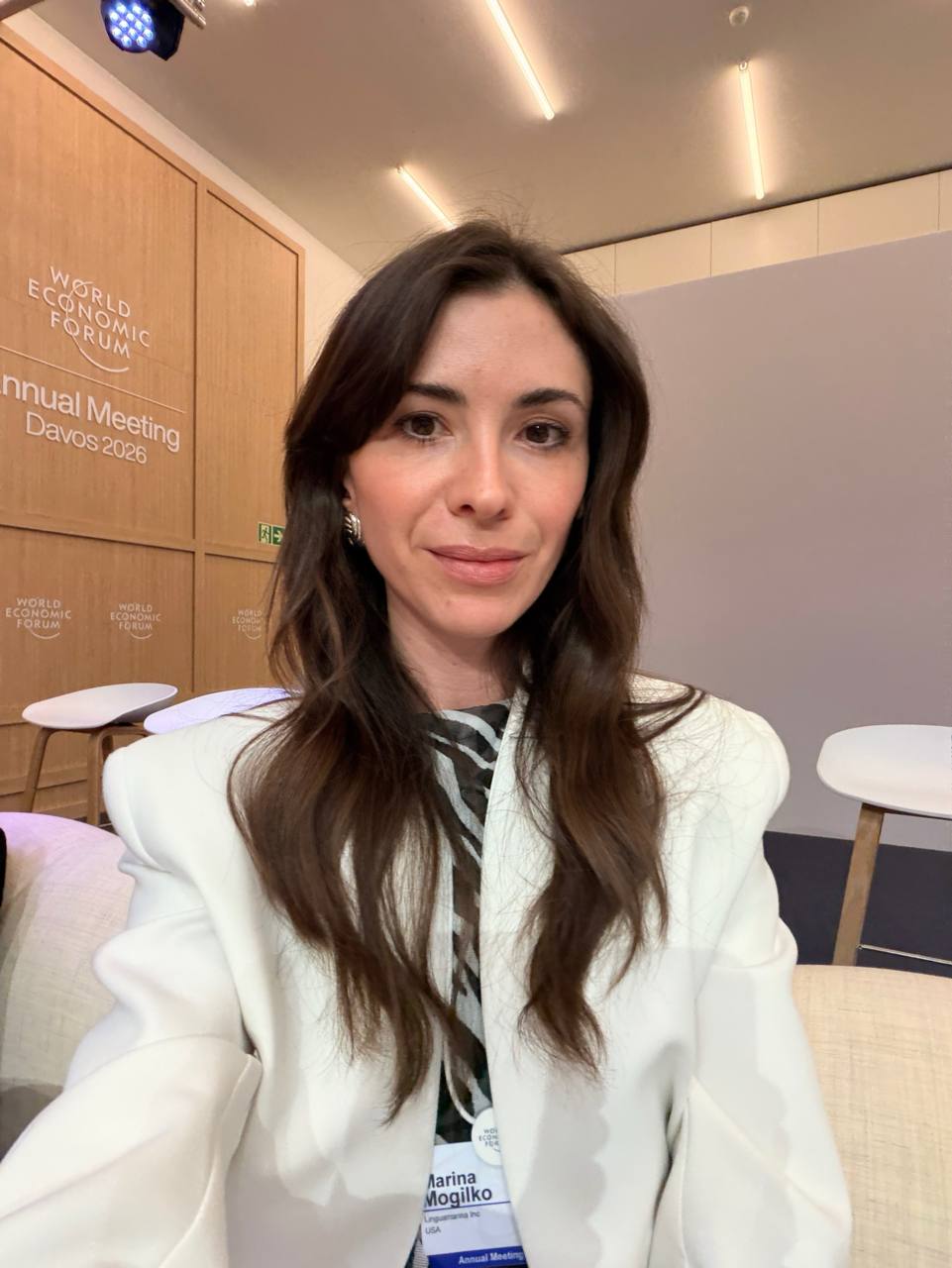
The trip offers a tidy image of how far she has traveled: a badge in Davos where there was once a stack of language-school forms. Yet the badge is less interesting than the continuity. The person who once wanted to know how to book a course without paying an unnecessary fee now wants to know what an invention will mean for a person outside the conference room. Both questions ask for the same courtesy: make the system legible.
The door stays open
Mogilko describes her work in terms of helping people use their talents and reach the lives they imagine. That aspiration can sound broad until it is put beside her actual projects. Someone can study a language abroad. Someone can apply to a university without feeling alone. Someone can see the cost of life in a place they hope to live. Someone can listen to a founder and leave with a practical idea instead of an impressive phrase.
There are businesses in that list, and there is media. There is also a personality: restless enough to start another channel when the existing one could not serve a new group, and practical enough to ask what a grand idea does on Tuesday. She has made mistakes and changed formats in public. She has described the near bankruptcy of a company, the limits of a one-minute lesson and the tradeoffs of financing a creator's future. Those admissions give the polished parts of the story some human scale.
The child arranging a trip to Britain could not have planned this career. She did learn a repeatable move. Notice where a door is hidden by paperwork, jargon or expense. Work out the route. Then tell the next person. Marina Mogilko has carried that move from Saint Petersburg to San Francisco, from a booking page to a camera and from a language lesson to a microphone. The audience followed because the question on the other side of the door was often theirs, too.
Keep reading, keep watching
YouTube Space photograph used under CC BY-SA 4.0; no changes made.