Person • Founder • Scientist
Marco
Marco
Lobba
The chemist who taught an enzyme to staple two proteins together - then built a company around the join.
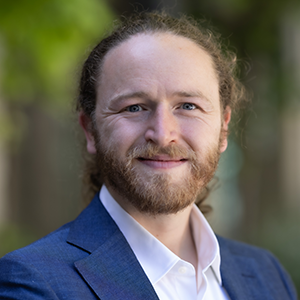
Marco Lobba // built a bond, named it, sold it
The chemist who taught an enzyme to staple two proteins together - then built a company around the join.
The Dispatch
Most proteins refuse to be combined. Try to bolt one onto another and you usually wreck the part that does the work. Marco Lobba spent his graduate years getting around that problem, and the workaround became a platform, and the platform became CatenaBio - the Berkeley company where he is now CEO and co-founder.
The trick is an enzyme. Lobba and his collaborators engineered one they call Catenase, which oxidizes an exposed tyrosine into a reactive group that latches onto a cysteine on a second protein. The result is a durable link they trademarked as the C-Y Bond, and a platform they call CysTyr. It happens under mild, oxygen-friendly conditions, and it can join two full-size proteins in under two hours without scrambling how either one behaves.
That sounds like lab housekeeping until you notice what it unlocks. Antibody-drug conjugates - the targeted cancer drugs that carry a toxic payload straight to a tumor - have always been limited to a single kind of cargo. Lobba's chemistry lets you hang several different payloads off one antibody. CatenaBio calls these Multi-Payload Conjugates, and they are the reason a 20-person company in Berkeley keeps getting invited to the big rooms.
He is not the loudest founder in biotech. He is the one who, when asked, will tell you that the journey is hard and that the smartest move is to let good science take the lead and to know where your limits are. It is an unusually disciplined thing for a CEO to say out loud, and it explains why the company's story is told in trademarks and peer-reviewed papers rather than press-release adjectives.
“I've always been really interested in how the world works and why it works.” // Marco Lobba
Origin Story
That is the ambition Lobba reports having as a four-year-old. Not a fireman, not an astronaut - a way to extract matter from a black hole. It is a strange thing to want before kindergarten, and it is the cleanest possible explanation for the rest of his resume. The kid who needed to know how the universe holds together grew into a chemist who needed to know how molecules hold together, and then decided the existing answers were not good enough.
He took a route that was not a straight line to a corner office. There was an undergraduate degree at Pomona College. There was a stint as a quality manager at Anresco Laboratories, a food-testing lab - the kind of unglamorous bench job that teaches you what rigor actually costs. Then came Berkeley, and a PhD in chemistry that put him in two of the most consequential labs on campus.
The detour matters. A quality manager's whole job is to be the person who refuses to wave through a result that does not hold up. It is a strange credential for a founder, and a useful one. By the time Lobba was running a company, the instinct to let the data set the pace - to know where the limits are before promising past them - was not a leadership slogan he adopted. It was a habit he had already been paid to practice.
HOW THE C-Y BOND WORKS
Mild aerobic conditions. Site-specific. No loss of binding.
The Pedigree
The Nobel laureate who co-discovered CRISPR gene editing. Lobba trained in her lab, where the delivery problem - how do you actually get an editor inside a cell - is a daily obsession. CatenaBio is, in spirit, a spinout of that world.
Emeritus chair of Berkeley's chemistry department and a leading figure in protein bioconjugation. With Francis, Lobba published the foundational work on tyrosinase-mediated coupling that the company is built on.
Training under a CRISPR pioneer and a conjugation pioneer at the same time is not a normal graduate experience. It is also the exact intersection CatenaBio sits on: the editors Doudna's field invented need the delivery and assembly tricks Francis's field perfects. Lobba lives in the seam between them.
The published record makes the seam concrete. In the 2020 ACS Central Science paper, the team showed tyrosinase oxidizing exposed tyrosine residues into reactive quinones that grab cysteines on a target protein. The same approach attached cationic peptides to CRISPR-Cas9 and pushed its delivery into cells twentyfold, and coupled reporter proteins to a cancer-targeting antibody fragment without costing it the ability to find its target. A year later, in JACS, the group went further - assembling multi-protein complexes by activating tyrosines one at a time, in sequence, steered by charge. That is the difference between a clever reaction and a controllable construction method.
The Bet
The cancer cell is an adversary that learns. Hit it with a single drug and the survivors are, almost by definition, the ones that shrugged it off - and they are the ones that grow back. The logic of combination therapy has been settled for decades. The hard part has been packaging.
An antibody-drug conjugate is elegant precisely because the antibody is a guided missile: it finds the diseased cell and ignores the healthy one, sparing the patient the worst of the collateral damage. But classical conjugation chemistry could reliably hang only one type of payload on that missile. You got the targeting, but not the combination.
Lobba's answer is to treat the antibody as a chassis you can load several ways - different toxins, different mechanisms, on the same precisely-aimed delivery vehicle. The keywords around CatenaBio read like a wish list the field has carried for years: payload diversity, drug-to-antibody ratio control, payload stability, off-target toxicity reduction, resistance overcoming. The C-Y Bond is the hinge that lets the wish list become a build sheet.
SINGLE vs. MULTI-PAYLOAD
Built on site-specific, charge-directed conjugation.
The Receipts
The papers came first - peer-reviewed work in ACS Central Science and the Journal of the American Chemical Society showing that the chemistry was real and repeatable. The company came next. The recognition followed. It is a tidy arc only in hindsight; at each step the science had to earn the right to the next one.
CatenaBio incorporated in 2020 and set up at Bakar Bio Labs, the Berkeley incubator built to keep university science close to where it was discovered. By 2024 the company was on the program at the Berkeley Bio Startup Showcase during JPMorgan week - the single most crowded calendar in the industry, where a 20-person team has to earn its slot against companies many times its size. The 2025 40 Under 40 nod was less a turning point than a receipt: confirmation, in public, of work that had been accumulating quietly for years. Lobba's own framing of it stays characteristically level. The recognition, in his telling, is a reason to keep engaging beyond the lab, not a reason to stop watching the data.
The Work
CatenaBio gave its inventions trademarks, which tells you something about the ambition. These are not features. They are meant to be the vocabulary of a field.
The umbrella technology that modifies and combines proteins with selectivity single-molecule chemistry can't match.
The engineered enzyme that does the work - turning a tyrosine into something a cysteine wants to grab. The name nods to catena, Latin for chain.
The tyrosine-cysteine link itself - durable, site-specific, and the structural payoff of the whole approach.
One antibody, several payloads. The pitch that keeps a 20-person company in the conversation alongside far bigger players.
In His Words
The Margins
There is effectively a chemical bond named after his company's reaction. Few founders can say that.
Before the CEO title, he ran quality at a food-testing lab. Rigor was a job description before it was a philosophy.
He mentors students through a Berkeley campus entrepreneurship program - the "engage outside the lab" line, made literal.
His enzyme's delivery demo boosted CRISPR-Cas9 entry into cells twentyfold by stapling on cationic peptides.
The company name comes from catena - a chain. Fitting, for a business about linking things that don't normally link.
Black holes at four, protein bonds at thirty. The throughline is the same question: what holds things together?