Marcello Bottoli once explained the weakness of a familiar brand by recalling his own luggage shopping. Samsonite had been around his family for generations. Buying it seemed obvious. Yet a competitor’s promotion could still have changed his mind. The name had earned a place in his memory without securing his loyalty. For someone who would run the company, this was a useful little embarrassment. Even the future chief executive could be tempted by the other suitcase.
That gap between recognition and preference runs through Bottoli’s career. A product can be known almost everywhere and still need a reason to be bought. His jobs have taken him through consumer goods, Louis Vuitton, Samsonite, Pandora, private equity and, now, Vestacy. Read as a list, the businesses make an eclectic shopping expedition. Read through that early luggage confession, they begin to look like related assignments.
At Vestacy, the products include Air Wick, Calgon, Cillit Bang and Mortein. The corporate name is newer than the habits attached to its brands. Bottoli is again working with names that have already entered people’s homes. Getting through the front door is one achievement. Continuing to earn the space is another.
Before the luggage, the shopping basket
Born in Milan in 1962, Bottoli studied business administration at Bocconi. His early professional itinerary was international: brand management at Procter & Gamble in Paris and Cincinnati, followed by consulting at Boston Consulting Group. Between 1991 and 2001, he held management roles at Benckiser and Reckitt Benckiser, working across Spain, France, the Netherlands and Britain.
Those jobs matter to the later story. The former Louis Vuitton chief is an appealing introduction; the consumer-goods experience explains why a portfolio of household products belongs in the same career. Before he dealt with the aspirations attached to a handbag, he worked inside businesses whose products had to earn repeat purchases in ordinary shopping baskets.
Louis Vuitton followed in 2001. His tenure as chairman and chief executive ran through 2002, bringing him into a business where the relationship between an object and its owner was particularly visible. The bag had a practical purpose, certainly. It also carried a public message. That second function would become central to his work on luggage.
His résumé moves between countries as readily as between products. There is little sense of a career anchored to one national market. France, America and several European operating roles supplied different settings for the same commercial question: what makes the person on the other side of the counter care?
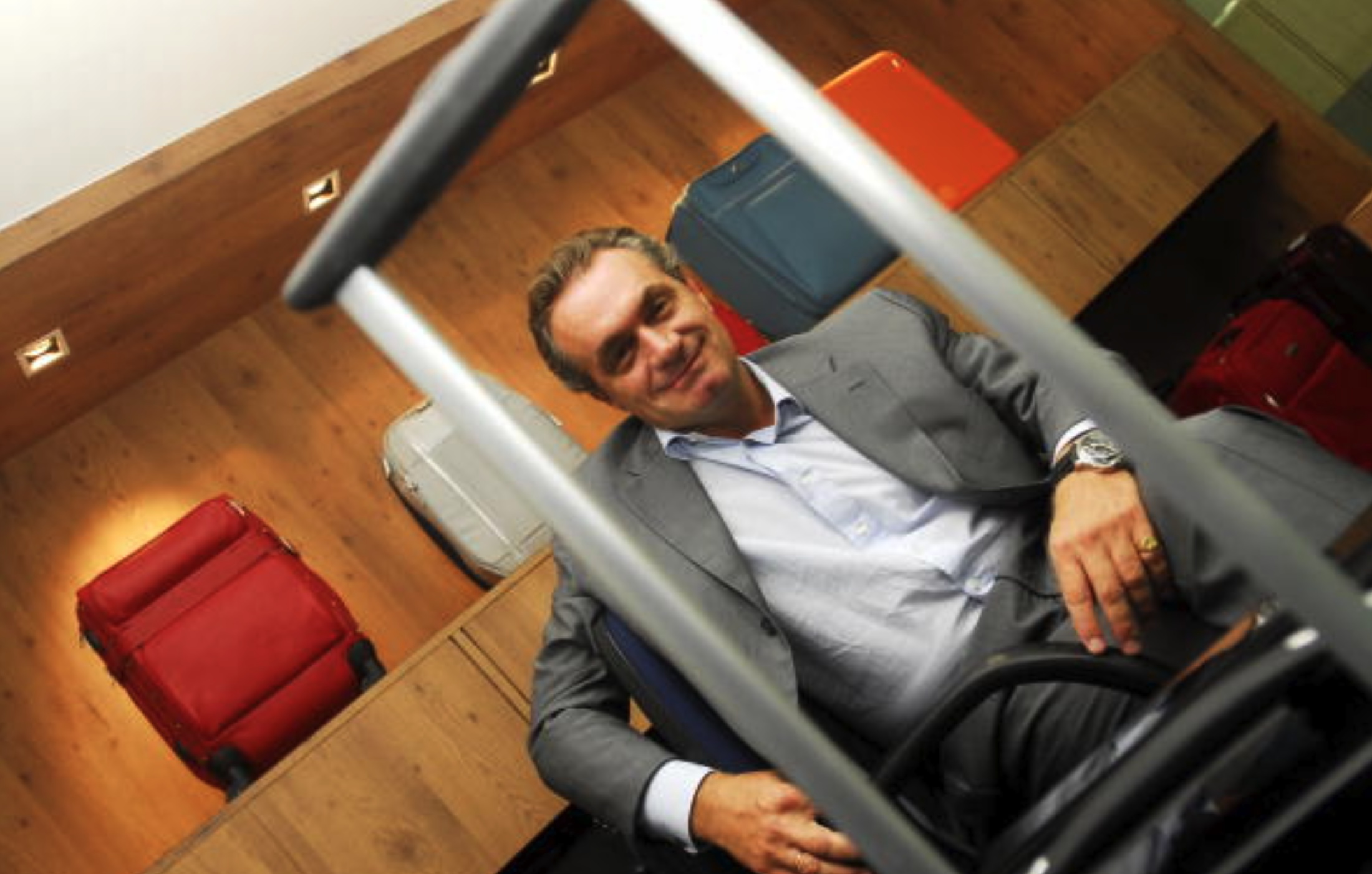
A suitcase gets ideas above its station
Bottoli became Samsonite’s president and CEO in March 2004. The company possessed the kind of recognition that most marketing departments would happily accept in lieu of a Christmas bonus. Its reputation for toughness was useful. It could also leave the customer thinking about replacement luggage only when the old case finally surrendered.
The task was to give that customer additional reasons to look. Working with creative director Quentin Mackay, Bottoli pushed product and image toward design and fashion. In Spain, Black Label’s choice of a Madrid address on Ortega y Gasset placed the luggage in a neighborhood associated with luxury shopping. Location was part of the proposition.
Alexander McQueen collaborations and the Black Label collection widened the conversation beyond endurance. Travel accessories offered more occasions for the customer to engage with the name. The ambition was to make Samsonite matter between the infrequent purchases of a large suitcase.
“We are convinced the brand is bigger than the business.”
Marcello Bottoli, 2007
There is an appealing danger in that thought. Once a name appears capable of carrying more, almost any new product can seem reasonable in a meeting. Bottoli’s expansion remained tied to travel. The intellectual exercise was finding adjacent purchases that made sense for the same customer, rather than treating recognition as permission to sell absolutely anything.
A fashionable ambition, measured
Share of total business reported in June 2008. The second bar is Bottoli’s stated target, not a subsequent result. Scale: 0–20%.
By June 2008, Black Label represented about 7 percent of Samsonite’s business. Bottoli wanted it to reach 15 percent over the following three years. The company was using fashion shows, a London design studio and designer collaborations to make that ambition tangible.
Yet most of the business still came from less expensive luggage. Samsonite intended to keep its middle-market lines. A premium collection could change the conversation around the brand without becoming the whole company. The arithmetic puts the glamorous photographs in perspective: the practical suitcase still paid much of the bill.
The investment chapter reached a transaction in 2007, when CVC acquired Samsonite in a deal valued at $1.7 billion. Bottoli remained CEO until January 2009. The sale and his departure were separate events, an important distinction in a career so often compressed into a handful of brand names.
Pandora, with the clock already running
The next chief executive assignment began with less room for a leisurely introduction. On 2 August 2011, Pandora announced a sharp deterioration in trading, reduced its financial expectations and said its CEO had resigned. Bottoli, already a board member, became interim CEO while the company searched for a permanent replacement.
The original expectation of at least 30 percent revenue growth gave way to an outlook broadly in line with the previous year. This was a job that arrived with the problem already visible. The title described temporary responsibility; the commercial pressure was immediate.
By the third-quarter report, Bottoli was speaking about corrective work in products, marketing, commercial operations and the organization. His description of performance was blunt: “far from satisfactory.” A recognizable jewelry name still had to get the mechanics of selling right.
Some of those mechanics were quite specific. In September, Pandora announced registration of its Latin-letter trademark in China, alongside existing Chinese-character and charm-bracelet protections. It was an unromantic part of looking after a brand: making sure the name and product could be defended in a market where the company wanted to develop.
In February 2012, Bottoli described a more measured approach to expanding jewelry categories and a program allowing retailers to exchange slow-moving inventory for stronger sellers. He pointed to room for growth in places such as the American West Coast and Manhattan. These were decisions about merchandise, geography and execution, with little use for decorative management language.
Björn Gulden took over as CEO on 1 March 2012, and Bottoli became deputy chairman. He later served as chairman. The interim assignment occupies only a short stretch of the timeline, but it shows a different version of the work: stabilizing a business while preparing to hand the operating responsibility to someone else.
Four desks, different assignments
- 2001–02Louis VuittonChairman & CEO
- 2004–09SamsonitePresident & CEO
- 2011–12PandoraInterim CEO
- 2026VestacyCurrent CEO
Another seat at the luggage table
Operating companies was only part of Bottoli’s subsequent working life. He was an operating partner at Advent International from 2010 to 2015. His investment work also included Es Vedra Capital Advisors and EVCP Growth Equity, focused on consumer lifestyle businesses. Board positions connected him to businesses beyond the ones he had personally run.
In discussing investing, he put particular weight on discipline: “Never get too greedy, never test your luck too much.” It is a less photogenic line than a promise to conquer a market. It also acknowledges the uncomfortable part of investing: deciding when a good outcome is sufficient.
In September 2022, Monos announced that he was joining its board alongside a $30 million Series B financing. The Canadian travel brand was planning further product, international and channel expansion. For Bottoli, luggage had returned as a boardroom assignment, with a younger business and a different route to the customer.
His mentoring work adds a smaller-scale version of that exchange. On MentorPass, he offers founders experience in leadership, organizational change and consumer brands. Clients describe advice that is practical and clearly explained. The attraction is easy to understand: a founder facing a specific decision wants experience translated into something usable, preferably before the next meeting.
The return address is home
Vestacy brings Bottoli back toward the household categories that occupied his earlier career. Advent agreed in July 2025 to acquire 70 percent of Reckitt’s Essential Home portfolio. Reckitt retained 30 percent. The announced enterprise value was up to $4.8 billion, including contingent and deferred consideration. The sale completed on 31 December 2025.
The plan was increased investment in brands, products and marketing for a business selling across more than 70 markets. Those were ambitions attached to the transaction. Delivering them belongs to the operating chapter that followed.
Vestacy now describes a workforce of more than 3,000 people across over 20 countries. Its categories include air care, laundry, surface care and pest control. Familiar product names provide the connection to shoppers; the new company has to provide the organization behind them.
There is a revealing instruction in its account of the workplace. Every colleague is treated as a founder, with room to make decisions and accept responsibility. For an established portfolio emerging from a larger parent, that is a demanding cultural proposition. Calling people founders is quick. Giving them the authority to act requires decisions about how the business actually runs.
Bottoli’s earlier life supplies a quieter image for all this movement. He grew up between Brazil and Italy, described sailing as a passion, and in 2007 said that his favorite luxuries were time and space. The personal details suit a career spent moving among countries and categories, although the objects in question have grown decidedly more domestic.
The suitcase now leads back to the house. On the shelf, a familiar name waits for the customer’s hand. Bottoli’s opening problem remains intact: familiarity has brought the product this far. The next purchase still has to be earned.
Follow the next chapter
- Vestacy
- Marcello Bottoli on LinkedIn
- Mentoring with Bottoli
- Listen: leadership and investing, Creative Return episode 61
- The Samsonite conversation, 2007
- Pandora’s 2011 results and leadership handover
- Monos board appointment, 2022
- Advent’s Essential Home investment announcement
Showroom photograph: published by MentorPass.