Marcel Cohen wanted to make the big company's advantage available to the smaller company. In poultry production, that advantage can be surprisingly unromantic: knowing what happened, what it cost and what to do next. A large producer can assemble an elaborate machinery of records and analysis. A smaller one still has to make decisions on Tuesday morning. Cohen's answer was Amino, a cloud software platform built to bring those decisions within reach.
There is something pleasing about a technology ambition that begins with the people who might otherwise be left out. Cohen co-founded MTech Systems, the Atlanta business whose work connects software to the practical business of producing food. His career has carried him through enterprise systems, a corporate acquisition and, now, a wider software leadership role under Speria. Along the way, his recurring concern has been how information becomes useful to the person doing the work.
The small producer's Tuesday morning
Consider the phrase Cohen used to explain Amino's beginnings: help small to medium producers capture the same level of control and insight through their data
. The comparison was with the large integrated producers that had enjoyed those capabilities for years. The ambition was specific. A smaller business should be able to understand its operation with comparable clarity.
Moving to the cloud was part of that proposition. The existing system's infrastructure made extending those capabilities to producers of every size a challenge. Cohen wanted an application that combined accessibility, ease of use and analytical power. The task required a team with knowledge of production as well as software. If the program misunderstood the work, a handsome interface would merely make the misunderstanding easier to admire.
This is where his story becomes more interesting than a familiar account of another business moving online. He was pursuing a different audience for an established kind of expertise. The challenge was to preserve the useful detail while making the system manageable for more people. Anyone who has wrestled a complicated application into answering a simple question can appreciate the distinction.
Make the big company's advantage useful to the smaller producer.
The idea behind Cohen's Amino brief
A long apprenticeship in the unglamorous details
Cohen's connection to software comes with a long institutional memory. His public professional profile lists Georgia Southern University between 1987 and 1992. At MTech, the business he helped establish, the subject has remained unusually concrete: poultry and swine operations, the records they generate and the planning they require.
The company's history traces a progression from ledger paper to databases, then to a dial-up system that replicated data across locations. Later additions included grower compensation, planning, handheld data collection and accounting. These sound like modest entries in a software catalogue. In an operating business, each describes a different person who needs an answer before the day can proceed.
Accounting brought production performance closer to costs and revenues. Purchase and sales information joined planning. The direction was toward a connected account of the business. It is an approach that makes particular sense in food production, where the work of one department becomes the constraint of another. The hatchery, the feed operation and the production planner cannot each have a private version of reality indefinitely.
What happened?
Who needs to know?
What comes next?
The people behind the planning screen
A photograph of Cohen with colleagues in Blumenau offers a welcome change of scale. There are people gathered in a room, smiling, with food along one side. The software business has bodies in it. Even the most elegant planning system ultimately depends on people being able to explain their work to one another.
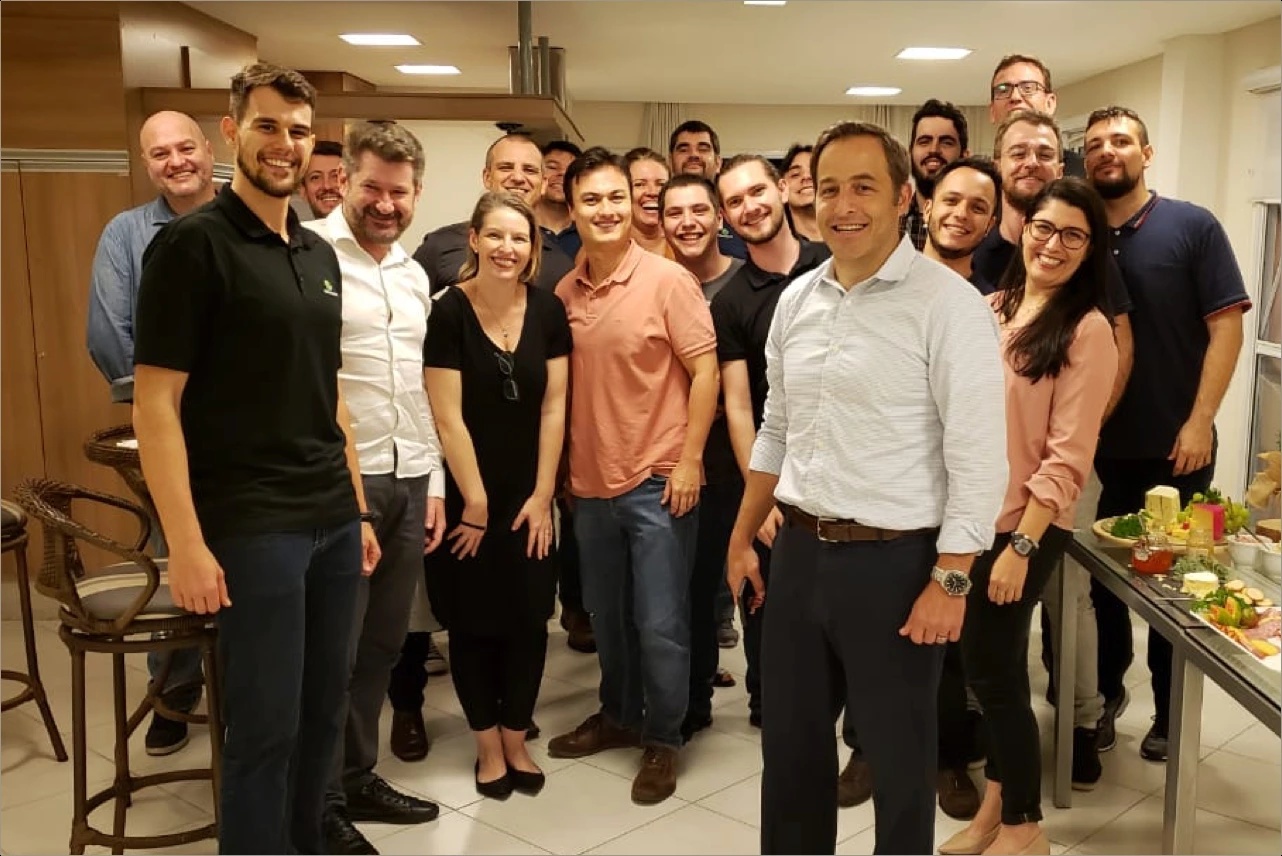
The Amino development team included experience in Brazilian poultry and swine operations, Canadian poultry finance, and breeding-company cost accounting and production planning. That mix helps explain the product's emphasis. A planning application has to accommodate the person responsible for the numbers as well as the person responsible for the flock. Neither is likely to be charmed by a feature that makes the other's job impossible.
Cohen's public product-development message also gives customers a place in that conversation. In 2024, MTech described its founder's approach as one shaped by relationships with industry partners and their feedback. The interesting management question is how to bring that knowledge into the product without turning every individual request into a permanent complication. His work sits squarely inside that tension.
When the controllers met the analysts
In February 2017, Munters completed its purchase of 60 percent of MTech. The transaction joined a software specialist to a company with climate-control equipment and farm controllers. The logic was physical as well as digital: combine data from the equipment with MTech's analytical capabilities to build a fuller view of production.
For Cohen, this placed the company he co-founded inside a larger organization while keeping its particular expertise relevant. A controller produces information about an operating environment. Software can connect information across stages and locations. The usefulness of the combination depends on whether those connections help someone decide what to do. Buying the pieces is one event; making them work together is a continuing occupation.
That relationship became complete ownership in 2025. Munters announced on April 2 that it had become MTech's sole owner after a transaction with the minority shareholders. It was a corporate milestone in a relationship that had already lasted eight years. Cohen's later leadership listings show his continuing involvement in the software business.
Munters acquires a 60% stake in MTech.
Munters announces full ownership.
Speria launches; Cohen leads its software business line.
A contract gives the idea a price
Two announcements in 2022 put commercial weight behind MTech's work. In February, the company secured an agreement to make its Protein SaaS system the standard across an unnamed food producer's US production complexes. Several facilities had already been converted. The broader commitment followed that initial work, making the sequence particularly instructive: operating experience preceded expansion.
Cohen described the partnership in terms of innovation, growth and responsible food production. The customer's name was withheld. What mattered in the announced scope was the effort to consolidate and standardize operations across multiple sites. Software in that setting has to survive the awkward details of implementation, including the differences between places that may appear identical on an organizational chart.
In December, another agreement brought Amino to an unnamed large North American poultry producer. The disclosed order value was $4.3 million. Its scope included breeding, hatching, feeding and growing, with software and consulting intended to standardize the producer's US operations. The announced schedule called for work to begin in the second quarter of 2023 and finish across all sites in the second quarter of 2024.
Value of the Amino order announced in December 2022. A contract value, rather than a price list.
Amino had begun with an aspiration to widen access to sophisticated tools. Here it was being chosen for a large operation. Those two audiences impose different pressures on the same product: it must be approachable enough to use and substantial enough to coordinate complicated work. Cohen's challenge is visible in that combination.
At nine, research. Then the difficult questions.
The September 2022 MTech users' conference placed Cohen's presentation on research, development and vision at nine in the morning, after a welcome from FoodTech president Pia Brantgärde Linder. The agenda moved through analytics, AI, connected devices and the practical use of data. It put the company's plans in front of the people expected to live with them.
His presentation covered quality control, user experience, security and data science. It described simplifying workflows, making inventory accessible within one screen, and using guided steps for complex processes. The details reveal what a product vision has to contain once customers arrive. A promise about better decisions becomes a question about whether somebody can find the right inventory record.
There is a quiet comedy to that translation. The future arrives wearing a conference badge, then spends the afternoon discussing screens and updates. Cohen's presentation treated those mechanics as part of the job. Reliability and clarity belong in the same conversation as forecasting.
The next version has another name
By the 2025 reporting period, MTech's development work included agentic AI. Internal applications covered code review, generating web services and moving from a reported software bug toward a verified fix. Cohen described customer-facing applications as early research and groundwork. That distinction gives the ambition a useful boundary: tools already supporting development, with further applications being explored.
Then came Speria, launched in May 2026 as the commercial brand bringing together Munters FoodTech technologies, software and services. MTech's supply-chain software is moving into that offering over time, alongside integrated solutions. Farm-controller brands retain their product identities under the umbrella. The intended connection between equipment, data and operating decisions now has a shared commercial home.
Cohen is listed as Speria's VP, Business Line Software, and as MTech's co-founder. It is a fitting pair of descriptions for this stage of his working life: responsibility for what comes next alongside a durable connection to what he helped build. The names around the business have changed. His original Amino question still earns its place at the table: how much useful insight can a producer actually put to work?