By December 2024, Manuela Sánchez Villamarín had a new way of counting progress: doors. Laika had just opened its seventh physical shop in Colombia. About a year earlier, it had opened its first in the Chía area. For a cofounder who had spent years helping people shop through a screen, each opening brought unfamiliar work. She described learning about areas she had never expected to encounter, listening more closely to customers and adapting as the business changed. The internet had brought Laika into people’s homes. Now she was learning what happened when people walked into Laika.
That second apprenticeship belongs at the centre of her story. Sánchez had already helped build a pet business with an app, delivery and membership. Yet she was willing to become a beginner inside the company she had founded. In August 2025, after leading its retail strategy, she succeeded her brother Camilo as CEO. The route to that appointment ran through growth, customer experience and the decidedly physical business of opening shops. A bag of dog food, after all, has never become lighter merely because somebody ordered it online.
The problem had a carrying handle
Long before the stores, Sánchez had an unusually concrete description of the customer’s difficulty: getting a large sack of pet food home. In 2022, she explained that Laika wanted to serve households for whom travelling to buy supplies was inconvenient, particularly people relying on public transport. The business would hold its own inventory, buy directly from producers and make its own deliveries. The promise of convenience depended on people moving real things across real distances. Beneath the app sat a logistics operation.
That makes the founding idea easier to understand. Sánchez and her fellow founders were pet owners who wanted the things their animals needed in one place. Food, toys and accessories were purchases scattered across different stops. Gathering them into a single service could save time as well as effort. Her explanation did not require customers to become enthusiasts for technology. They simply had to prefer an easier shopping trip. The dog, meanwhile, could remain admirably indifferent to the software.
An education in leaving
Before Laika, Sánchez worked at IBM, Oracle and Rappi. The established technology companies offered a career she could do well; Rappi supplied a closer view of how a young business was built. Her recollection of that period is refreshingly unceremonious: “I was doing great but I wasn't happy.” Seeing ordinary people build a fast-growing company made entrepreneurship feel within reach.
The founding circle was close to home. Her brother Camilo, Tulio Jiménez and Andrea González became her fellow founders; her husband, Felipe Samper, helped connect the group. A family conversation led to a phone call and then a business. The beginning had the informality of people discovering that their skills might fit together. The consequences would be considerably less informal.
In a May 2022 interview, Sánchez described the difficulty of the initial commitment: resigning, giving up a salary and taking the plunge. The founders began with savings, contributing equal shares before seeking outside backing. This part of her advice has little of the glamour associated with fundraising announcements. Before an investor can say yes, somebody has to decide what they are willing to put at risk. Her account leaves the hesitation in the picture, where it belongs.
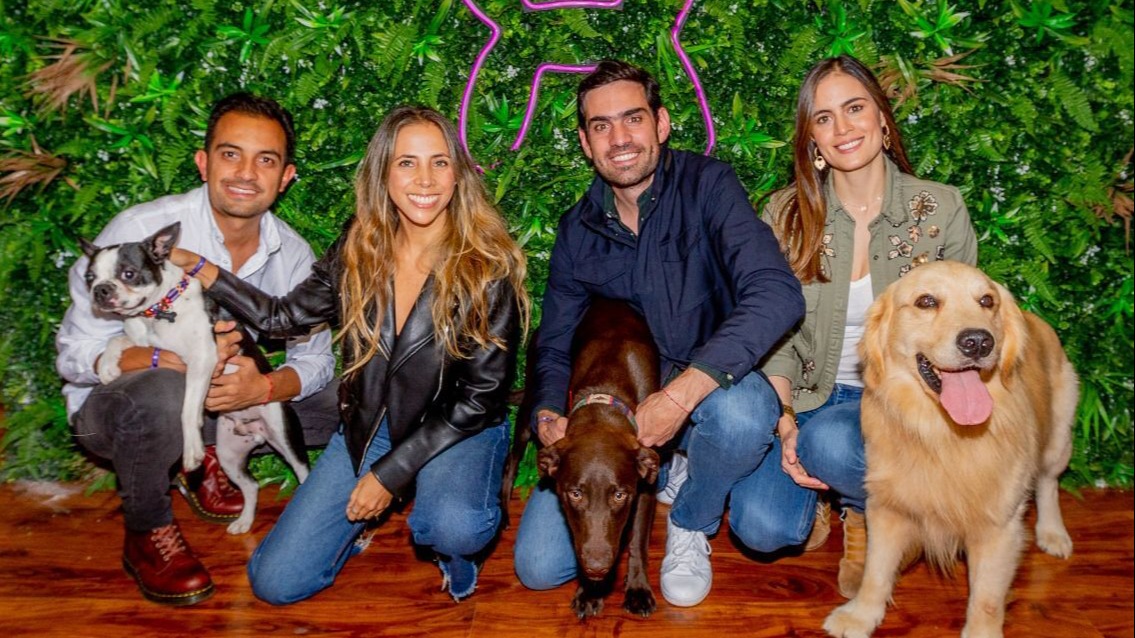
From left: Tulio Jiménez, Andrea González, Camilo Sánchez and Manuela Sánchez. Photo courtesy of Laika.
A wider world, then a narrower question
Sánchez studied business administration at Universidad de La Sabana and pursued a master’s in International Management at Università Cattolica del Sacro Cuore through a double-degree programme in Italy. She has credited the experience with broadening her outlook. In 2022, she received an iNNpulsa Colombia recognition as an entrepreneur of high impact. The recognition acknowledged Laika’s business and its support for animal foundations.
The education matters here because her ambition has repeatedly crossed borders. Her professional world includes technology companies, a Colombian university, study in Italy and a business built for Latin American customers. Each setting offers a different idea of what a company might become. Yet the customer’s question stays narrow: can I get what I need, at a price and in a way that works for me? International ambitions still have to survive that small examination.
By October 2022, she was discussing growth and international expansion in a long conversation about Laika’s model. The subjects included entering Mexico, having founders close to a new market and deciding when to add services. Expansion meant learning another place’s habits. A successful home-market formula still needed people prepared to test its assumptions elsewhere.
The customer who comes back
Her growth work also involved membership. In 2022, Laika described members as generating 70 percent of sales. That historical figure helps explain why the membership programme deserved attention: the company was building around customers who returned. Pet supplies lend themselves to repetition. A toy may be an impulse purchase; an empty food container is rather more persuasive.
Membership changes the questions a founder asks. Acquiring a customer is only the start. Why should that person buy again? Which benefits are useful often enough to justify paying? How does the service earn a place in a household routine? Sánchez’s public conversations about Laika have kept returning to convenience, loyalty and the relationship around the purchase.
The social element was part of that relationship early on. Laika linked a portion of membership-related purchases to food donations for animal foundations. Online shopping and delivery sat alongside support for rescue and adoption organisations. The proposition joined an everyday household errand to a wider community of animal owners. It gave the company another responsibility to carry alongside the order.
A unicorn can wait
Asked in October 2022 whether Laika wanted to become one of Colombia’s next unicorns, Sánchez replied that “llegar a serlo no es el sueño principal.” Becoming one was not the main dream. A billion-dollar valuation might mark a stage in building a company, she argued, but it was a poor substitute for the work itself. Creating employment, improving processes and helping customers save time and money were closer to the point.
She was already discussing the path to profitability and the importance of the economics of individual transactions. That is a useful detail in a founder’s portrait. The language of startup success can turn an enterprise into a scoreboard whose largest number wins. Sánchez’s answer brought the conversation back to a functioning business. A valuation cannot pack an order, pay a shop’s rent or make a customer return.
Her stated ambition was to make Laika an effective solution for pet owners and to contribute to Colombia’s economy. Those aims demand a longer attention span than an announcement. They also make her later retail work intelligible: another way to serve the customer had to be considered, even if it required learning an unfamiliar trade.
“Llegar a serlo no es el sueño principal.”Manuela Sánchez, on unicorn status · 2022
Learning the shop floor
The physical-store plan was visible before she became CEO. In July 2024, Laika was describing its second Colombian shop and an ambition to reach 100 by 2028. That number was a goal. The business continued to offer digital shopping while opening places where customers could browse in person. By the end of that year, Sánchez was celebrating store number seven.
Her own phrase was plain: “Laika seguirá siendo omnicanal.” Laika would keep both routes to the customer. In practical terms, a person could value delivery on one occasion and want to see a product on another. A founder responsible for experience had reason to care about both. The work could no longer be understood entirely through what happened on a phone.
In September 2025, the company reported 21 physical shops and more than 400 new direct jobs during the year. New locations included Cali and Medellín. Sánchez spoke about direct contracts, legal benefits and opportunities for staff to develop professionally. Expansion was creating a larger organisation to manage, with people whose work could not be reduced to a store-opening photograph.
Her brother’s chair, her own responsibility
The CEO appointment was announced in August 2025, with the backing of cofounders Jiménez and González. Camilo had led the business for seven years. Sánchez arrived with responsibility for the retail expansion already behind her. She was taking charge of a company she knew from several different angles, while the departure of her brother changed the shape of the founding partnership.
On her first anniversary as CEO, she described the transition as deeply emotional. It had felt like being pushed from an aircraft and told to learn to fly. She wrote about difficult decisions, mistakes, quick corrections and accepting responsibility without having every answer. The image is extravagant; the work she attached to it is ordinary and demanding. Lead the team. Make the decision. Correct what needs correcting.
There was also a small family detail in the reflection: Camilo had reminded her of the anniversary. The brother whose departure made the transition difficult was still the person who remembered the date. A change at the top of a company rarely fits neatly into the language of an appointment notice.
A place to stay a little longer
By September 2026, Laika’s Bogotá store on Calle 94 offered another expression of the retail experiment. The format included a pet bakery, an immersive room for photographs and an area devoted to adoption and donation initiatives. The company then reported 23 Colombian stores, alongside a location in Chile and a planned one in Mexico. The shop had become somewhere to spend time as well as spend money.
For Sánchez, this is the customer-experience question made visible. What earns a visit when a purchase can arrive at the door? What makes that visit worthwhile? The bakery supplies a particularly agreeable answer for a dog, although somebody still has to persuade the human holding the wallet. The business has to make these encounters work alongside the convenience that brought customers to Laika in the first place.
Sánchez has also used her public platform to encourage other women to build companies and seek leadership roles. She names Whitney Wolfe Herd and Melanie Perkins among the founders who inspire her, and stresses learning, decisions supported by data and strong teams. Her own career now offers a fairly concrete example of continued learning: help build the digital business, take on its shops, then accept responsibility for the whole company. Somewhere in that progression, the beginner became the boss without getting to stop being a beginner.