The everyday inconvenience of irritable bowel syndrome is easy to describe and hard to arrange a life around. A meal becomes a calculation. A commute becomes a survey of available bathrooms. The symptoms are physical; the anticipation of them can become its own demanding companion. Mahana Therapeutics built a business around a proposition that sounds odd only until you look at the evidence: what if part of IBS care could be learned, practiced and carried in a pocket?
- Mahana sold a prescription, self-guided CBT app for adults with IBS.
- Its clinical roots came from King’s College London research, not an invented wellness routine.
- A 2024 study of 843 users found that 19% completed all 10 sessions.
- In 2025, Nerva acquired key Mahana IBS CBT assets.
The company, founded in San Francisco in 2018 by Robert Paull and Simon Levy, did something refreshingly unromantic at the start: it went looking for work that had already been done. Paull said he contacted experts at the intersection of gastroenterology and psychology to find a validated digital treatment. The trail led to a web-based cognitive behavioral therapy program developed by researchers at King’s College London and the University of Southampton. Mahana licensed it in 2020.
An academic head start
The underlying idea is straightforward. IBS can involve a sensitive exchange between gut and brain: discomfort, worry about the next episode, and behavior shaped by that worry can reinforce one another. Gut-directed CBT gives people exercises to notice and change those patterns. It does not ask them to pretend symptoms are imaginary. It asks them to practice a different response to real symptoms.
The academic program came with an unusual asset for a young software company: a 558-person randomized trial. In that ACTIB study, both telephone CBT and web CBT with some therapist support improved IBS outcomes compared with usual treatment at 12 months. The distinction matters. The researched web program had clinician support; Mahana’s later phone product was self-guided. A clinical pedigree made the product worth investigating. It did not make every version of the product identical to the trial.
“As quickly and as responsibly as we can.”Robert Paull on bringing the licensed treatment to market
Mahana translated the research into Parallel, a prescription web product that received FDA De Novo authorization in November 2020. The mobile version was cleared in June 2021 and marketed as Mahana IBS. For a category crowded with breathless “gut health” claims, the regulatory route was a specific commercial choice: build software that clinicians could prescribe, patients could use at home, and regulators would scrutinize as a medical device.
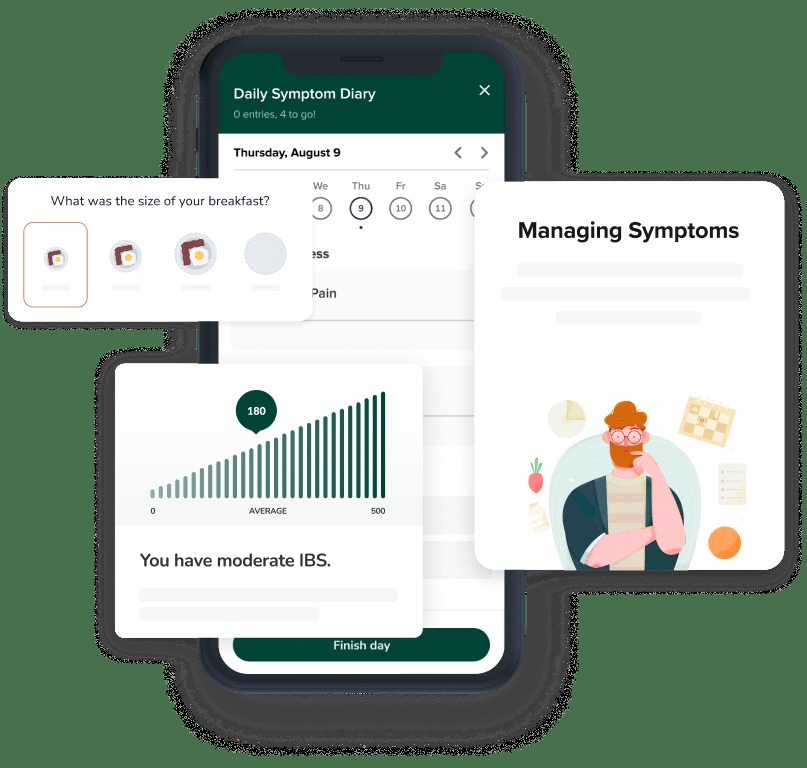
The product was a course, not a tap
Mahana IBS delivered ten sessions over a 90-day prescription. People worked through lessons, practiced CBT skills outside the app, and could track symptoms in a diary. The intended customer was an adult with diagnosed IBS who wanted another way to manage pain, bloating and unpredictable bowel habits, particularly when access to a GI psychologist was limited. The app could sit alongside ordinary medical care; it was never a substitute for establishing the diagnosis.
A published Mahana provider page listed the price at $199 for the 90 days, with HSA and FSA eligibility. It described that as far below the cost of equivalent in-person therapy. This was the business model in miniature: clinician referral, a paid digital treatment, and a promise of wider access to a scarce kind of expertise. Mahana also sought larger distribution channels. It joined the DigitalHealth.London accelerator in 2022 to work toward NHS adoption and signed a multi-million-dollar marketing and distribution agreement with Bayer Consumer Health in 2023.
The 2021 Series B, led by JAZZ Venture Partners and Gurnet Point Capital, gave Mahana $61 million to launch the IBS app and pursue other chronic conditions. The company announced $81 million raised in total at that point. Money could pay for the machinery of a regulated product: engineering, clinical work, compliance, sales, and the patient support that sits between a prescription and actual use. It could not do the exercises on a patient’s behalf.
The number behind the nice idea
A 2024 real-world study looked at 843 people whose Mahana IBS prescriptions had been dispensed between August 2021 and August 2023. Of them, 324 reached at least session five. Just 162 finished all ten. The researchers reported improvements in IBS symptom severity among users, but the completion figures are the number a product builder should pin above a desk. Availability and use are separate achievements.
The study also helps explain why this is not a simple tale of an app that “failed.” Among people who did use it, symptom outcomes were promising. But self-guided treatment asks people who are already managing a chronic condition to keep doing homework for weeks. In the older ACTIB trial, therapist contact was part of the web program, and researchers explicitly called that support important. Mahana made access easier; sustained attention remained a problem to solve.
There were other limits. The ACTIB participants had refractory IBS and received support that app customers did not necessarily receive. The real-world Mahana study lacked a randomized comparison group, so it cannot prove the app alone caused each reported improvement. Its sample was people with dispensed prescriptions, not everyone who heard about the product. These are ordinary distinctions in medicine and unusually useful ones in evaluating software that advertises therapeutic results.
A second life for the lessons
In May 2025, Nerva announced that it had acquired key assets from Mahana’s IBS program: an enhanced, non-FDA-cleared version of its CBT content, the brand, and supporting materials. That description is precise. The old FDA-cleared prescription product and the later assets should not be treated as one regulatory object. Nerva, best known for an app-based gut-directed hypnotherapy program, said it would explore adding Mahana’s CBT elements to its existing offering and directed former Mahana referrers to Nerva.
The pairing is logical in a market where the alternative is often a long wait for a specialist, a complicated diet, medication, or another digital therapy. Mahana’s particular expertise was the structured, research-linked CBT course. Nerva brought a different behavioral method and an established consumer channel. Whether their combination improves completion or outcomes is a question for future evidence, not a fact established by the transaction.
For people with IBS, the practical idea is modest and useful: brain-gut therapy can be one part of care, and a phone can deliver some of its exercises. For anyone building in health, Mahana’s sequence is more instructive than a tidy triumph story. Find a treatment worth translating. Keep the evidence attached to the exact product tested. Measure what people actually finish. And remember that a prescription opens the door only once; the patient has to walk through it ten times.