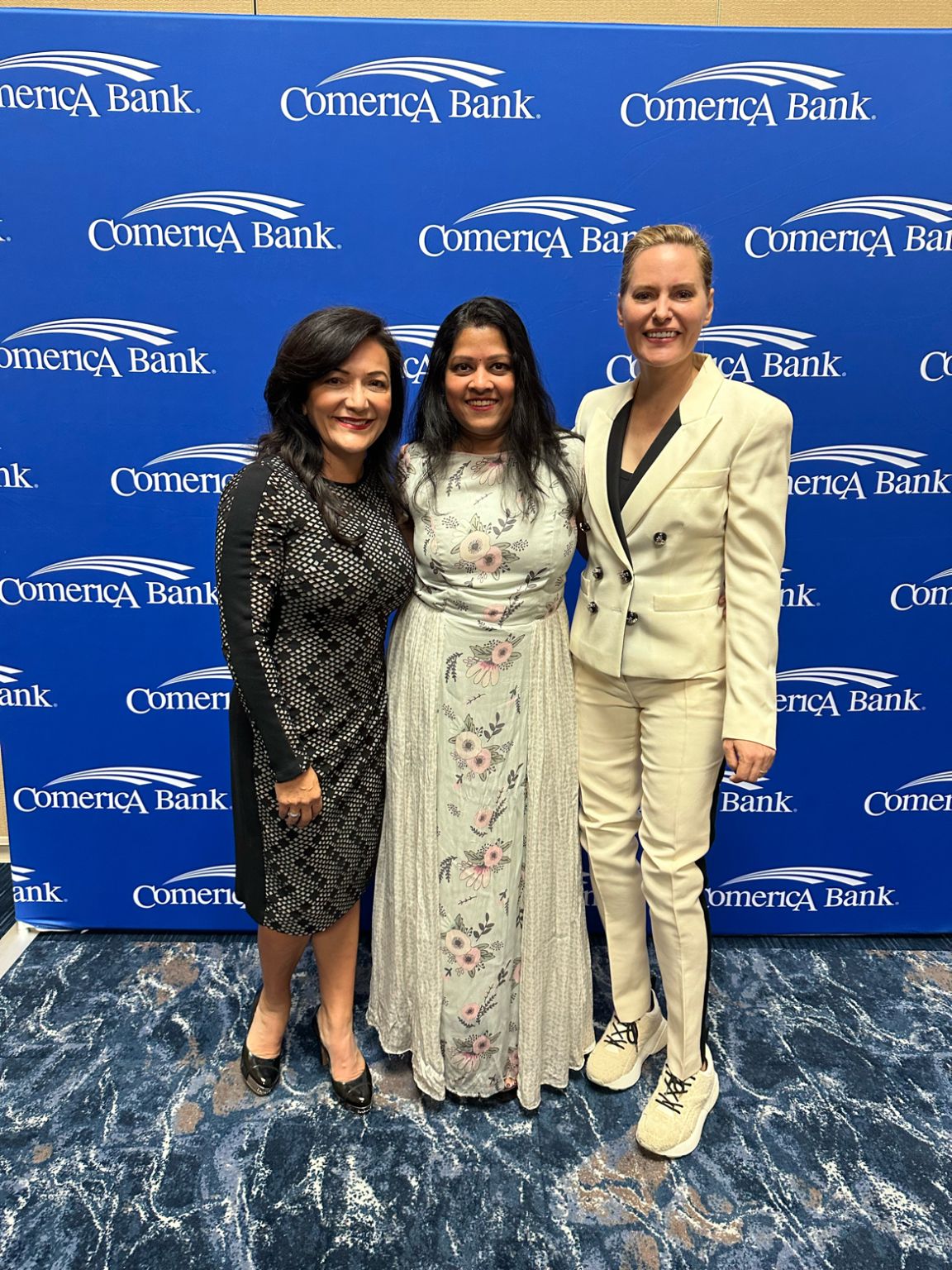
Maha Manickam had been running her own company for eighteen years when she met someone she admired. At Comerica’s women’s conference in October 2022, she posed with Nina Vaca and Aimee Mullins against a blue bank-branded backdrop. Manickam stood in the middle, smiling. Later, she called Vaca “my idol.” Even a founder with nearly two decades behind her could still have a fan moment.
Vaca’s reply supplied the pleasing turn. She acknowledged Manickam’s eighteen years of founding and leading Themesoft. Admiration had travelled across the room and come back. The photograph catches three people; the exchange catches something less visible, a working life long enough to earn respect from someone whose respect matters to you.
It is a useful opening for Manickam’s story. The founder, CEO and president of Themesoft operates in a business where introductions can become assignments, and assignments depend on people doing what they promised. An anniversary gives that work a date. A conference gives it a photograph. Most of it happens between the occasions.
August 2004, and the work between milestones
Manickam founded Themesoft in August 2004. Based in Plano, Texas, she has kept the titles of founder, CEO and president as the business has continued. Those three words cover different stretches of time: starting the enterprise, making decisions for it, and remaining answerable for what it does.
Her company works in technology consulting and workforce solutions. These are practical trades. A business may know that it needs a software project completed while still needing help deciding whom to hire, which skills to secure, and how to organize delivery. Themesoft sells services around those needs.
Its workforce offering separates contingent assignments from permanent hires. A project with an end date presents one sort of problem. A role inside a client’s continuing organization presents another. The company offers screened professionals for temporary needs and support for hiring people into full-time positions.
That distinction gives the founder’s job its everyday stakes. To a customer, a vacancy may look like an obstacle on a project plan. To an applicant, the same vacancy can be the next chapter of a career. A staffing business sits between those two perspectives. The paperwork is rarely romantic; the consequences can be quite personal.
- 2004Founded in August
- 2019Supplier recognition
- 2021Another supplier award
- 2024Twenty-year anniversary
A seat at the supplier table
By 2019, Themesoft was helping support the gatherings where businesses meet potential buyers. At the Dallas/Fort Worth Minority Supplier Development Council’s ACCESS event, it appeared as a luncheon sponsor, with Manickam identified as president and CEO. Its description covered artificial intelligence, cloud services, data science and blockchain work.
The council’s purpose was commercial: connecting buying organizations with certified minority-owned suppliers. Sponsoring lunch sounds modest beside the language of digital innovation. Yet a meal gives people time to talk. The person across the table may understand a buying process, need a service, or know somebody who does. Business development has never entirely escaped the seating plan.
Themesoft also lists certifications connected to that identity: women’s business enterprise recognition through WBENC, minority business enterprise certification through the National Minority Supplier Development Council, Texas HUB certification, and certification from the Canadian Aboriginal and Minority Supplier Council. These designations concern the business and its eligibility within supplier programs. For Manickam, they place the company in a formal purchasing environment as well as a social network.
A buyer still has an assignment to fill and a supplier still has to deliver. The introduction starts a conversation about capability, availability and fit. That gives the gatherings their practical purpose: a company can explain what it offers to someone with a reason to listen. The meeting has somewhere to go after lunch.
In November that year, Manickam celebrated a Supplier of the Year award by praising the Themesoft team. A subsequent gala letter confirmed the recognition as the DFW MSDC Supplier of the Year - Class IV award for 2019. In November 2021, she announced another supplier-of-the-year win from the council.
The announcements have a recognizably enthusiastic register: capitals, exclamation marks, thanks. The 2019 post included an employee-first hashtag. There is no need to turn punctuation into a personality test. The narrower observation is enough: when she announced recognition, she made room for the people working alongside her.
The obligations behind the introductions
The company’s history also contains a less celebratory hiring episode. In April 2018, Themesoft reached a settlement with the U.S. Justice Department following an investigation into its treatment of a work-authorized applicant. The department found citizenship-status discrimination and improper demands for specific immigration documents involving an asylee.
The agreement required a $4,543.25 civil penalty, compliance with an agreement to pay the worker $12,000 in back pay, staff training, and monitoring and reporting. The department also said Themesoft had offered the worker a job during the investigation. These were findings and obligations involving the company; they do not establish personal misconduct by Manickam.
The episode belongs in a story about a founder whose business helps determine access to work. Referring a candidate is an ordinary administrative action with a real person on the other side. A company’s statements about inclusion have to survive that encounter, where a rule, a document request, or a recruiter’s decision can change an applicant’s prospects.
Keeping expertise in the building
In a welcome letter for the council’s 2020 E Awards Gala, Manickam described Themesoft as the event’s MBE Signature Sponsor. She also set out how she wanted the business to treat its people. Her account emphasized developing talent, rewarding performance, providing opportunities inside the organization, and encouraging colleagues to support one another.
“Our approach to people and talent development is what defines us.”
Maha Manickam · 2020 gala welcome letter
It was a statement of intended practice, with a commercial argument attached: expertise mattered to customers, so retaining experienced people mattered to the company. An employer can recruit for an opening; keeping knowledge inside the business requires a longer relationship. For a consulting firm, somebody leaving may take a useful understanding of a customer’s work along with them.
There is a reason the word “development” earns its place here. The work of a technology consultant changes as tools and assignments change. Giving someone room to grow can serve both the employee’s ambitions and the next customer’s requirements. Manickam’s letter tied those interests together rather than treating staff development as a ceremonial extra.
She closed by encouraging support for minority businesses and thanking the people who organized the evening. It was a sponsor’s welcome, certainly. It also placed her company within a network whose continued usefulness depended on other members participating.
The distance between a plan and a working system
Themesoft’s current offer makes clear how much territory that expertise can cover. Software consulting includes understanding requirements, designing architecture, advising on languages and databases, and helping manage projects. These tasks begin before anyone can sensibly declare that the coding is finished. They ask what the software must do, how it should fit together, and how a team will know whether the work is progressing.
Cloud services bring another set of assignments: moving applications, data and infrastructure, using software-as-a-service products, and handling security and administration. The attractive promise is a more useful computing environment. The working reality involves deciding what moves, what connects, and who will maintain it afterward. Somewhere beneath every elegant diagram is a list of responsibilities.
Permanent hiring
Cloud & data services
Cybersecurity
A map of Themesoft’s published services, without implying a fixed delivery sequence.
Quality engineering covers the checks that make software usable: functional testing, automation, and performance testing. A feature can look finished in a demonstration and still need scrutiny across browsers, devices and operating conditions. Testing gives a team evidence before the customer supplies it, occasionally with less polite language.
Cybersecurity adds work around networks, information and applications. Together, these offerings explain why a people business can also be a technology business. The product of the engagement may be a working system, but the route to it includes judgment, coordination and expertise. Those qualities belong to people before they appear in a proposal.
The company now describes offices in the United States, Canada, India, Sri Lanka and Brazil. That footprint puts Manickam’s Texas base within an international operation. Geography extends the reach of a services firm while adding the practical work of coordinating across locations. Five countries make an appealing line on a page; delivering across them requires actual arrangements.
Another twenty, please
On August 5, 2024, Manickam marked Themesoft’s twentieth anniversary. Her message thanked the people who had supported the company along the way. Its forward-looking wish was brief: “Here’s to another 20 years!” The ambition was continuation, expressed with the understandable enthusiasm of somebody whose business had reached a significant birthday.
A founding date can make twenty years seem like a straight line. A working company spends those years handling individual situations: a hiring need, a customer requirement, an employee’s next opportunity. The public milestones interrupt that flow just long enough for someone to take a photograph or write a message.
Return to the conference picture. Manickam had arrived with eighteen years of her own work behind her and still wanted to meet a person she admired. Vaca recognized the work. Two years later, the anniversary message widened the circle again, acknowledging others who had made the company’s progress possible.
That is a fitting way to leave her: still running the business she founded, still willing to express admiration, still asking for more years. There will be plenty to put on the next agenda. With luck, there will also be a little time left for lunch.