The most revealing thing about VIVA USA’s supplier software is that it comes with people who make phone calls. The platform collects records, tracks spending and organizes reports. Then a concierge team can contact the suppliers who have yet to send anything. Somewhere between a beautifully configured portal and a usable quarterly report sits a person who has been meaning to get back to you.
That small detail helps explain a company whose service menu initially looks like several businesses sharing a filing cabinet. VIVA recruits workers. It builds applications. It sells supplier-management software. Across those activities, it deals with a familiar enterprise problem: important work becomes slow when information, people and responsibility do not arrive in the same place.
- Hire the people: contract, contract-to-hire and permanent staffing.
- Build the system: custom software, cloud work and workflow portals.
- Organize the suppliers: STARS software plus reporting and outreach support.
Before the software, a business that was hard to run
Vasanthi Ilangovan grew up in India around family businesses, including leather, import-export and farming. Entrepreneurship was familiar; a woman having an equal place in it was another matter. After receiving a U.S. work permit, she started an import-export venture of her own. With her husband working elsewhere and two young children, running it alone proved difficult.
In a 2015 interview with Minority Business Entrepreneur, she described seeing an opening in IT. VIVA began in 1996 with Ilango Radhakrishnan. The early machinery was decidedly human: friends helped, and she attended networking events, workshops and seminars. As business increased, she brought her husband into the operation and hired a senior employee.

The lesson is more practical than the usual founder mythology. A business can be attractive in principle and awkward in daily life. Ilangovan changed the kind of work she pursued, then learned through relationships and participation. VIVA’s present-day assortment of services has that same practical flavor: follow a customer’s operational needs into the next piece of work.
“I wanted to prove that I could have my own successful company and wanted to help our community.”Vasanthi Ilangovan · 2015 interview
The supplier behind the supplier
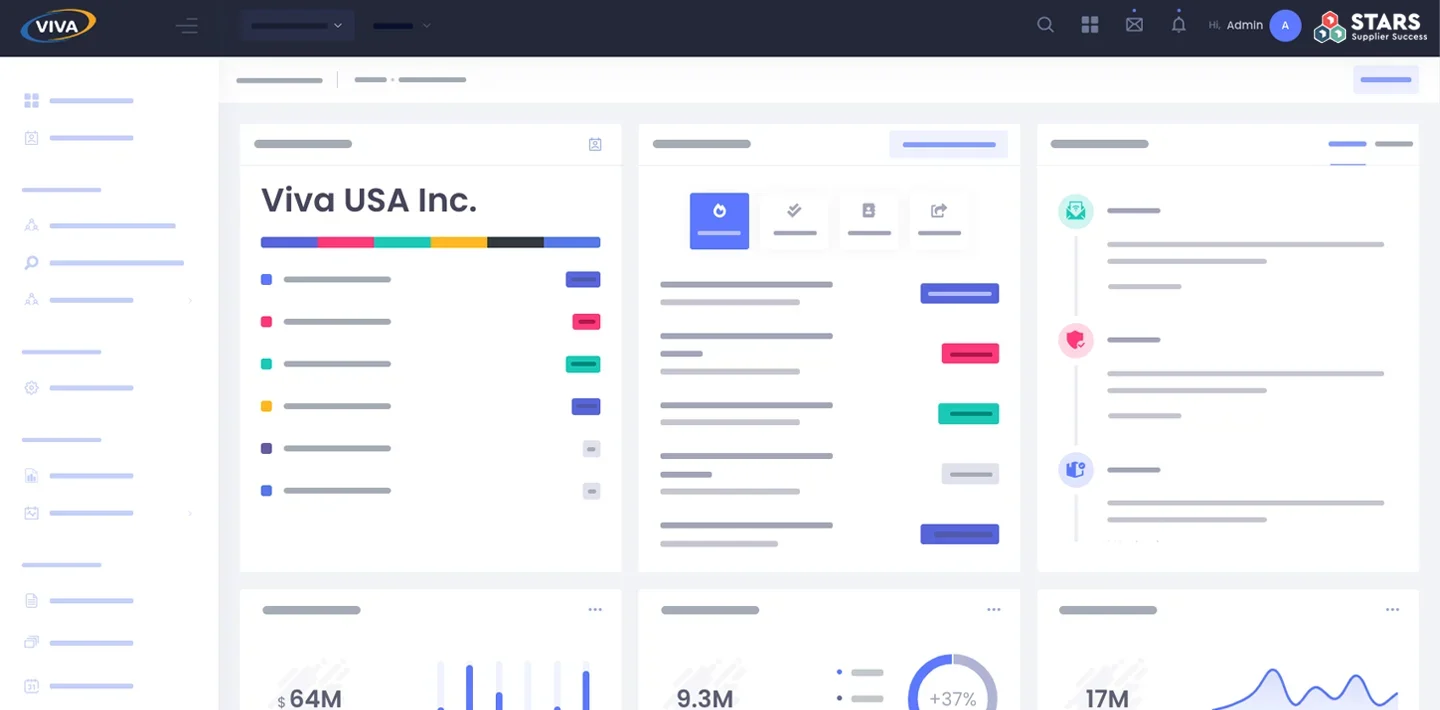
STARS, short for Supplier Tracking and Reporting System, makes the company’s software business concrete. A procurement team can use it to register suppliers, maintain their profiles, clean records, examine spending and manage reporting. Instead of treating every buyer as identical, VIVA offers branded portals and workflows configured around the customer’s processes.
The distinction between Tier 1 and Tier 2 spending explains why this matters. Tier 1 concerns purchases from a company’s direct suppliers. Tier 2 concerns spending those suppliers report further along the supply chain. The first can be visible in the buyer’s own purchasing records. The second requires information from somebody else.
Direct spend is in your records. Indirect spend needs a supplier’s submission.
That is where VIVA’s concierge service becomes interesting. Its advertised work includes reminders by email and phone, deadline tracking, contact updates, registration assistance and report preparation. A workflow can issue a reminder automatically. A service team can work on the reasons the reminder went unanswered.
For supplier-diversity programs, correct records also determine what a report means. Duplicate entries, missing information and outdated certifications can spoil a tidy dashboard. STARS offers cleansing, enrichment and validation, with reporting layered on top. The sequence matters: collecting more data is useful only if the resulting categories and records can be trusted.
Buy a developer, or buy the development
VIVA’s staffing business supplies technology talent for software, cloud, cybersecurity and data roles. Engagements include contingent assignments, contract-to-hire and permanent placement. The company also describes managed staffing programs that coordinate suppliers and work within vendor-management systems. For a hiring manager, the purchase is access to people; the organization still needs to decide how their work will be directed.
Software project consulting is a different transaction. Here VIVA offers discovery, architecture, development, testing, deployment and continuing support. Its published technical scope includes application maintenance, cloud migration, ERP integration and business intelligence. SAP, Oracle and Microsoft Dynamics appear as technologies it works with, while AWS, Azure and Google Cloud appear in its migration offering.
A buyer choosing between these services should ask where responsibility sits. A contractor can join an existing team with a clear manager and backlog. A consulting engagement can assign delivery against an agreed scope. Buying the wrong arrangement leaves an expensive gap between the person doing the work and the person accountable for the result.
The market between a template and a blank sheet
VIVA also develops custom workflow portals using a proprietary low-code framework. Reusable modules can support functions such as document management, recruitment and reporting. Its portal offering includes permissions, audit trails and connections to existing business systems. The proposition is appealing when a standard application requires too many workarounds but writing everything from scratch would consume too much effort.
This places VIVA among several sets of alternatives. A buyer can hire another staffing firm, build with an internal engineering team or commission another consultancy. In supplier management, broader platforms such as SAP Ariba, Coupa and JAGGAER are part of the buying landscape. Some can also be systems STARS connects to. The market is less a neat tournament than a question of which tools and people should perform each task.
VIVA’s differentiator is the combination: configurable supplier software, implementation expertise and operational support alongside staffing. Its website publishes customer testimonials attributed to Northwestern Mutual, Kaiser Permanente, Gilead and AMC Networks. Separately, terms for Robert Half’s supplier site identify VIVA as its manager and host. That is a specific example of the customer-facing portal model.
The price is a conversation about responsibility
VIVA describes staffing prices as dependent on the role, location, contract type and market. For software consulting, it offers time-and-materials, fixed-price and outcome-based engagements. STARS advertises fixed pricing, selectable modules and unlimited users. These are different ways of allocating cost and risk, and a buyer should compare them against the work being purchased.
Unlimited users is a meaningful design choice for a supplier portal: participation extends beyond the buyer’s own employees. Still, software cost is only one item in an implementation. Someone must prepare data, agree on definitions, connect systems and train participants. A sensible evaluation includes those responsibilities in the scope, rather than discovering them after the demonstration has ended.
Public-sector work provides another view of the business. An executed Florida agreement names VIVA for IT staff augmentation under a state term contract scheduled to expire in September 2027. The contract incorporates a price sheet, résumé certification and performance-survey documents. In this market, the administrative detail belongs to the product being bought.
A small experiment beats a large promise
There is a useful practice to borrow from VIVA’s own procurement guidance: pilot before scaling. Pick one difficult role, one supplier file or one approval chain. Establish what is currently slow, who owns the decision and what a better result would look like. Measure time-to-fill, record completeness or approval time, as appropriate. Give the test a boundary.
Custom software makes the strongest case when the workflow has specific rules, meaningful integrations and enough repetition to justify development. A simple, occasional task may be served perfectly well by an existing tool. Supplier reporting also depends on participation: a portal cannot manufacture spending information that a prime supplier never submits. Human follow-up helps, but ownership and clear requirements remain necessary.
The technologist takes the chair
VIVA entered 2026 with a leadership change. Vinu Ilangovan became CEO on January 1, following more than a decade at the company and a period as CTO. Vasanthi Ilangovan moved to chairwoman. The announcement emphasized continued technology development and workforce solutions, and stated that the transition would preserve the company’s woman- and minority-owned certification status.
The business now operates across U.S. teams and delivery centers in Chennai, Coimbatore and Bengaluru. Its breadth will matter to a buyer only when it makes a particular job easier. The most persuasive way to understand VIVA is to look at the unfinished work: the role nobody has filled, the application nobody has connected, the supplier report nobody has returned. Those missing pieces have a budget attached.