In 2003, Maggie Gu arrived in Africa as a diplomat and encountered a problem of scale. The continent's promise was easy to praise from a conference room. Turning that promise into locally useful institutions was slower, less glamorous, and much harder. Gu had spent the opening stretch of her career around the United Nations, international mediation, and strategic questions for multinational groups. She understood the language of cooperation. In Africa, she began asking whether fluency in that language was enough.
She has described that first journey as the turn in the road. Gu believed more varied economic and political partnerships could be good for African development, but she no longer wanted to remain merely an observer or intermediary. She wanted to put her network and energy behind work that made sense on the ground. Diplomacy had taught her how institutions speak to one another. The next chapter would ask whether they could listen.
The shift did not happen with cinematic haste. Gu accumulated more than two decades across international affairs, public institutions, mediation, and impact investment. Her education is almost comically interdisciplinary: a professional medical degree, a master's in communication and public relations from Peking University, an MBA in global management from Thunderbird, and graduate study in international relations and economics in Geneva. She is also proficient in ancient Chinese. When your résumé contains both medicine and ancient Chinese, “multidisciplinary” begins to feel a little underdressed.
The turnA foundation built from a diplomatic question
In 2017, Gu founded Tomorrow Foundation in Geneva. The Swiss nonprofit began with a broad but coherent brief: education, digital inclusion, entrepreneurship, and international cooperation across Africa and the Middle East. The work was less about arriving with a finished solution than helping people acquire the tools, relationships, and authority to shape one themselves.
That distinction became the house philosophy. Gu speaks of empowerment rather than assistance. She wants young people to think critically, create, lead, and choose a path rather than inherit one. It is an unfashionably patient proposition. A ribbon can be cut in an afternoon. Capability takes years, and it has an annoying habit of demanding local teachers, trusted partners, repeat visits, and budgets after the photographers have gone home.
First visit to Africa as a diplomat, later described by Gu as the turning point in her career.
Tomorrow Foundation is established in Geneva.
Gu joins JA Africa's Board Digital Innovation Committee.
Her Startup launches to support women leading tech-enabled businesses.
AI for All and an expanded Nigerian partnership put agency at the center of the agenda.
The foundation's partnerships show how Gu works. Tomorrow Foundation became a founding supporter of JA Côte d'Ivoire. In 2021, she joined JA Africa's digital innovation committee alongside figures from technology, mobile communications, and investment. The committee was charged with helping JA Africa expand digital learning, strengthen its internal systems, and reach more young people. A year later came JA DEEP, a digital entrepreneurship education program for francophone Africa.
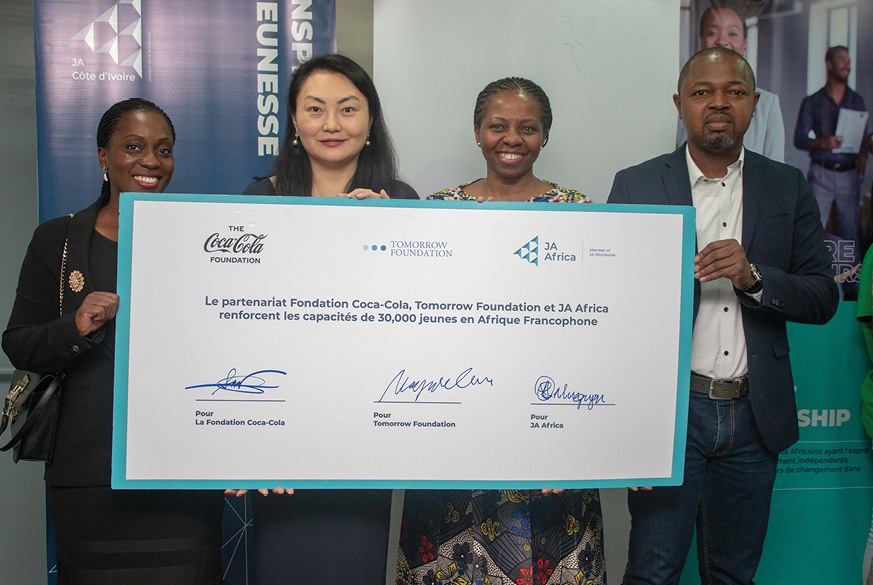
The photograph from that launch supplies a useful corrective to the airy language development work can attract. Four people hold an enormous signed board. The board promises training for 30,000 young people. Everybody is smiling, as one does when the agreement is fresh and the verbs are still in the future tense. The real story starts the next morning, when a partnership must become a timetable, a classroom, and eventually a result.
Teach for the next change, not the last one
By 2026, Gu's vocabulary had sharpened around artificial intelligence. Her argument begins with two clocks. Education ministries revise policy in cycles of years. AI development moves in cycles of months. A curriculum can be carefully debated, approved, funded, and rendered quaint before the ink has dried. Blaming civil servants misses the mechanics of the failure. The institutions were designed for a slower machine.
Gu therefore treats learning less as a prelude to working life and more as a permanent condition of it. A fixed credential records what somebody once completed. She is interested in systems that recognize capability demonstrated over time and through actual projects. Her phrase, “Skills depreciate rapidly. Agency compounds,” carries the whole theory in six words. Skills remain useful, but the ability to learn, judge, adapt, and act grows more valuable as technical fashions expire.
This is where access, the favorite noun of well-meaning technology programs, becomes insufficient. A person may gain access to a tool without gaining any say over how it is built, trained, governed, or used. Gu's call for AI sovereignty is an argument for moving young people from the audience to the workshop. She wants emerging markets to produce builders and decision-makers, not merely a tidy new population of users.
Reliable access to the computing and systems that make participation possible.
Continuous learning that favors problem-solving, judgment, and creation over memorization.
Language, culture, and intellectual creation treated as economic and strategic assets.
Her AI for All framework gives that ambition three rooms: infrastructure, education, and creative industries. The last is the surprise. Gu argues that culture and storytelling should sit inside an AI strategy, not decorate it later. Human teachers, mentors, and cultural experts must test context, ethics, and meaning. Languages, rituals, philosophies, and discoveries should remain living knowledge. An AI future without cultural memory may be efficient, but it will have the charm of an airport corridor.
From theory to roomsRedesigning who gets through the door
Her Startup turns another of Gu's diagnoses into program design. Women founders often face thinner access to funding, mentors, and professional networks. Those networks need not post a “closed” sign to exclude. Their habits of trust-building, availability, and social connection may simply have been formed around lives unlike those of many women, especially people carrying family responsibilities.
The four-month accelerator, delivered with partners including Founder Institute, combines training, mentorship, seed financing, and routes to later capital. At the 2025 pitch stage in Lagos, six of nine participants reached the final investment round. Three received convertible financing: founders working on assistive technology, bookkeeping tools, and a digital operating system for legal services. The businesses differed. The intervention was consistent: strengthen capability and connections before pretending a cheque can cure an ecosystem.
Gu applies the same order to entrepreneurship more broadly: capability before capital. Mentorship, market access, and a functioning support system come first; money works as a catalyst rather than an ambulance. This challenges the convenient story that failed young businesses prove a shortage of talent or grit. Where formal labor markets cannot absorb new workers, entrepreneurship may be less a heroic choice than the only unlocked door. Failure can be designed into the surroundings long before a founder writes a pitch deck.
The 100 Million Learners initiative extends the education side of that logic. Built with Thunderbird School of Global Management and Arizona State University, the platform offers self-paced courses in entrepreneurship, innovation, and leadership in as many as 40 languages. In July 2026, Tomorrow Foundation signed a three-year agreement to expand the program in Nigeria, where it would recruit learners and build relationships with government agencies, universities, and youth organizations.
Scale appears in the program's name, almost impudently, but Gu's public language keeps returning to confidence and authorship. In announcing the Nigerian expansion, she said young people should not merely gain entry to the future economy; they should have the competence and confidence to shape it. Numbers can tell you how many people clicked through a course. They are less good at measuring the moment someone stops waiting for permission.
The long translationDiplomacy, with deliverables
Gu never entirely left diplomacy. She translated its useful parts into another setting: coalition-building, cultural fluency, and the patient alignment of institutions with different motives. Tomorrow Foundation's work links schools, nonprofits, public agencies, investors, and companies across borders. The alliance is the instrument. The young founder, learner, or builder is supposed to remain the point.
There is an obvious tension in any Geneva-based foundation working across Africa and the Middle East. Who defines the need? Who holds the authority? Who remains when the visiting delegation leaves? Gu's own answer is embedded in her preferred words: local capability, co-creation, sovereignty, agency. Those are promises that deserve to be tested against each program. They are also more demanding than the older development habit of counting what was delivered.
That line connects the diplomat who arrived in Africa in 2003 with the foundation chair talking about AI in 2026. The technologies changed. The argument did not. Diversified partnerships matter because dependence narrows choice. Education matters because choice without capability is theater. Entrepreneurship matters because talent needs routes into markets. Culture matters because a future people cannot recognize as their own is merely an upgrade imposed from elsewhere.
Gu's ambition is not modest, but its clearest unit is small: a person who can keep learning after the course ends, a founder whose network continues after demo day, a community able to govern a system rather than petition its owner. Institutions adore a finish line. Gu is building around continuation.
The future, in her telling, is not a train one either boards or misses. It is closer to a room under construction, crowded with competing blueprints. Access gets you through the door. A skill may put a tool in your hand. Agency lets you decide what the room is for.