There is a moment in the life of a growing organization when its marketing becomes a junk drawer. The logo lives with a designer. The website password belongs to a developer. Someone in accounting remembers the radio contract. A volunteer has the event photographs. The social calendar sits in a spreadsheet that no one has opened since Tuesday. Each piece may be perfectly competent. The trouble is that the pieces have never met.
MadCap Marketing + Creative has built its business around that moment. The Washington agency does not merely offer a long list of creative services, though the list is impressively long. It offers to become the connective tissue. Its own phrase is that it works as an “extension” of the client. Translated from agency language, that means the client can hand one team the media budget, the web build, the headshots, the launch event, the campaign copy, and the monthly report - and expect those things to recognize one another.
A media buyer notices the missing job
Stephanie Schramm came from the media business. That detail matters because media buyers see marketing after the beautiful mood board has left the room. They see budgets, placements, run dates, audience choices, and the awkward question of whether anyone measured what happened. Schramm started the company in 2011 and now leads it as CEO, managing client relationships and budgets as well as the daily operation.
Her public biography says she has spent more than two decades in the South Sound business community. MadCap grew around a collection of specialists: designers and copywriters, web developers and search experts, photographers and videographers, social coordinators, an event manager, and a data and quality-assurance role. The company lists 13 employees in business data supplied for this profile, while its own team page also names a group of contract specialists. Even Thor Escobarson, the resident dog, has a job title: Chief Barketing Officer.
We don’t design for brands. We design for people interacting with brands.MadCap book of services
The joke titles and bright geometric identity can make MadCap look loose. The operating premise is not. A customer encounters one organization, even when that organization has commissioned the work from five vendors. If the billboard promises one thing, the website suggests another, and the event feels like a third company entirely, the customer does not blame the vendor chart. The customer blames the brand.
One brief, six connected workstreams
The product is fewer handoffs
The range is almost comic when written down. MadCap can develop a brand name, write copy, design packaging, buy a podcast spot, build the website, manage its DNS, test the user experience, photograph the staff, record a voice-over, run the golf tournament, monitor the comments, and analyze the campaign. Most agencies narrow their specialty until it fits neatly into a sentence. MadCap has gone in the other direction.
That makes sense for its customers. The public portfolio reads like a cross-section of Washington's practical economy: King's Way Christian Schools, Pacific Mountain Workforce Development Council, WorkForce Snohomish, Visit Federal Way, Capital Injury Law, Fat Zach's Pizza, Suburban Opticians, and eliseo, a Tacoma retirement community. These are organizations with genuine marketing needs and finite internal bandwidth. They may need a campaign this quarter and an auction next quarter. Hiring a permanent specialist for each task would be extravagant. Managing a rotating cast of freelancers would create another job.

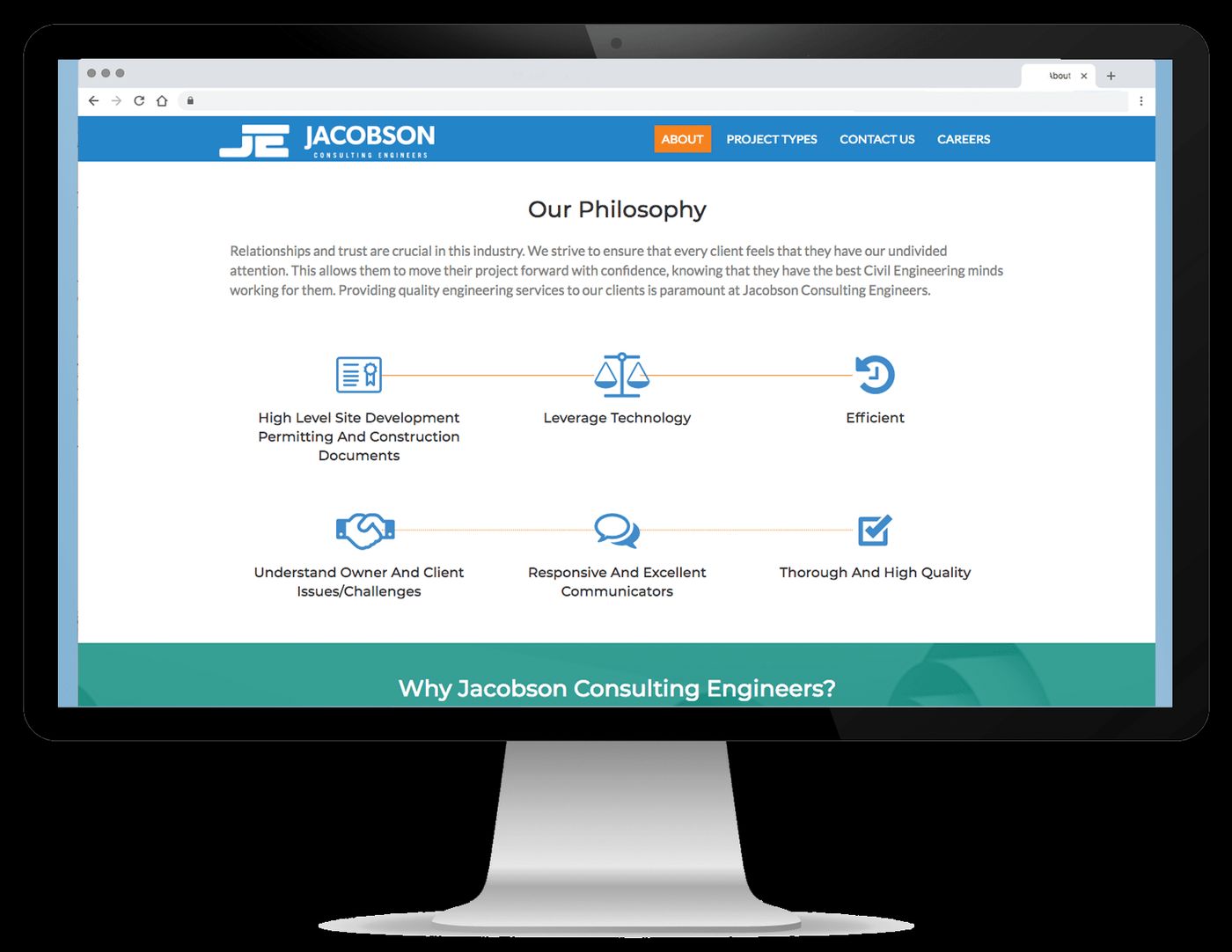
MadCap's detailed case study for Jacobson Consulting Engineers reveals the method underneath the menu. The first problem was not design. It was translation. Civil engineering is technical; prospective clients may not be. MadCap researched the industry and its competitive field, then worked with founder Alan Jacobson to find a position that was conventional enough to signal competence and distinct enough to be remembered. The identity was built around strength, stability, and balance. The same logic moved into the website, photography, business suite, social content, and video.
What failed first, in other words, was the assumption that technical expertise explains itself. It rarely does. MadCap did not ask engineering to become less technical. It built a bridge for people who did not speak the dialect. That move - first understand the customer's knowledge gap, then choose the creative treatment - is more useful than any particular shade of blue.
A regional advantage, with strings attached
MadCap's distinction is not that nobody else in Tacoma can design a website or place an ad. The market contains full-service firms, boutique studios, digital specialists, freelancers, and the option to hire internally. Its edge is the combination of local relationships, media-buying experience, and breadth. In 2024, a community vote placed it Silver for marketing agency and Bronze in both video production and web design. Three categories are more revealing than one: they match the integrated claim.
The model is strongest under particular conditions. The client has to share access to budgets, analytics, employees, and customers. It has to tolerate questions before deliverables. It must also value consistency more than the theoretically perfect specialist for every isolated task. A company with a mature in-house team may want a narrow expert instead. A startup seeking one logo at the lowest possible price may not need a department-shaped relationship. Integration pays when the work actually touches several channels.
The economics mix projects with ongoing management work: a site or identity can be a defined engagement, while social media, search, IT maintenance, and media buying naturally continue. The relevant comparison is not one agency invoice against one freelancer's invoice. It is the agency against the combined cost of specialists plus the person required to keep them aligned.
The four moves worth stealing
A reader does not need to hire an agency to copy the underlying sequence. MadCap describes a process that begins with business insight, continues through strategy and making, and ends with analysis. The useful part is the order. Too many organizations begin with the artifact - “we need a video” - before deciding what the customer should understand or do.
Review the business, audience, competitors, analytics, staff knowledge, and customer language before naming the deliverable.
Give every channel the same audience, promise, evidence, voice, budget, owner, and measurable action.
Create assets that recognize one another. A site, ad, event, photograph, and post should feel related without becoming identical.
Measure reach, engagement, clicks, placement performance, and customer response. Feed the result into the next brief.
There is nothing mystical here, which may be the point. The agency's own writing is playful - “social butterflies,” “creative alchemical cocktail,” a dog in the org chart - but its value proposition is administrative in the best sense. It promises that the campaign will have a center of gravity. The creative people and the budget people will sit close enough to argue. The photographer will know what the website needs. The event team will know the brand voice. The report will arrive after the ad buy, not as an afterthought.
Small organizations are often told to behave like big brands. MadCap offers a more believable arrangement: behave like a coordinated one. Looking fully staffed is useful. Thinking from the same brief is better.