The broadband customer has paid. The broadband customer still has no broadband. Somewhere between those two facts sits a spreadsheet, a service order and a person who will be back in the office on Monday. For WTC, a MACC customer, that was an ordinary weekend problem. Ordinary problems, repeated often enough, can become a business model for somebody else.
MACC lives in this territory. It sells the software and services that help telecom providers manage customers, produce bills, account for money and connect administrative decisions to network operations. The glamorous object is the fiber connection. The less photogenic question is whether the people running it have to type the same instruction twice.
- What it does: billing, customer management, accounting and network tools for communications providers.
- Who buys it: rural and regional broadband operators, telecom companies, ISPs and municipalities.
- Why it matters: connected records can remove the waits between payment, service and support.
- What to inspect: your actual workflows, integration requirements and the full conversion cost.
The weekend was the bottleneck
WTC’s story starts with non-payment disconnects. Its staff created individual service orders and tracked accounts in a shared spreadsheet. When money arrived, a customer service representative checked it, contacted operations and queued the reconnection. The system depended on people handing work to other people. Outside business hours, the handoff simply waited.
“In the manual process, if the customer paid over a weekend, they had to wait until Monday for us to restore services.”
Jeff Wick, CEO of WTC · MACC customer story
After nearly 20 years with MACC, WTC enabled automated provisioning. MACC’s published account describes a direct connection to WTC’s Calix system, with no middleware required. When a payment posts through a supported channel, the software generates the reconnect order and sends it to Calix. Wick says service is restored within minutes. A household need no longer wait for an office to open.
What failed first was the timing of the manual process. WTC could operate it, but it could not make a Saturday payment coincide with Monday staffing. At up to 100 disconnects a month, the repeated administrative work also accumulated. CFO Devin Weis described the automated approach as easier, with fewer steps and better accuracy. That is the attraction: remove a handoff people already dislike.
WTC’s reported estimate for a disconnect or reconnect. Small enough to overlook. Frequent enough to count.
The case study estimates roughly 280 staff hours saved annually. The arithmetic works if 100 monthly disconnects each have a corresponding reconnect: 200 transactions, times seven minutes, times 12 months. That is a reconstruction of the estimate, rather than a promise that every provider will recover seven working weeks. Count your own transactions before borrowing somebody else’s result.
posts
the order
service
After-hours operation depends on supported payment channels and a configured provisioning integration.
A bill has a surprisingly long journey
There is another MACC workflow that ends at the post office. In its published explanation of monthly billing, the company describes receiving a provider’s billing file, checking for toll data, processing the bills and, for customers using print notification, waiting for approval. Then come printing, bursting, folding, inserting and postage. The statements travel in USPS-approved trays to the post office in Blair.
The explanation allows five business days between transmission and handing bills to USPS. That buffer accommodates things software brochures seldom feature: a broken machine, a paper problem or an unexpected absence. It also describes printing for more than 300 companies. This is a software business with a physical production queue attached.
The practical lesson is wonderfully unromantic. Earlier transmission changes your place in the queue. Electronic delivery removes printing and postage from that route. MACC supplies both paper and digital options, along with payment processing, bill images and reporting. A provider can modernize the process while accommodating subscribers who still want an envelope.
The map, the ledger and the muddy boots
The interesting thing about MACC’s product range is how much of it concerns information adjacent to a bill. Accounting Master includes payroll, general ledger, inventory, materials management and stock dividends. Its published features accommodate Part 32 accounting requirements and patronage tax reporting. Those details help explain the appeal to telecom operators: the software remembers obligations a general-purpose package may require someone to configure separately.
MACCGIS connects another set of records. An AutoCAD plug-in links graphical objects to a database, while a browser viewer makes maps accessible beyond the drafting workstation. Its integration with Customer Master ties customer and plant information to addresses. Cables, conduits, splices, ports and dark fiber all appear in its tracking list. A map becomes more useful when it can tell you which customer record belongs to the connection.

MACC Mobile carries account details, tickets, schedules, inventory and time entry into the field. Technicians can close tickets without calling the office and record equipment as they install it. The app supports offline work and synchronizes after reconnection. Rural coverage is an operational constraint; a field tool earns its place by accommodating it.
The portfolio extends into network monitoring and voice services. MACC acquired NAMS and PhoenixSoft in 2023. NAMS Firefly provides visibility into call activity, usage and fraud patterns. PhoenixSoft supplies softswitch and cloud communications products. Together, these broaden MACC’s place in the market beyond subscriber billing, though a buyer still needs to check the integrations required for its particular deployment.
A browser is only the beginning
MACC now presents MACC | ONE as its browser-based billing and customer management platform, with live data, dashboards and AI tools. Its product page says provider feedback shaped the interface. It also makes a revealing migration claim: ONE covers 98% of the daily work performed in legacy Customer Master. The claim concerns tasks, rather than 98% of features.
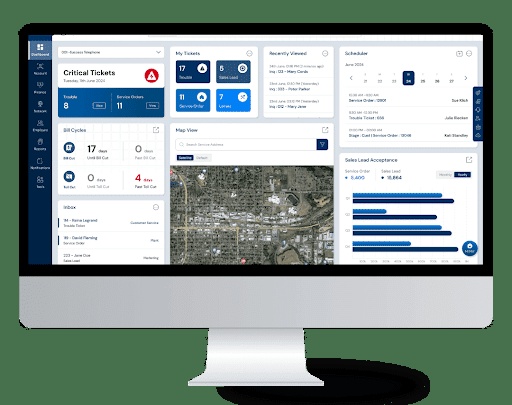
That distinction belongs in a purchasing conversation. A rarely used task can still determine whether month-end closes successfully. Ask staff to demonstrate an ordinary service change, a difficult billing correction and a busy reporting day. Then ask which tasks still require the older system. The remaining work matters more than an attractive percentage.
MACC also offers MSaaS, managed hosting of its billing and accounting software on Microsoft Azure. It handles infrastructure, backups and updates. The advertised absence of an upfront hardware purchase assumes an up-to-date network and Windows workstations. Hosting reduces some local responsibilities; the fit still depends on the buyer’s equipment and connectivity.
The commercial route is sales-led and tailored to the provider. A useful cost comparison includes software, conversion, hosting, integrations, training and ongoing bill production. Those categories are a buyer’s checklist, not a published MACC tariff. Savings depend on whether the deployment removes paid work, avoids trips or improves service enough to justify its total cost.
Forty percent fewer calls, with an asterisk
Varcomm supplies a different customer example. MACC’s public case-study page reports a 40% reduction in support calls after the rural operator adopted its digital toolkit. It describes LiveChat, chatbots and personalized customer videos, including English and Spanish explanations. The idea is to answer routine questions in a form customers can revisit.
That figure is a customer result published by the vendor. It does not establish what another operator will achieve. The copyable move is to identify recurring questions, improve the explanation and measure the subsequent call volume. A confusing bill needs a clearer explanation before it needs an especially charming chatbot.
There are alternatives in this market. Innovative Systems’ eLation and Communications Data Group’s MBS also serve telecom billing and operations, and both publish Calix integration material. Integration alone therefore does not settle the choice. MACC’s case rests on the combination of telecom-specific accounting, network tools, fulfillment and support. Which combination matters depends on the operator’s existing systems.
A long memory, and someone accountable
MACC marked 50 years in 2025 and joined Harris in 2022. Its current About page reports 200 employees, approximately 40% dedicated to customer support, and more than 600 customers globally. Separately, it reports more than 350 telecom billing customers. The two counts describe different scopes and should stay separate.
The careers page adds a human detail: systems analyst Bobbie Ruhs says her husband proposed over the office intercom. Both still worked there when the testimonial was published. An intercom proposal is an unusual retention statistic, but employee accounts of decades of service suggest why industry memory can matter when a customer has a peculiar billing question.
Memory alone cannot run the next version. In September 2026, MACC described forming an AI Governance Committee after experimentation spread across teams without consistent rules for tools, data protection or ownership. Its account asks who reviews an output, what happens when it is wrong and whether the tool helped. MIMiR, its integrated assistant, can help with questions, account information, notes and tickets; accountability remains a person’s responsibility.
For a prospective customer, start with the Saturday payment. Follow it through your operation. Write down each person who touches it, each record copied and each wait imposed by office hours. Then test whether the proposed system can finish the journey. Seven minutes is a modest prize. A customer who gets their connection back before Monday may see it differently.