For six hours, the money was imaginary and the decisions were consequential enough to practise. Founders negotiated investments, worked through due diligence, weighed valuations and picked their way through term sheets. M. Shameem Jawed led the exercise at IIMV FIELD, the startup incubator associated with the Indian Institute of Management Visakhapatnam. It was the closing simulation of a fundraising programme. A pitch was only the beginning.
There is a useful little reversal here. Entrepreneurship is often presented through the moment somebody says yes: an investor commits, a customer buys, a company launches. Jawed’s classroom gives attention to the work surrounding that moment. What must a founder understand before accepting an offer? What happens when an attractive valuation arrives with awkward conditions? A mock investment offers the luxury of finding out before the signature becomes expensive.
That exercise provides a way into his career. Jawed is a finance academic who helped establish an incubator, an operations director who teaches, and a programme builder whose classrooms have extended into district administration. The recurring subject is the decision: how to examine it, rehearse it and give more people the means to make it.
The course behind that exercise, Mastering Startup Fundraising: From Pitch to Deal Close, was advertised for April to June 2025. Its 30 hours combined 16 online sessions of 90 minutes with the six-hour campus simulation. The syllabus covered funding sources, investor expectations, business plans, pitch decks, negotiation and deal structure. The timetable made room for both explanation and application. A founder could encounter the vocabulary online, then have to use it while responding to somebody across a negotiating table. That is an exacting test of a lesson: can it survive a conversation in which the other person has interests of their own? Jawed’s role in the concluding exercise put the finance professor at precisely that point.
An engineer walks into finance
Jawed’s education began in mechanical engineering. He went on to complete the Fellow Programme in Management, equivalent to a PhD, in Finance and Accounting at IIM Indore. His working life includes more than five years as a consultant at SunGard, now FIS, across public-sector, finance, information and knowledge-management assignments. Before joining IIM Visakhapatnam, he was an assistant professor at MDI Murshidabad.
The combination places several professional languages in the same career: engineering, enterprise software, academic finance and entrepreneurship. At IIMV, where he is an associate professor, his teaching interests include corporate finance, valuation, governance, startup financing and financial analytics. These are subjects with a habit of interrupting a pleasing business story. Revenue needs a cost structure. Ownership needs rules. A confident projection still needs its assumptions checked.
His training also includes participant-centred learning and case teaching at Harvard Business School. The distinction matters in a classroom built around decisions. A case asks the learner to take a position; a simulation allows somebody else to challenge it. The six-hour negotiation exercise makes that teaching approach unusually tangible.
First, build somewhere to begin
In 2018, IIM Visakhapatnam began entrepreneurship activities through the Women Startup Program, in partnership with NSRCEL at IIM Bangalore. Jawed’s institutional responsibilities in entrepreneurship development date to that year. The venture-support operation was taking shape inside a young management institute, whose own operations had begun in 2015.
Recognition as a G3 centre under MeitY’s TIDE 2.0 programme followed in 2019. Incorporation as a Section 8 company came in 2020. Jawed became a director and chief operating officer in July of that year. His current board designation is Director (Operations), IIMV FIELD. The founding-director description reflects his role in creating the incubator, rather than founding one of the businesses it supports.
These dates describe an institution acquiring the machinery to keep helping people after an event ends. A workshop can fill an afternoon. Incubation involves selection, mentoring, administration, partners and continuity. The milestones suggest why operations belongs prominently in his title: somebody has to make the programme work when the opening ceremony is over.
A route for women with a business idea
The Women Startup Program gives this institutional history a more concrete shape. IIMV FIELD supported 25 women-led startups in 2018-19 and 20 in 2020-21. Jawed served as programme director. These are separate cohorts, each representing the practical business of helping an idea become something that can be tested, developed and offered to a customer.
The programme’s design moves from online learning to pre-incubation and then incubation for selected ventures. Its stated emphasis includes women in smaller cities, with access to entrepreneurial and managerial learning. IIMV FIELD works with NSRCEL to provide support for selected entrepreneurs from Andhra Pradesh and Telangana.
The sequence is worth lingering over. An idea does not have to arrive fully dressed as an investable company. There is an earlier place in the process for learning the language, making a prototype and discovering what needs to change. For an academic whose expertise includes valuation, this is an interesting stretch of the job: helping businesses take shape well before there is much to value.
The banker gets a speaking part
At Pragati Engineering College on 27 September 2021, Jawed delivered a lecture on funding support for early-stage entrepreneurship. The agenda included startup life cycles, the difference between a small business and a startup, and what incubators expect. He discussed examples of enterprises that succeeded and those that did not.
One detail stands out: the chances of obtaining a bank loan were considered from the banker’s perspective, including risk. It is a useful change of chair. The entrepreneur knows what the money could make possible. The person lending it has to consider what might prevent its return. Both parties can be sensible and still begin with different questions.
Seen alongside the later fundraising simulation, the lecture suggests a consistent teaching concern: understanding the other side of a transaction. Enthusiasm can bring a founder to the table. An appreciation of someone else’s constraints helps keep the conversation going. Even a very persuasive slide deck cannot do the banker’s arithmetic for them.
A mock investment offers the luxury of finding out before the signature becomes expensive.
On the logic of the fundraising classroom
Twenty-seven ventures, a more revealing scoreboard
By the graduation of the first Naaripreneur for Her cohort in March 2025, the women’s entrepreneurship work had another set of results to examine. The NBCC-supported programme selected 27 startups from 155 applicants. Over 15 months, it combined an ideation bootcamp, capacity-building sessions and incubation support. Jawed attended in his operations-director role.
At graduation, 23 of those 27 ventures were generating revenue. The cohort had collectively raised nearly ₹2 crore and created 158 direct jobs. These are programme-level outcomes, produced by the entrepreneurs and the people supporting them. They help put the incubator’s work in perspective without turning every business achievement into an individual director’s trophy.
On the graduation post, Jawed left a short public message: “Hearty congratulations to all the graduating entrepreneurs.” It is a modest sentence beside a collection of substantial numbers. Its attention is in the right place: on the people who have spent the previous months trying to make their businesses work.
The classroom goes to the district
Jawed’s programme-building work also includes the Mahatma Gandhi National Fellowship at IIMV. He led a project designed to train and support 76 fellows working with district collectors on skill development and entrepreneurship. Their field assignments covered Andhra Pradesh, Bihar and Arunachal Pradesh.
The two-year fellowship brought management learning into district-level public work. At the programme’s October 2023 graduation, Jawed, its chairperson, discussed the fellows’ work, initiatives and academic modules. An Arunachal Pradesh government representative praised their contribution and the cooperation they received from officials.
The setting changes the scale of the questions. In an incubator, support is organised around an entrepreneur and a venture. In a district, skill development has to engage with public administration and local employment. Jawed’s involvement in both puts a management teacher close to two different places where the word opportunity has to acquire practical meaning.
Finance, with the room included
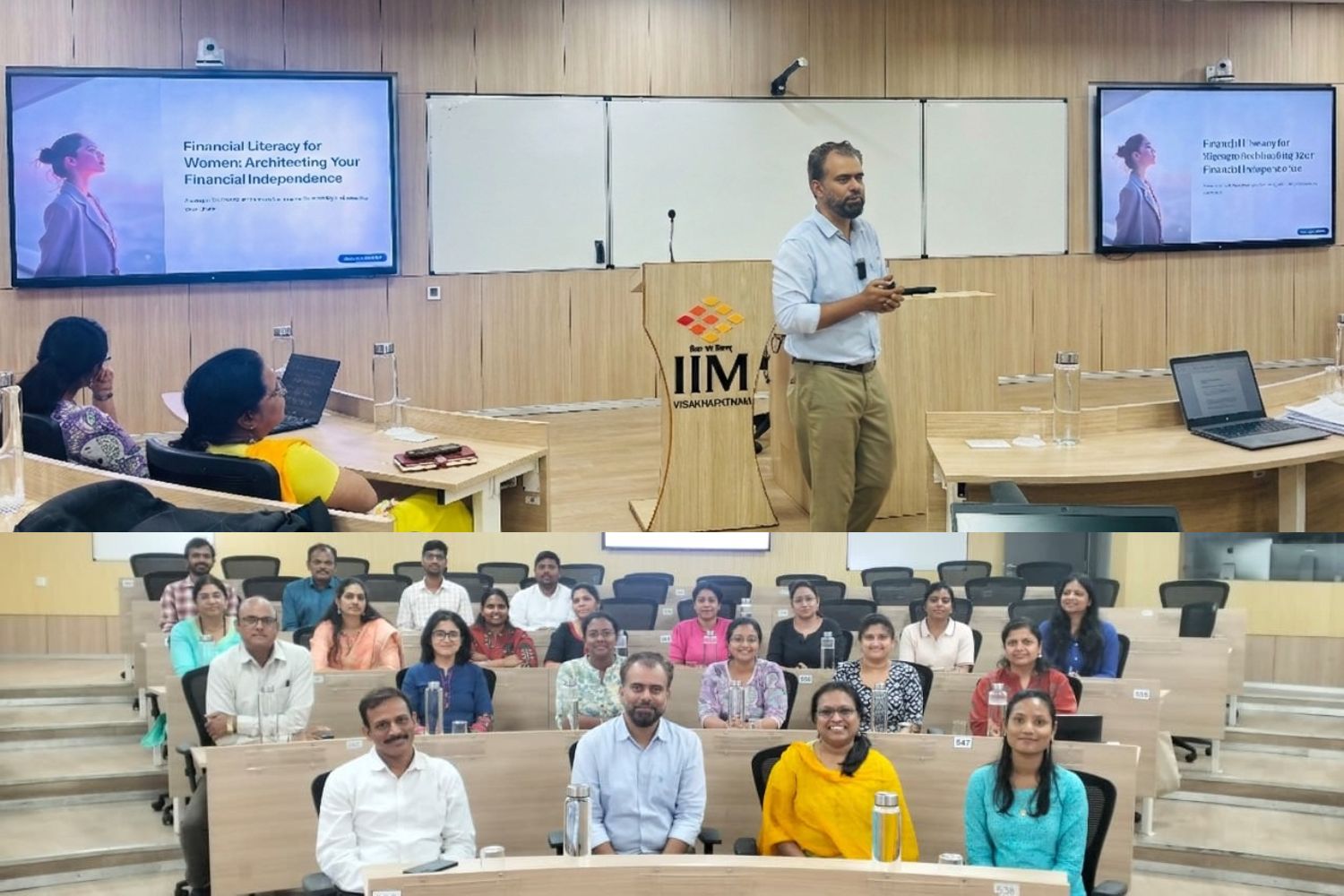
On 5 March 2026, ahead of International Women’s Day, Jawed delivered a financial-literacy session for women at IIM Visakhapatnam. Faculty and staff attended. The discussion addressed financial awareness, planning and informed choices, connecting money decisions to personal goals and financial independence.
The classroom photograph catches him standing between screens, with participants seated around the tables. The subject on the screen is financial independence. It is a quieter counterpart to the investment-negotiation exercise: finance taught for the decisions people face beyond a startup pitch. The audience changes; the need to understand consequences remains.
Experience still has homework
His 2026 teaching calendar also reached people already carrying considerable responsibility. A Canara Bank leadership initiative launched on 8 June brought together 37 Scale IV executives in its opening batch, with more than 100 executives intended across three batches. Jawed and Vijaya Marisetty led the programme. Topics included operational risk, governance, cybersecurity and banking data.
On 27 July, Jawed and Milan Kumar led a five-day mid-career programme for around 30 Indian Ordnance Factory Service officers, in partnership with the National Academy of Defence Production. Finance, operations and strategy shared the curriculum with geopolitical risk. Case discussions and simulations were again part of the learning.
From first ventures to experienced public-sector officers, his audiences occupy different points in their working lives. The connection is a willingness to put a decision back under examination. A title does not exempt anyone from the next difficult question. In Jawed’s corner of Visakhapatnam, even experience is expected to do its homework.