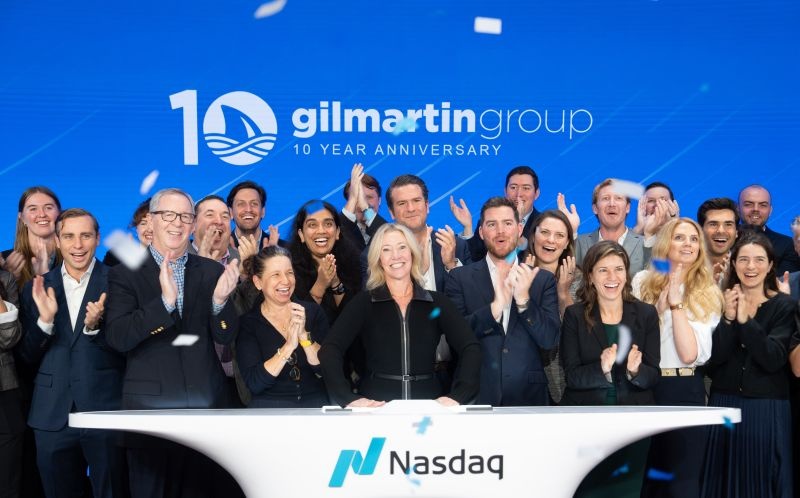
There is confetti in the photograph. Lynn Pieper Lewis stands at the center of a Gilmartin Group gathering at Nasdaq, smiling behind the bell podium while colleagues applaud around her. Behind them, a screen marks the firm's tenth anniversary. A business devoted to helping other companies communicate with investors has acquired a celebration of its own.
The occasion, in September 2026, offers a tidy anniversary picture: a founder, a team, a decade. It also supplies an unusually public setting for a profession whose daily work is often quieter. Investor relations involves preparation, repeated conversations and the patient business of explaining what a company intends to do. The camera catches the applause. Much of the job takes place before anyone is invited to clap.
Lewis founded Gilmartin in 2016 after working as an analyst, investor and adviser. Her career has placed her on different sides of the conversation between companies and capital. That sequence gives the anniversary a useful backstory. Long before she helped executives answer investors, she worked in businesses built around asking questions.
Learning to sit on both sides of the table
Her earlier roles included senior vice president in equity research at Adams & Harkness & Hill and partner at Thomas Weisel Partners. She subsequently became a founder and portfolio manager at Aphelion Capital, then a managing director at Westwicke Partners. Research, investing and consulting became successive chapters in the same professional life.
Those jobs come with different obligations. An analyst examines a business and explains an investment view. A portfolio manager has to decide what deserves capital. An adviser helps a management team understand the questions its business will face. Moving between them changes the immediate task, while keeping the company and its financial prospects in view.
Lewis's shift into strategic consulting came in 2008. The work encompassed investor relations, capital markets and financial and operating milestones. By the time she established Gilmartin eight years later, the change in perspective had already happened. Founding the firm gave that advisory career an organization of her own.
It is tempting to make any career change sound like a sudden revelation. Her sequence is more interesting as an accumulation: evaluate a business, invest in businesses, advise their leaders, build an advisory firm. The experience travels even when the job title changes. A founder explaining a forecast is still speaking to someone who must decide what to believe.
- ResearchEvaluate the business
- 2008Move into advisory
- 2016Found Gilmartin
- 2026Mark ten years
A bank interview with an awkward question
A revealing example of her approach appeared in a 2018 essay about choosing investment banks. Lewis urged companies to look beyond the institution and examine the people handling the transaction. Relevant experience mattered, as did the quality of research coverage, senior attention and the associates doing the daily work.
She also recommended asking about transactions that failed to close and how the bankers handled the difficulties. That question has a useful social inconvenience. A polished introduction can glide past disappointments. An inquiry about a failed deal asks for an actual account of judgment under pressure. It gives the person hiring the bank something more substantial than a handsome list of successes.
The essay treated partnership as a question of fit, including the possibility that a smaller bank might suit a company better. Its concern was practical: understand the team, its priorities and its reasoning. A recognizable name on the presentation cannot attend every meeting for you.
“What is the bank’s transaction experience, specifically with comparable companies?”Lynn Pieper Lewis · 2018
Leave a little daylight in the diary
Six years later, her attention turned to another ordinary object with considerable power over corporate life: the calendar. In an October 2024 discussion about planning investor relations for the following year, Lewis described working out the sequence of strategic messages ahead of the tactical decisions about conferences and roadshows.
The distinction is useful. Before deciding where executives should appear, decide what the company needs to explain and when. A calendar can fill itself with opportunities that look individually sensible. Whether they add up to a coherent year is a separate question. Even the most industrious scheduling assistant cannot settle that one.
Lewis also argued for keeping room to respond to incoming interest. Her phrase was direct: “We can’t over-schedule”. Planning, in this account, includes preserving the ability to change a plan. An empty space in the diary can have a purpose, especially when an unexpected conversation deserves it.
Read alongside her bank-selection essay, the point suggests a consistent preference in her professional advice: inspect how arrangements will work in practice. A banking relationship needs people who can deliver. An investor program needs time in which a useful conversation can actually happen.
Promises travel farther than presentations
That same month, Lewis took part in Optimum Strategic Communications' investor conference in London. The program included presentations on preparing for a Nasdaq IPO and a discussion of communications around a listing. Her fellow participants included representatives from Nasdaq and Citi, as well as communications and capital-markets advisers.
Her warning concerned overpromising before a company goes public. Claims made on the way to a listing can become liabilities once investors begin examining a public company's performance. It is an observation with a longer shelf life than any particular market outlook. The presentation ends; the expectations it creates remain available for comparison.
There is a human difficulty here. Executives preparing for a major milestone are asked to explain why their business deserves attention. Enthusiasm belongs in that conversation. So does an account of what must happen next. Lewis's contribution directs attention toward the cost of letting the first outrun the second.
The London appearance also shows the geography of her work. Based in San Francisco, she participates in conversations that connect companies, advisers and investors across the Atlantic. Her subject travels easily because a company seeking capital has to make itself intelligible to people who have other options.
A recurring conversation, rather than a victory lap
By February 2025, Lewis was announcing a panel appearance at TD Securities' Board Members Conference in San Francisco. The topic was public equity value, with Ovid Amadi of RTW Investments and moderator Michael Campbell of TD Cowen. The audience and participants brought the discussion close to the people responsible for investment and boardroom decisions.
Her public activities also include repeated conversations with J.P. Morgan bankers Annie Wernig and Benjamin Burdett. She hosted them for a post-conference webinar in 2023 and again for the annual discussion covered in February 2026. The recurrence matters more than the glamour of a conference name. Markets change; the conversation has to be renewed.
The 2026 discussion examined investor selectivity, financing preparation and the predictability expected of companies considering public markets. The bankers emphasized starting investor relationships well before a listing and doing substantial work before a compressed roadshow. Lewis hosted a forum in which preparation received more attention than ceremony.
For an executive, those subjects belong together. A financing timetable affects the questions investors ask. Forecasting influences how a business is understood. Relationships need time before they are urgently required. The practical challenge is to keep these matters in conversation with one another, instead of discovering their connections during a deadline.
That makes the anniversary photograph more pleasing. After years of working around other companies' milestones, the team had one of its own. Confetti is an entirely reasonable accessory to a tenth birthday. It simply cannot do the work required for an eleventh.
From its founding in 2016 to its anniversary celebration in 2026.
Another board, overlooking the Pacific
Lewis's other boardroom leads to Slide Ranch, the environmental education nonprofit on the coast north of San Francisco. Its board lists her as a vice president. Here the organization concerns itself with children, families, farming and the natural world, rather than a company's next meeting with investors.
In an October 2025 appeal, she described children gathering eggs, harvesting vegetables and exploring tidepools. She wrote about scholarship visits and asked people to consider visiting, volunteering or contributing. Her account gave the institution a physical texture: gardens, cypress trees, coastal fog and waves below.
The appeal was personal about purpose and specific about support. Lewis wanted children to develop curiosity, confidence and a sense of responsibility for the environment. Readers were offered several ways to participate. Someone could give time, visit the place or help fund its work. The invitation allowed for different kinds of contribution.
There is a biographical connection, too. Her undergraduate studies at the University of Vermont combined environmental science and mathematics; she later earned a master's in finance at Boston College. Environmental education remains part of her life alongside the financial career. The two subjects on that earlier academic record have both found room in the years since.
Outside work she enjoys back-country camping, hiking and skiing, and spending time outdoors with family and the dog. The coast is therefore more than a picturesque setting for a nonprofit affiliation. It belongs to a set of interests she has carried beyond the office.
The question worth carrying home
There are smaller details with a welcome absence of corporate polish. Lewis was on her high-school math team. She has taken Spanish lessons with her daughter. She also likes to read a book's final chapter first, a habit that gives suspense writers reason to put down their pens and stare at the ceiling.
None of these details needs to be converted into a theory of leadership. They give the person room to exist beyond the title. A founder can spend a working week discussing expectations and still cheerfully spoil a novel for herself. Professional discipline does not require literary obedience.
What does connect her public advice is its attention to the questions that survive an introduction. Who will do the work? What happened when a transaction struggled? Does the calendar leave room for a response? What expectations will remain after the presentation? These are useful questions precisely because an impressive first meeting cannot answer them all.
The Nasdaq photograph records a happy moment in an ongoing career. The colleagues gathered around Lewis are visible; the years of ordinary work are harder to photograph. Her practical questions offer a way into those years. After the applause, there will be another conversation, another decision and another promise to examine.