Most wearables ask for a wrist. Lura Health wants a molar. The Newark medical-device startup is developing a sensor small enough to live inside a retainer, aligner, dental band or denture, where it can read saliva throughout the day. The measurements travel by Bluetooth to a phone, then to software designed to turn a wet stream of chemistry into trends a patient and clinician can understand.
It is an odd place to build a computer. The mouth is warm, wet, cramped and rarely still. Food arrives without warning. So do toothbrushes, pressure, changing acidity and radio interference from the human head. Lura's argument is that these inconveniences surround an unusually useful sample. Saliva carries hundreds of measurable compounds, but today's saliva tests are usually one-time events. The company wants to make them continuous.
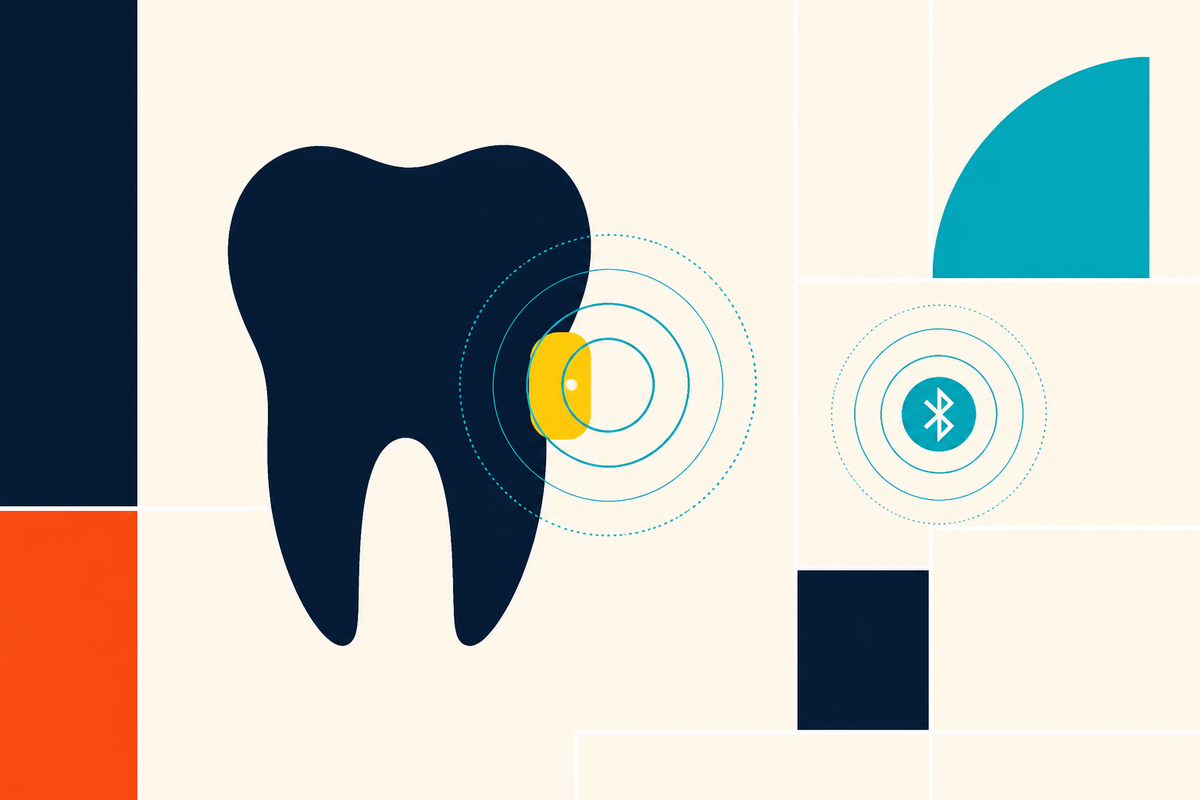
A diagnostic fluid hiding in plain sight
Lura's first commercial target is narrower than its long-term pitch. The company plans to begin with oral acidity. Sustained acidic conditions can contribute to tooth decay and erosion, yet a dentist generally sees the consequences at periodic appointments rather than the daily pattern that produced them. A continuous pH record could show when acidity spikes, how long recovery takes and whether a change in behavior appears to help. That is a useful first wedge because the measurement is concrete, the clinical home is obvious and the hardware can arrive through products already used in the mouth.
Beyond acidity, Lura has discussed glucose, electrolytes, metabolites, therapeutic drugs and other biomarkers relevant to chronic disease. Those possibilities belong to the research roadmap, not the store shelf. The company's own website says the product is in development and not approved for sale or distribution in the United States. In medtech, shrinking the circuit is only one gate. Each intended use needs dependable sensing, clinical evidence, manufacturing controls and an appropriate regulatory path.
“Our mission is to pave the way to preventative and user-friendly health management, using the diagnostic power of saliva.”Daniel Weinstein, co-founder and CEO
The product is a chain, not a chip
The physical sensor gets the photographs, but Lura is assembling a full monitoring system. An electrochemical sensor reads an analyte. A tiny low-power processor handles the signal. Bluetooth Low Energy carries data outside the mouth. A smartphone interface displays alerts and trends. Cloud software stores and analyzes longer histories, which can be shared with doctors or dentists. For a removable device such as a retainer, the case can recharge the sensor much as an earbud case tops up its contents.
Partners fill several difficult links in that chain. Silicon Labs has supplied a compact Bluetooth chip for the current design. Resonant Link Medical and battery maker Ilika worked with Lura on low-profile wireless charging and energy storage. PATHS-UP at Texas A&M collaborated on sensor characterization and validation with support from the National Science Foundation. The pattern is typical of serious hardware: the defensibility lives partly in the integration of specialized components and processes that must all behave together.
Who actually buys it?
For all the consumer-friendly imagery, Lura's direct customer is not the person browsing fitness trackers. Its initial business model is B2B and B2B2C. Dental-product manufacturers can embed the module in retainers, aligners, dentures and other appliances. Clinics and health systems can use the resulting monitoring service. Patients wear the device and receive the insights, but distribution and regulatory responsibility run through established industry channels.
That choice solves a problem many new wearables underestimate: getting onto a body. A familiar appliance already has a fit process, a professional relationship and a reason to be worn. Lura does not need to persuade every customer to adopt a visible new gadget. It needs manufacturers to design the module into products, clinicians to trust the output and patients to tolerate it. The sales cycle is slower than a direct-to-consumer launch, but the clinical route can be more durable.
If the model works, revenue could come from more than the sensor itself. Hardware can open the account; recurring analysis, monitoring and clinical software can deepen it. Lura has not published pricing or commercial contracts, and it does not disclose revenue, so the exact split remains unknown. What is visible is a platform strategy: one core module, several dental form factors and additional assays added only as the science and regulatory record support them. That is more complicated than selling a gadget, but it offers a way for each validated biomarker to expand the same underlying system.
A category between dentistry and medicine
Lura sits at the intersection of salivary diagnostics, connected medical devices and remote patient monitoring. Its alternatives change by use case. For oral acidity, the comparison includes dental exams, diet logs and intermittent chairside tests. For future metabolic markers, the competition includes established continuous glucose monitors from companies such as Abbott, Dexcom and Medtronic. Wrist wearables offer easier adoption but measure a different and generally narrower set of signals. Academic teams and early startups working on mouthguards, tooth sensors and lab-on-a-chip saliva systems are the emerging technical peer group.
The company's differentiation is therefore not simply “saliva instead of blood.” It is the combination of long-duration placement, continuous sampling, appliance integration and a path from sensor to clinical dashboard. Lura says its microsensors can be bonded directly to a tooth or built into dental hardware. That flexibility gives manufacturers several form factors and gives the company multiple routes into oral health, chronic-disease research, sports and eldercare. It also multiplies the validation work.
The startup was born at a three-day event
The origin story is unusually tidy. Daniel Weinstein, Saam Bozorg and Noah Hill met at a Tufts startup event in 2016. Weinstein was studying biomedical engineering and had competed in soccer; he wondered whether a wearable could automatically understand what athletes were eating and drinking. Bozorg brought dental training. Hill brought embedded-systems and computer-science experience. They formed UCHU Biosensors in 2017, the legal company that now does business as Lura Health.
Early prototypes plugged into computers. Wireless versions followed. In 2019 the team joined SOSV's HAX hardware accelerator. Weinstein and Hill entered Forbes' 2021 30 Under 30 list in Manufacturing & Industry. A $1 million NSF Phase II grant arrived in 2022, followed by additional federal and state awards, venture backing and a U.S. patent for a long-term, continual, wireless intraoral monitor. MATTER reported in 2024 that Lura had raised nearly $5 million.
The culture described in current job materials sounds like a lab company approaching its manufacturing and regulatory middle years: radical candor, creativity, grit, agility, collaboration and an instruction to enjoy the journey. The work spans circuit design, firmware, electrochemistry, mechanical packaging, quality systems and ISO 13485 design controls. Lura operates from the HAX facility in Newark, with workshops and wet labs close enough to Manhattan to make the commute less exotic than the product.
Japan offers a deployment route
In August 2025, Lura announced an investment and business partnership with Japan's SCO Group, whose Pay Light X platform supports thousands of dental clinics. The plan included clinical pilots with universities and research institutions, then possible expansion across Asia after regulatory progress in the United States. SCO made an additional investment in August 2026, describing a broader platform that would combine oral sensing, AI, testing and data. The amounts were not disclosed.
The partnership matters because novel sensors need a place to become routine. SCO brings dental relationships and clinical infrastructure; Lura brings the component that produces a new kind of longitudinal signal. The company has also joined the American Gastroenterological Association and MATTER incubator, a clue that it sees saliva as useful well beyond the dentist's chair. Digestive health is one plausible bridge between the mouth and whole-body monitoring.
The remaining questions are less whimsical than the premise. Can the sensor remain stable for months? Can a signal collected inside different mouths be calibrated well enough to guide action? Will users forget the device is there? Can Lura manufacture it consistently, protect the data and prove that continuous readings improve decisions? The answers will determine whether a tooth-scale computer becomes a medical platform or an elegant prototype.
What Lura has already done is make the mouth legible as a product category. The wrist became valuable when sensors, batteries and software made everyday signals easy to collect. Lura is attempting the same move with a fluid people encounter constantly and almost never consider as data. The next useful alert may begin not with a needle or a watch face, but with a quiet reading from the retainer case.