The wedding dress is a strange piece of consumer machinery. It carries more feeling than almost anything in a closet and gets less use than almost everything in it. The buying ritual asks for a large budget, an opinionated audience, a calendar full of fittings and, afterward, enough storage space to preserve a garment that may never be worn again. Lundyn Carter understood the contradiction only after paying for it.
In 2014, unhappy with the conventional shopping process, Carter decided to marry in her grandmother's gown. The choice had family meaning. Making the dress fit cost $5,000. The bill turned sentiment into a business question: why should so much fabric, labor, money and attention be organized around a single use?
Four years later, she started Laine London in Atlanta. Its proposition was simple enough to explain at a fitting: rent the designer gown, tailor it to the bride, wear it for the wedding and return it. Yet the company was not really selling temporary possession. It was selling a way to keep the experience while letting go of the object.
“So much time and energy is built into one dress. Why is only one person using this, and then it's gone?”Lundyn Carter
The receipt was the research
Carter did not arrive as a bridal insider. She spent a decade in corporate America across banking, retail and cable. At Emory University's Goizueta Business School, where she completed an MBA with concentrations in leadership and strategy in 2017, entrepreneurship courses changed the shape of her ambition. She had been aiming at the corporate glass ceiling. Building a company offered a different target: an old category whose rules looked sturdy mostly because nobody had bothered to test them.
That outsider's eye mattered. Tuxedo rental had been ordinary for generations, while bridal ownership remained freighted with ideas about permanence and romance. A used or rented dress could be framed as a concession. Carter and her early collaborators instead asked what brides were actually hiring the dress to do. It had to photograph beautifully, fit precisely, survive a very specific day and make the wearer feel understood. None of those jobs required lifetime ownership.
She bootstrapped the first year. That constraint forced the team to look for product-market fit before polishing the startup story. Carter later said the period helped build a working-capital model that could fund growth. By 2022, she had received more than $150,000 in non-dilutive support from organizations including Google, American Express, Facebook and Unilever, while Verizon helped with marketing communications and SAP worked with the business on operations.
Fit is the trust layer
Clothing rental becomes difficult at the exact moment a customer cares most about fit. A loose jacket for a weekend is one thing. A wedding gown, photographed from every angle and discussed by relatives before the bride reaches the mirror, is another. Laine London's useful insight was to treat alterations as part of the product, not a repair made after the sale.
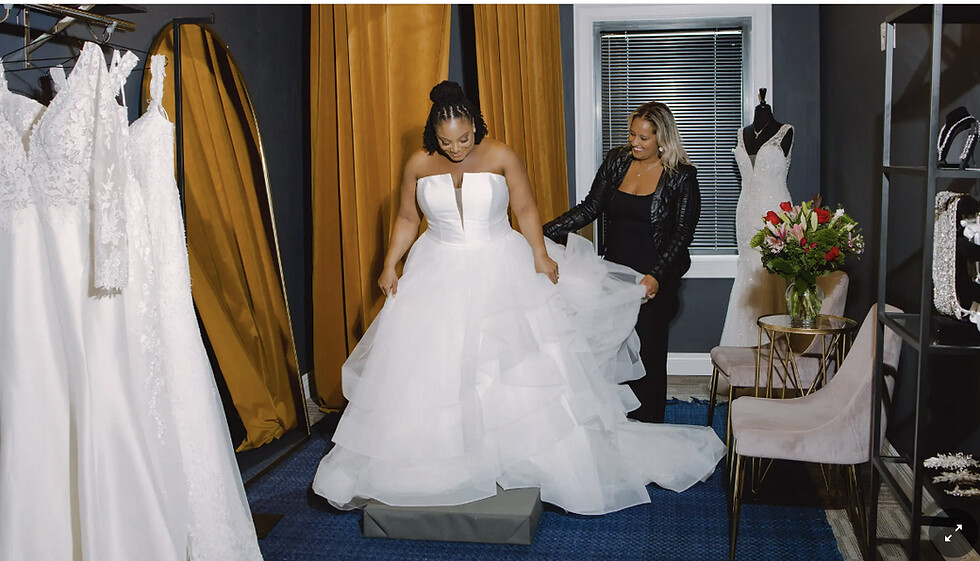
A private appointment, a stylist who listens and a gown shaped to one body can make access feel more luxurious than ownership. The return is only the final step. The emotional product has already been delivered. Carter has spoken about the expression on a bride's face when she realizes the process does not have to be stressful or punishingly expensive. That expression is not soft anecdotal garnish. It is evidence that the service has removed friction from a high-stakes purchase.
The model also changes what inclusion looks like. Carter has said the company deliberately focused on groups traditional bridal retailers often treated as undesirable or unprofitable, including plus-size brides and customers working below a $5,000 dress budget. Inclusion here is operational. It determines which samples sit on the rack, which designers make sense, how the appointment feels and whether a customer sees possibility before she hears a price.
A founder who prefers the long fitting
Carter's public advice is unusually resistant to founder theater. “Slow and steady,” she has said. “You don't have to be moving at a hundred miles an hour.” Another line is even plainer: “Focus on one thing, do that well, and you'll thrive.” The words fit a company whose value is created through repeatable detail - measurements, schedules, cleaning, alterations, customer communication and inventory that has to work more than once.
She describes herself as an introvert with an extrovert personality when she needs one. The distinction explains some of her operating style. Public confidence can open a partnership or reassure a nervous bride; private discipline keeps the calendar and capital from becoming chaos. In 2023, she told Goodie Nation that managing her time and preserving meaningful relationships had become central to her founder life.
Design for the customer who enters the room, not the imaginary customer a category has served by habit. Inventory, pricing and hospitality all follow from that choice.
Her founder huddle at Goodie Nation still met every Monday after three years. Carter called the members brothers and sisters who had watched one another grow. She also told a story about nearly skipping a group session because her plate was full. She joined anyway, met another founder, Colette Johnson, and turned the encounter into an in-person conversation about their companies and Johnson's wedding plans. Carter's conclusion was concise: “Keep space in your life for the unexpected.”
“Success is truly a function of how you define it, not anyone else. Hard work plus bravery equals success.”Lundyn Carter
Atlanta is part of the model
Laine London grew inside an Atlanta network, not in isolation. Carter has credited Amelia Schaffner at Emory, Atlanta Tech Village co-founder David Lightburn, investor Sean O'Brien and Google startup leader Jewel Burks Solomon with helping when the business was still, as she put it, “a hope and a dream.” Programs supplied grants and technical help, but the network also supplied context: other founders who understood the odd mixture of customer intimacy and institutional ambition.
Her affection for the city is specific. Asked to plan a visit for friends, Carter built a route through the Trap Music Museum, Friday Night Jazz at the High Museum, a BeltLine bike ride, tea from Just Add Honey and shopping at The Village Market's collection of Black-owned brands. It sounds like leisure, but it also reads as a founder's map of Atlanta: culture beside commerce, established institutions beside independent operators.
The company eventually hosted pop-ups in New York and Washington, D.C. Carter's stated ambition has been larger than a single boutique: she has described Laine London as clothing-as-a-service and talked about becoming a broad U.S. wedding resource. The framing matters because it turns a shop into an operating model. A gown can circulate. So can the appointment playbook, the fitting knowledge and the data about what brides actually request.
The next recommendation
In 2024, Carter said Laine London planned to incorporate artificial intelligence or machine learning to better understand what customers want. The idea is less science fiction than accumulated fitting-room memory. Bridal shopping produces many signals: silhouette, designer, size, venue, comfort, alterations and the difference between what a bride saves online and what she loves on her body.
Used carefully, software could narrow the first rack without flattening the conversation. It could help a small team notice patterns across appointments or recommend inventory with fewer guesses. The human stylist would still interpret the hesitation in front of a mirror. Technology would handle recall; hospitality would handle meaning.
This is the through-line in Carter's work. She is not trying to remove the ceremony from bridal shopping. She is trying to remove the waste, pressure and exclusion that accumulated around it. The gown can move to another bride. The experience must still feel singular.
The distinction is small enough to miss and large enough to build on. A retailer usually wins when the customer walks out carrying the product. Laine London completes the loop when the product comes back. That return is not evidence of a lesser relationship. It proves the company delivered what the bride came for without asking her to become the dress's permanent custodian.
There is a founder lesson folded into the train of every dress: ownership is often a proxy for care, but it is not the only way to create care. Service can be precise. Access can be beautiful. A returned object can still leave behind something permanent.