A dozen pairs of jeans went into the fitting room. None came home. Romney Evans watched his wife try to find a pair that worked, then carried the story back to business school. Jessica Arredondo Murphy heard something familiar in it: the distance between a rack full of merchandise and a shopper who leaves satisfied. She had worked as an apparel buyer. Here was a problem she understood from the other side of the curtain.
There is a peculiar insult built into an unsuccessful clothes-shopping trip. The shop has supplied the garments, the labels and the mirror. Somehow the person wearing them can end up feeling responsible for the failure. Murphy and Evans began asking whether better information could make that encounter less frustrating. Their company, True Fit, would spend years working on the answer.
Twelve pairs, one unanswered question
Evans sent an email to his Babson classmates looking for someone who could help develop the idea. Murphy brought the apparel knowledge. They met while earning their MBAs at the F.W. Olin Graduate School of Business and graduated in the same class, in 2006. The business began while they were still students.
The pairing matters. A shopping disappointment had suggested an opening; a merchant could see the work hidden inside it. Clothing comes in different cuts, fabrics, styles and sizes. People bring equally particular preferences. The label sewn into a waistband is a small amount of information to ask to carry such a large conversation.
True Fit’s early form was a consumer-facing site. It later became a software business serving retailers. That move changed where the company met the shopper. Instead of asking people to visit a separate destination, it could help them while they were considering a purchase. The fitting-room question could follow the customer onto the product page.
Murphy’s part in this story has a useful specificity. She understood the merchandise before she began building technology around it. The original question was practical enough to survive a change in business model: how do you make it easier for someone to find a garment they will keep?
The buyer behind the algorithm
Before Babson, Murphy graduated from Brown University in 2000. Her degree was in international relations. She then held buying positions in women’s sportswear at May Department Stores, including the Filene’s business. Her professional starting point was the department store, with its assortment decisions and customers, rather than an abstract exercise in recommendation software.
Buying is a useful preparation for a business where preference keeps complicating the arithmetic. The retailer has a selection to sell. The shopper has a reason to want one piece and leave another behind. Murphy’s later descriptions of True Fit repeatedly return to this relationship between a particular person and a particular item.
Her account of growing up adds another kind of preparation. She came from a single-parent household in a blue-collar Massachusetts town and moved frequently. Arriving at Brown brought culture shock. She describes that experience as part of learning to adapt quickly, including when she felt behind.
There is also a family connection to the material itself. Her grandfather moved from Colombia to Central Falls, Rhode Island, to repair looms. Murphy has used his photograph in sales presentations. A machine that makes fabric and a system that helps people buy it belong to different working worlds. In her story, the distance between them is one family.
The interesting part happens after checkout
Ask Murphy how True Fit understands a shopper and she gets to an awkward human habit: what people say they like can differ from what they repeatedly buy. The company brings stated preferences together with information about purchases and returns. Both have a place. A questionnaire supplies one kind of account; the shopping history supplies another.
She has illustrated the limits of a single retailer’s view with an example of a consumer buying expensive boots at Neiman Marcus and a cheap T-shirt at Old Navy. The same person can appear very different depending on which counter is doing the looking. Cross-retailer information allows a fuller view of the preferences that move between those purchases.
That is the merchant’s problem, expanded into a data problem. A useful recommendation has to connect what is known about a product with what is known about the person considering it. Fit includes how someone wants a garment to sit and feel. Two shoppers can choose different experiences without either having made a mistake.
A recommendation gets a second opinion.
- 01PreferencesWhat the shopper tells you
- 02PurchaseWhat the shopper chooses
- 03OutcomeWhat is kept or returned
The 2023 National Technology News Awards named True Fit Retail Tech of the Year. Murphy was then the company’s co-founder and chief operating officer. The recognition concerned a familiar retail task: making the online buying experience easier. An award can be displayed immediately. A recommendation has to wait for the package to arrive.
Even the machinery needed a new fit
By July 2026, Murphy was discussing another kind of mismatch. At Sourcing Journal’s Visions of Tomorrow event, where she was an inaugural honoree, she described telling her chief technology officer roughly two years earlier to rebuild the company’s systems. Years of additions had produced what she called a “Frankenstein system.”
It is an unflattering name for infrastructure, although a memorable one. The image makes the problem easy to picture: something assembled over time, with each part carrying the history of the moment it was attached. A company can grow into a collection of decisions that made sense separately and become difficult to work with together.
“There were no sacred cows.”
Jessica Arredondo Murphy, July 2026
Murphy’s account of the overhaul stressed the need to make fragmented information usable. Retailers working with AI need a coherent foundation for the tools they want to introduce. For a company whose business already depended on connecting retail data, that required examining its own accumulated machinery.
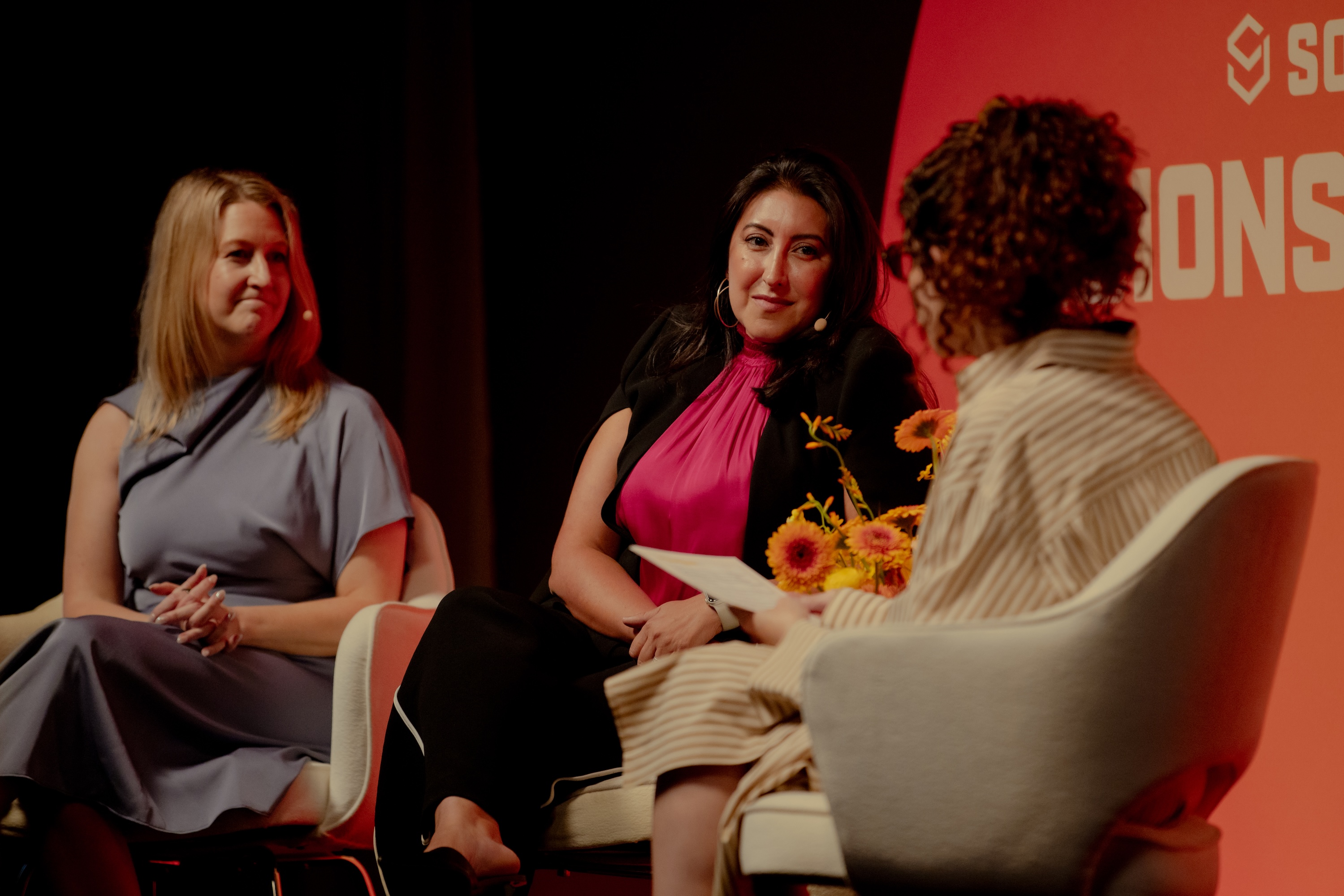
The decision fits a career that has already included a change from consumer site to retailer software. Persistence has not required preserving every earlier version. She has kept returning to the shopper’s problem while changing how the company tries to solve it. In that sense, the rebuild belongs in the founding story as much as the first email does.
A conversation with consequences
In February 2026, True Fit announced an AI shopping agent powered by its accumulated purchase and return data. Murphy, now co-founder and CEO, was taking the fit question into a conversational interface. A shopper could ask about an item instead of relying entirely on the size selector and the surrounding product description.
In June, she discussed that work with Arthur Zaczkiewicz on Street Talk. The conversation covered connecting True Fit’s specialized fit intelligence with other AI shopping agents. The practical ambition is to make the information available where the purchase decision takes place, even as the interface changes.
A conversation offers room for questions that a letter or number cannot comfortably answer. Where will the hem fall? How will the waist sit? Is the fabric structured or stretchy? Those questions ask the system to understand a garment and a preference together. The answer has consequences that remain pleasantly resistant to presentation skills. The clothes eventually have to be worn.
Apparel and footwear brands represented in True Fit’s data, as reported by the company in September 2026.
September brought an announced collaboration with Glance. Its conversational discovery and generative virtual try-on were to be paired with True Fit’s size and fit guidance. The companies described a path that lets a shopper discover an outfit, visualize it and get information about how it may fit. True Fit reported data spanning 60 million products.
The first integrated Glance experiences were planned for the 2026 holiday season, with broader availability for True Fit merchants in 2027. The distinction between seeing a look and choosing a size gives the collaboration its logic. An appealing image can begin the decision. Evidence about fit can help someone finish it.
The question she keeps coming back to
Murphy’s reflections on leadership include a project, earlier in her career, that exceeded her experience. She tried to solve the problems herself and became a bottleneck. The team lost clarity. She came away putting more emphasis on shared ownership and systems that let other people make decisions. That is a fairly concrete lesson for someone leading a company built on information.
She also describes learning to examine profitability customer by customer, even when doing so meant letting a large client relationship go. There is an echo of the buying problem here: an impressive-looking choice still has to work in practice. Size alone offers very little assurance.
Her advice on sales is brief: “Make trust the objective.” It asks for clear claims and follow-through. For fit technology, follow-through has an unusually literal destination. It ends up in a parcel, in front of a mirror, with a person deciding whether the recommendation deserves another chance.
The early commitment was personal. Murphy put $5,000 from repurposed student loans into the business and went without a salary for years. She has called her husband, then her boyfriend, her first angel investor. In 2019, she returned to Brown to address its Breakthrough Lab founders, speaking about the difficult stretches as well as the achievements.
She is a mother of three and has said she intends to keep being an entrepreneur. “I will never not be an entrepreneur,” she told the Brown audience. The sentence leaves little room for a retirement brochure. What has lasted through her own changes of role, business model and technology is a portable question. Somebody wants the jeans. Will they fit?
Keep the conversation going
Explore the work, watch a conversation, or follow Murphy’s updates.
- True FitThe company’s fit intelligence and shopping technology
- Jessica Murphy on LinkedInHer public professional profile
- Watch: The Fit Intelligence LayerStreet Talk with Arthur Zaczkiewicz
- Listen: Leadership and Innovation UnlockedA 2022 conversation about the company’s early days
- Read: Make Trust the ObjectiveMurphy’s 2026 leadership interview
- Read: The systems behind the AI workHer July 2026 Visions of Tomorrow discussion
- Explore: Glance and True FitThe September 2026 collaboration and planned rollout