JIMINI HEALTH RAISES ~$25M MEET SAGE: THE AI THAT WORKS UNDER A THERAPIST IMMUNAI CO-FOUNDER STARTS OVER IN MENTAL HEALTH MIT BEST-THESIS PRIZE, 2015 "WORK WITH PEOPLE YOU LOVE WORKING WITH" JIMINI HEALTH RAISES ~$25M MEET SAGE: THE AI THAT WORKS UNDER A THERAPIST IMMUNAI CO-FOUNDER STARTS OVER IN MENTAL HEALTH MIT BEST-THESIS PRIZE, 2015 "WORK WITH PEOPLE YOU LOVE WORKING WITH"
Founder File / AI & The Mind

Luis Voloch

He spent years teaching machines to read the immune system. Then he turned the same toolkit on something harder to map: the week between one therapy session and the next.

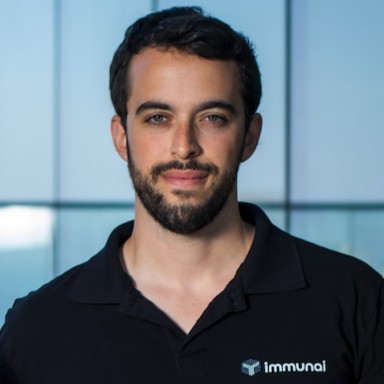
Luis Voloch, co-founder and CEO of Jimini Health
The mathematician who keeps changing fields - and bringing his models with him. Luis F. Voloch, NYC.
$1B+
Immunai valuation, co-founded
~$25M
Raised for Jimini Health
2015
MIT best-thesis prize
3
Co-founders behind Jimini
The Pitch

A therapist, a patient, and an AI named Sage walk into a session

Luis Voloch is co-founder and CEO of Jimini Health, a New York company built on a simple complaint with the way therapy works: you see someone for fifty minutes, once a week, and then you are on your own until next Tuesday. Six days of silence. Jimini's answer is Sage - an AI assistant that lives in those gaps, reinforcing the exercises a licensed clinician assigns, never standing in for the human.

The distinction matters to Voloch, and he repeats it like a man who has watched the alternative go wrong. Sage does not diagnose. It does not freelance. It works under therapist supervision, nudging patients through cognitive behavioral techniques the clinician has already prescribed. The model is human-led, machine-extended - and Voloch insists that is the entire point, not a hedge.

He likes to describe the ambition in borrowed grandeur: a "Genentech-like company in mental health, powered by AI." It is a big claim from a young company. But Voloch has done the thing before where a strange technical idea becomes a billion-dollar enterprise, so he has earned a little swagger.

"Therapy has been constrained by a traditional once-a-week model that leaves patients unsupported between sessions - a shortcoming that can be overcome with LLMs."— Luis Voloch, on launching Jimini
House Philosophy
The most powerful AIs are not standalone products. They collaborate with human clinicians.
— LUIS VOLOCH
Two Maps

From immune cells to inner life

Before therapy, there was the immune system. In 2018 Voloch co-founded Immunai and became its CTO, applying machine learning to immunology and drug discovery - building, in the company's own framing, a vast computational map of how immune cells behave. The work was cited by MIT News as a model for how AI could accelerate drug development. The company climbed onto Crunchbase's unicorn board.

He ran the technology, sat on the board, and chaired the scientific advisory group until the end of 2022. Then he did the unusual thing. He left the unicorn he helped build and started again from zero, in a field with different rules and far softer data: the human mind.

The throughline is the method, not the subject. Immunai mapped immune cells. Jimini maps the space between therapy sessions. Both bets rest on the same conviction - that messy biological systems yield to rigorous models if you respect the domain enough to build for it specifically.

"My larger goal is to help patients improve their mental health by leveraging clinician expertise and large language models to truly deliver much better, personalized, customized care."— Luis Voloch
The Record

A career in deliberate restarts

2015
MIT, best thesis. Wins the William A. Martin Best Thesis Prize in Computer Science, capping degrees in mathematics with computer science and a master's in EECS.
pre-'18
The machine-learning years. Leads data science and ML work at Palantir, and heads data science at Israel Tech Challenge.
2018
Immunai. Co-founds the AI cancer-immunotherapy company and serves as CTO, building a computational map of the immune system.
2022
Unicorn, then exit. Steps back from Immunai at year's end after it crosses a $1B valuation.
2023
Jimini Health. Founds the AI-supported mental health company with Mark Jacobstein and Sahil Sud.
2024
Launch. Jimini comes out of stealth with $8M in pre-seed funding and unveils Sage.
2026
Scaling. A reported $17M seed round brings total funding to roughly $25M.
What He Believes

Three rules, learned the hard way

RULE 01 / PEOPLE

Bet on who, not what

"The most important part of the entrepreneurial journey is who you're working with, because these things always change." Products pivot; co-founders are the constant. His closing advice to founders: "Work with people you love working with."

RULE 02 / MOATS

Context beats cleverness

The defensible AI, he argues, is the one built deep into a specific domain - clinical supervision, evidence-based protocols, real workflows. A general model is a commodity. A model that knows the rules of therapy is a moat.

RULE 03 / RIGOR

Guard the thinking time

A scientist's habit: "Really guarding your time and making sure that you're spending time in the optimal way is really important." His teams take, in his telling, a more scientifically rigorous approach than most of the field.

Off The Clock
He teaches founders at Stanford how to build AI companies - then goes home and builds one.
— LECTURER, STANFORD GRADUATE SCHOOL OF BUSINESS
The Long Game

An audacious arithmetic

Voloch's pitch carries a number that makes the establishment flinch. He envisions a future where AI could "take 80-90% of the human effort out of providing care to some lower-acuity patients" - not to remove the clinician, but to stretch one therapist's reach across many more people who currently get nothing at all.

Read uncharitably, that sounds like automation come for the couch. Read the way Voloch means it, it is a distribution problem: there are not enough therapists, the ones who exist cost too much, and millions of people fall through. If software can carry the routine load under human supervision, the scarce human attention goes where it counts.

Whether the science holds is the open question, and Voloch - who won a best-thesis prize and then spent years modeling immune cells - seems to know it. He has built his company to answer it carefully rather than loudly.

It helps that he is not building alone. Jimini's founding team reads like a deliberate assembly of people who have already shipped hard things in health and software: Mark Jacobstein, a veteran of Guardant Health and Immunai, and Sahil Sud, who worked at Ribbon Health and Palantir. Three founders, overlapping résumés, a shared allergy to hype. That is the kind of lineup Voloch's own rulebook would predict, since he keeps insisting the team matters more than the idea.

The early backers agreed. Jimini's launch round drew Zetta Venture Partners, LionBird, PsyMed Ventures, BoxGroup, Arkitekt Ventures and SCB into a company that, at the time, was mostly a thesis about LLMs and a name for an assistant. By 2026 the total raised had climbed toward $25 million. For a founder who could have coasted on a unicorn, the second act is being financed by people betting he can do it twice.
  • The nameSage is the assistant. It supports patients between sessions and never replaces a human therapist.
  • The arcHis career runs from the immune system to the mind - Immunai mapped cells, Jimini maps the gaps.
  • The credentialOfficial member of the Forbes Technology Council.
In His Own Words

Hear him think out loud

PODCAST

AI & the future of therapy

A conversation on Business Trip / PsyMed Ventures about collaborative AI, clinical rigor, and why the once-a-week model is overdue for change.

PODCAST

The Wantrepreneur Show

"The AI secret that built a $1B+ healthtech company" - Voloch on Immunai, moats, and choosing co-founders.

INTERVIEW

Eqvista founder Q&A

The founding story of Jimini, the Genentech ambition, and his advice to healthcare entrepreneurs.