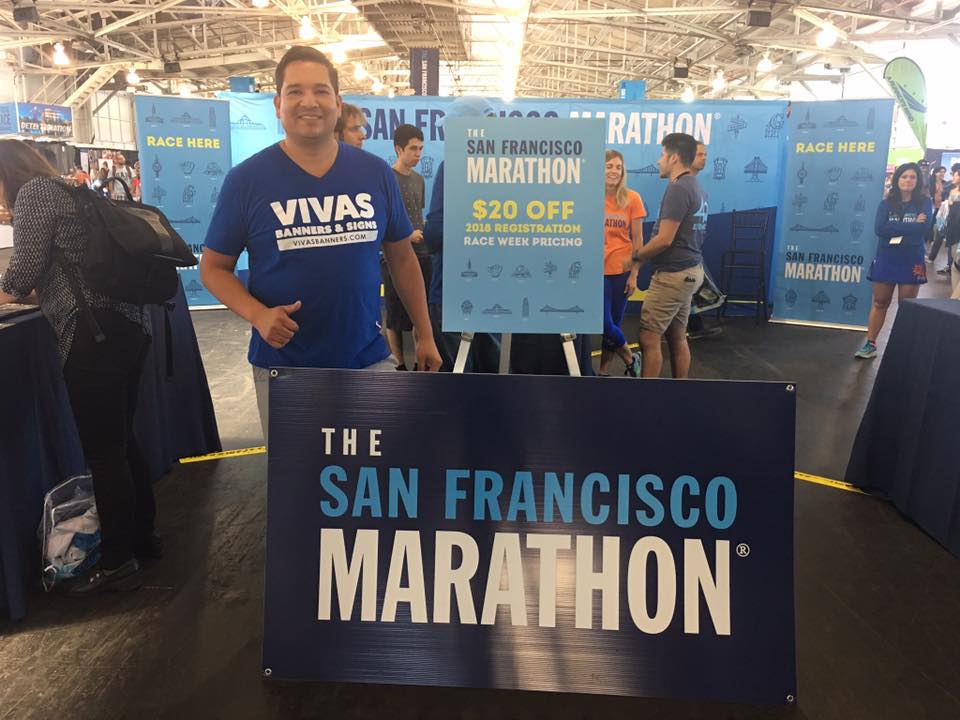
Luis Vivas had found a rather awkward way to enter the printing business: he was selling banners without owning a printer. His promise was brisk and reassuring, “online and on time.” The production arrangements were less settled. Then the San Francisco Marathon called, asking whether he could supply banners by Saturday. Vivas contacted a friend with a large-format machine. An initial request for 20 banners became 200. The first race his business had to finish was its own.
There is something appealingly physical about this beginning. An order cannot be downloaded onto a fence. Someone must print it, finish it and put it where people need to see it. Vivas was selling that completed transaction before he possessed all the means to carry it out. A friend’s machine filled the gap. Eventually, the business would have machines of its own.
An apartment, then a door of his own
Vivas moved to the United States from Peru in July 2006. Friends in California helped connect him with printing work at Fast Imaging. There, a colleague operating a new banner printer became a mentor. The trade offered a concrete education: artwork went into a machine, material came out, and somebody had to make the result useful.
His formal education had already placed him near this territory. He attended San Martin University from 1996 to 2001; his LinkedIn education entry names communication science, marketing, graphic design, publicity and public relations. Printing brought those subjects into rooms, onto windows and beside roads. It also introduced the less glamorous questions that accompany every attractive design. How large? On what surface? By when?
Vivas dates his early apartment venture to December 2010. He worked from a two-bedroom home in Alameda, brokering printing supplied by other firms. The arrangement kept initial costs down. The marathon breakthrough came in 2012, helping fund a Richmond District shop of 400 square feet. Its furnishings were economical: one printer, one desk and a four-by-six-foot production table. A spacious executive office would have required evicting the business.
The small shop gave his promises an address. By 2013, VIVAS was a preferred marathon vendor, producing 600 signs. A race presents a useful discipline for a supplier. Its schedule is public, its route is real, and missing signs have a way of becoming everybody’s problem.
The audition on the wall
Another early call asked for something modest: one wall graphic at Lucasfilm’s Presidio headquarters. The assignment was an evaluation, although Vivas did not know that when he took it. Successful delivery led to six months of interior graphics featuring Star Wars and other George Lucas productions. One wall had become a route into the building.
The work demanded a more capable production setup. Vivas used the project’s down payment to purchase a Roland printer, having seen the equipment at a Las Vegas trade show. The eventual graphics covered 15 walls, including an old photograph enlarged to 30 feet by nine feet. The client requested color proofs for each wall. Those approvals were part of the job, as consequential as the printing itself.
“You never know who’s calling you.”
Luis Vivas
The sentence explains why the single wall belongs in his story. A first assignment offers little certainty about the next one. The customer can observe whether the supplier returns calls, understands the brief and leaves the finished work looking right. Vivas’s subsequent work would include office interiors for recognizable brands. The introduction was a small job with a large capacity to disappoint.
His company’s client testimonials make the personal dimension unusually plain. Sephora’s Monique Orsot describes his responsiveness and attention to detail. Lucasfilm art director David Nakabayashi praises the team’s patience and expertise. These are useful qualities around occupied offices. A wall may be ready for its close-up; the people working beside it would still like to get through their afternoon.
Twenty thousand small obligations
Large printing jobs can hide their difficulty inside ordinary nouns. Consider a decal. It sounds manageable until the order contains 20,000 of them, the colors belong to an established brand, and different quantities must reach different cities. That was the scale of a Shell Recharge assignment handled by Vivas’s company and reported in a 2024 trade feature.
The project was budgeted at $250,000. Its contents included 4,000 die-cut logos and 16,000 additional decals, including instructions, numbers and branding for charging stations. Production ran from January 10 to January 31. Vivas’s team checked the Pantone colors, printed and laminated the material, then shipped it for installation across the United States.
Shipping brought its own puzzle. Destinations required different quantities, and individual machines had unique serial numbers. The team had to keep those details straight and supply installation instructions for the metal surfaces. A beautiful logo in the wrong box is an administrative error wearing excellent colors.
“We closed the deal over the phone,” Vivas recalled. What followed the conversation occupied an entire team. His role connects the commercial promise to the people who must fulfill it. On a project like this, the founder’s confidence becomes useful only when it can be translated into correct files, checked numbers and packages that arrive where they belong.
A staircase with somewhere to go
At Sherman Elementary School, the scale was architectural. Vivas joined a collaboration involving Lane Displays and Bay Area Community Resources to transform a three-story entry stairwell. The finished graphics covered 2,900 square feet. The location gave the work a different audience: children passing through a familiar space, repeatedly, as part of the school day.
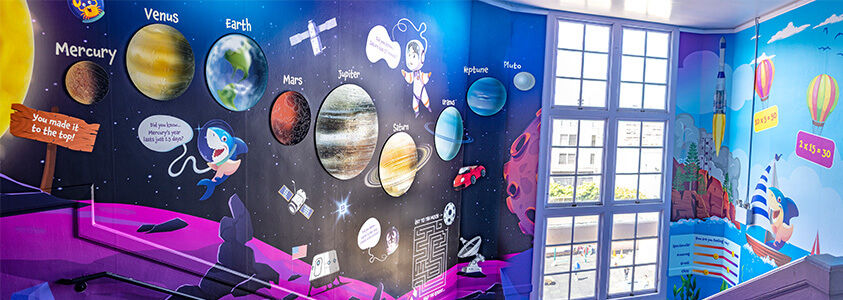
Production took approximately two weeks, followed by seven days of installation. Vivas identified surface preparation, logistics and precise alignment among the challenges. The dimensions explain the effort, but the corners help explain the skill. A staircase offers interruptions, turns and changes of level. Imagery has to make sense around all of them.
He described the appeal in terms of creating a more engaging environment for students. That intention needed a durable result: printed vinyl that could carry vivid imagery through the daily traffic of a school. His satisfaction came from seeing the completed space. The project gave a public purpose to the same practical capabilities used for commercial interiors.
Another assignment compressed the timetable differently. In 2023, the National University of Singapore opened a Palo Alto location, and VIVAS produced five wall graphics within a three-day turnaround. Vivas had worked with the university since 2016. Prints that could be laminated immediately helped the team deliver and install on schedule. The decision about ink therefore reached beyond the printer: it changed when the next person could begin working. For a founder who began by borrowing production capacity, that is a specific kind of progress. He could now choose the process around the deadline.
The vans need to match
Vehicle graphics became a formally promoted VIVAS service during a 2019 rebranding. In a later Meals on Wheels project, the company took responsibility for design, mock-ups, color testing, printing, installation and final review. Vivas was describing a service that began well before a roll of printed material reached a van.
The fleet created a particular demand for consistency. Colors needed to agree from the first vehicle to the last, including where the material stretched during application. Fast-drying resin printing helped shorten the route from production to installation. The equipment decision was tied to the way the work would actually be handled.
Vivas’s explanation of successful fleet work gave equal attention to people, materials and printers. Each affects the result. A machine can reproduce a color, but installation places that color over a real vehicle with seams, doors and curves. The finished van offers the public no convenient way to separate the designer’s contribution from the installer’s. They see one object.
The clock gets a larger audience
By the 2025 NBA All-Star events, the orders had grown into approximately 8,000 square feet of graphics in two weeks. Vivas shared project management with Jefferson Vertiz. Separate production and installation teams allowed work to proceed at the same time, while the scope kept expanding through additional requests and sponsor referrals.
One Friday request arrived at seven in the morning: six double-sided pole banners and 12 large logo decals, required by six that evening. The team finished the graphics at four and delivered them at five. The measurements were substantial, the margin on the clock modest. Previous NBA work and improvements to the company’s online visibility had helped bring the opportunity through the door.
The scale makes the early borrowed printer seem distant. The underlying situation remains recognizable. A client has an event to hold, and Vivas has agreed to make something exist before it starts. Now the answer depends on a coordinated shop, several printers and colleagues with distinct responsibilities. Experience has supplied an organization around the original willingness to accept the call.
Vivas has also spoken about plans for a custom wall-coverings brand. It is an ambition that follows naturally from work already close to him: printing that becomes part of a room. For the moment, the projects offer their own portrait. Banners beside a racecourse. Images inside an office. A staircase encountered on the way to class. Vans heading out into the city. His business leaves evidence at human scale, even when the order is measured in thousands.