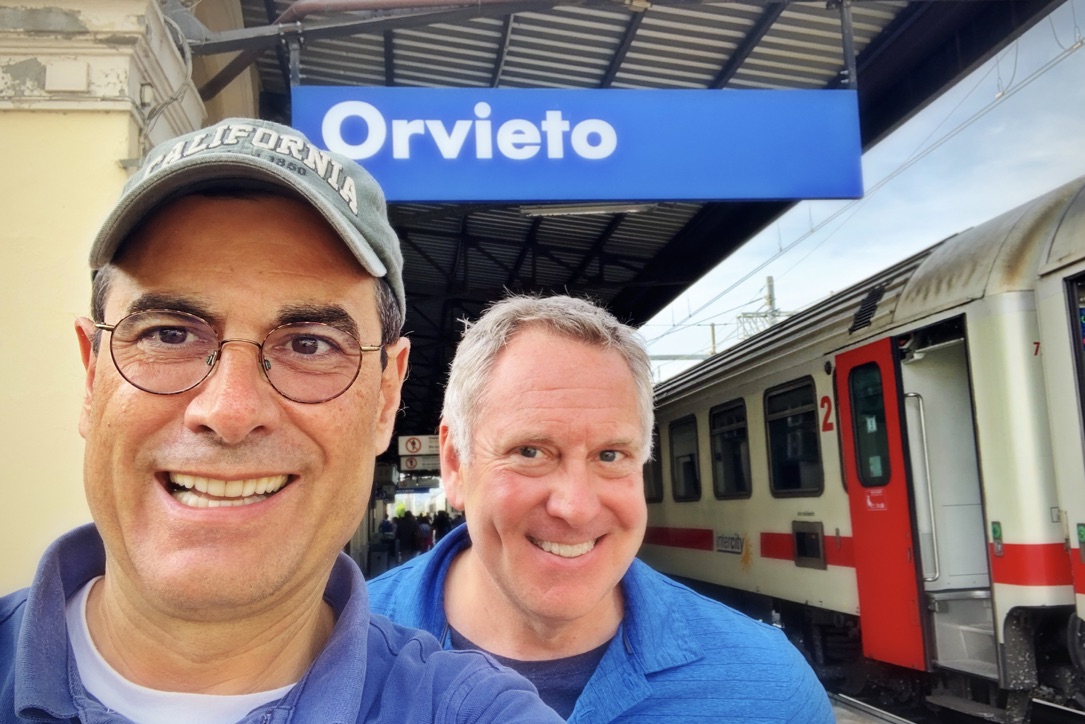
The offer arrived by email: a house swap, three months, a small town in Italy. David Perry and his husband, Alfredo Casuso, volunteered before asking where. The geographical details could catch up. Here was an opportunity to leave the usual calendar behind, and they intended to take it.
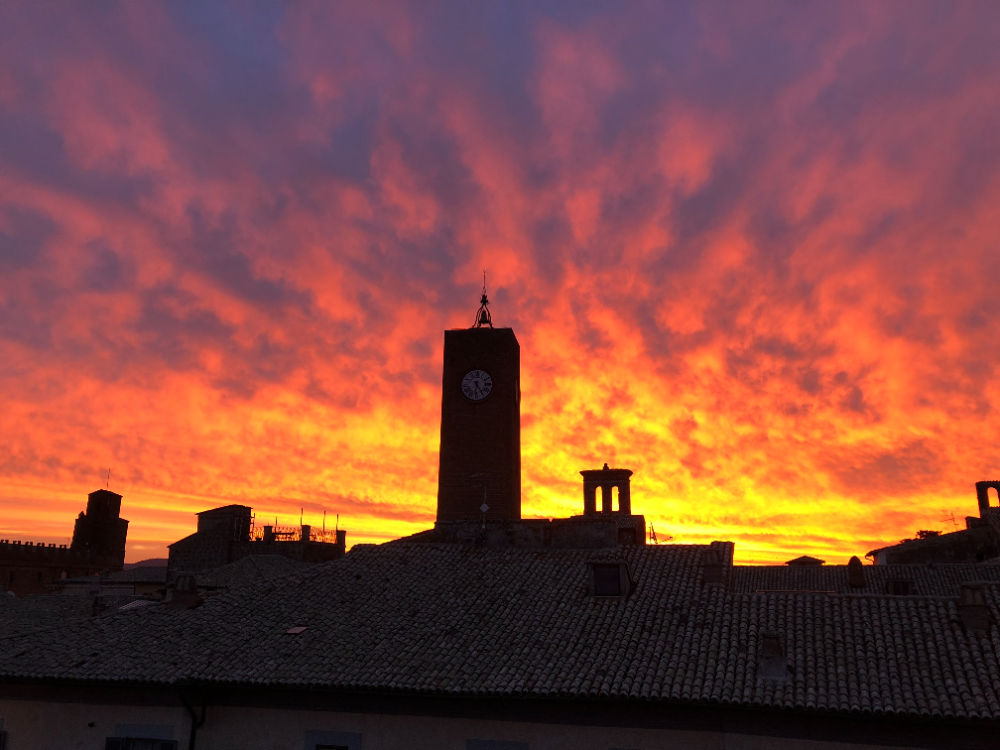
When they looked up the address, they found the blue neon of a café across the street. Their temporary home in Orvieto required a climb of 68 steps. By the end of that stay, the publicist who earned his living getting other people’s stories into circulation had begun turning the town into a story of his own. The café, the stairs and the borrowed address would acquire a second life in fiction.
It is a useful way into Perry’s life because the detour contains so much of it: Casuso beside him, a willingness to travel, a historical curiosity that refuses to behave like a holiday pastime. Back in California, his work includes communications, interviewing and the Rainbow Honor Walk. In Italy, a change of address gave his long-delayed ambition to write a novel somewhere to sit down.
The publicist enters the plot
Upon This Rock, published in 2020 under the name David Eugene Perry, follows an American couple whose Italian escape becomes an investigation. Lee Maury works in public relations; his husband is Adriano. Readers looking for the author’s professional fingerprints do not need a magnifying glass. Perry has acknowledged that his years in PR helped shape the book.
His fictional itinerary moves through church politics, concealed connections and a historical thread involving Pope Clement VII. The pope’s refuge in Orvieto after the sack of Rome supplies a bridge between the sixteenth century and the present. It is a novel built around the suspicion that a place’s past keeps making appointments with its inhabitants.
Perry enjoyed the homework. During the Italian stay he wrote for four to eight hours a day, working through the narrative chronologically. He has described the pleasure of checking dates and following the town’s Etruscan, Roman and Renaissance history. For a writer of conspiracies, the archive offers an agreeable advantage: some of the improbable material has already happened.
The book won a silver Benjamin Franklin Award from the Independent Book Publishers Association and the San Francisco Book Festival’s gay fiction award in 2021. In June 2022, Perry brought it to Fabulosa Books on Castro Street for a reading. The fictional journey had returned to the neighborhood where another of his stories was already set in bronze.
“Orvieto is a character in several eras.”David Eugene Perry, on Upon This Rock
A history lesson at shoe level
Perry first imagined a walk honoring LGBTQ figures in the late 1980s, while passing the Castro Theatre. Hollywood offered a familiar model: people could encounter a name simply by walking down the street. His version would make room for the people whose contributions deserved a more visible place in public memory.
The years between the idea and the first installation contained the less cinematic business of civic projects: meetings, fundraising, committee appearances and design decisions. Perry and fellow co-founder Isak Lindenauer helped bring the Rainbow Honor Walk into being. Bevan Dufty connected their efforts, and the project moved toward a physical form that pedestrians could meet without buying a ticket.
The first twenty plaques were unveiled on September 2, 2014. More than $100,000 had been raised privately for their design and manufacture. Each bronze square measured three feet by three feet. Architect Carlos Casuso of Madrid supplied the winning design after an international competition; Mussi Artworks in Berkeley manufactured the plaques.
The initial group included Jane Addams, James Baldwin, Frida Kahlo and Alan Turing. Together, the names make an argument about the breadth of LGBTQ achievement. A person coming for one familiar figure can discover another a few steps away. The sidewalk permits a kind of accidental education that a carefully planned museum visit sometimes misses.
By 2019, another installation brought figures including Josephine Baker, Alvin Ailey and Freddie Mercury into the walk. Perry had also been raising money in the familiar manner of a publicist with a telephone and a large address book. The bronze was permanent; getting it into the pavement required repeated conversations. Today the volunteer organization lists him as a co-founder on its advisory committee.
History placed where everyday life happens.
Before the borrowed keys
Perry grew up in Richmond, Virginia, and graduated from the State University of New York at Fredonia. Washington, DC, supplied an early mixture of writing and public relations work, with other jobs along the way: cocktail pianist and catering waiter at Capitol Hill parties and presidential inaugurations. He has a résumé with room for both a press release and a piano stool.
His San Francisco career passed through the Opera, Yerba Buena Center for the Arts and the San Francisco Partnership, where the worlds of culture, business and City Hall intersected. Those positions help explain the shape of the practice he opened in 1997. David Perry & Associates was incorporated in 2004; its work reaches into government affairs, public events and communications when an ordinary announcement will not quite do.
The 2008 Olympic torch relay and San Francisco’s 2010 delegation to the Shanghai Expo belong to that professional history. So does work around Super Bowl 50. These assignments place a communications business amid schedules, officials, visitors and expectations. A city event has many audiences, and they rarely arrive with precisely the same question.
The connection with civic business continued when Perry joined the San Francisco Chamber of Commerce board in 2019. He has also helped co-found BuildOUT California, which supports LGBTQ-owned and certified businesses and allies in construction-related industries. His professional relationships repeatedly lead back to organizations where people need to meet, cooperate and be understood.
- 1997Opens David Perry & Associates
- 200910 Percent begins its television run
- 2014First Rainbow Honor Walk plaques unveiled
- 2020Upon This Rock is published
The interviewer’s other address
Television supplied another place to have those conversations. Perry created and hosted 10 Percent, the Comcast interview series that ran from 2009 to 2018. Its half-hour format gave LGBTQ subjects a recurring appointment on the schedule. Over hundreds of episodes, a community could appear in its own variety, rather than being compressed into a single news occasion.
The program’s hundredth episode featured Armistead Maupin. Other listings show how widely Perry cast the net: a neighborhood shopkeeper discussing local shopping, theater directors discussing productions, politicians, historians and tourism executives. One 2017 episode paired a conversation about political documentaries with a tour guide’s account of Castro history.
A weekly interview has a different rhythm from a novel. The guest supplies surprises; the host has to listen quickly enough to follow them. Perry’s later online interview show, Ahoy!, carries a greeting that also fits his maritime interests. Across these settings, he keeps finding reasons to ask someone to explain a life, a project or a place.
Two years before the masthead
Ocean liners have occupied Perry’s imagination since childhood. He remembers watching the Clifton Webb and Barbara Stanwyck film Titanic with his mother in Richmond, then reading Walter Lord’s A Night to Remember in one sitting. He returned to the book many times. Eventually the fascination took him beyond reading about ships to working aboard one.
On Crystal Symphony he edited the daily newspaper, Reflections, and wrote about maritime history. He calls the experience his “two years before the masthead.” It is a pleasing job description for a writer afloat: the sea outside, a deadline inside, and a vessel full of people who will need tomorrow’s edition.
His LinerLore presentations have since taken maritime history to audiences at sea and ashore. In November 2025 he was aboard Holland America’s Oosterdam, giving a Titanic presentation during a transatlantic crossing. The childhood interest had become a recurring part of his working itinerary. Ships supply both transport and subject matter, a convenient arrangement for someone who likes his travels to produce a story.
A deadline, with shore leave
There is a practical question hiding beneath this full calendar: when does the novelist get the desk? In 2025 Perry announced that he was stepping back from personal social media to concentrate on the sequel to Upon This Rock. Client work would continue. The discretionary scrolling would have to wait while he aimed for a November 1 birthday deadline.
On November 2 he reported progress, rather than a finished manuscript. Thorns of the 15 Roses draws inspiration from Grazalema in Andalusia, where he had read two chapters that September. He granted himself more time and extended the break from personal posting. Political arguments, puppy pictures and Golden Girls clips were among the temptations he named. Even a mystery writer can identify the suspects.
He already knew how this new story ended, he explained, unlike his experience with the first novel. The remaining difficulty was getting there on the page. That is an unusually recognizable problem in an otherwise crowded biography. Awards and a published debut do not persuade a sentence to write itself. A birthday can come and go while a chapter remains stubbornly present.
Travel, meanwhile, continues to feed his nonfiction. In September 2026 he wrote about arriving in Tokyo and taking the train to Kyoto with Casuso. His accounts move easily between the immediate business of getting off a ship and the history waiting on shore. At home in Palm Springs, at work in San Francisco or on the way somewhere else, he keeps material close at hand.
The same appetite makes sense of the novelist, the interviewer and the co-founder of a sidewalk memorial. Each chooses a different way to put a person’s experience within somebody else’s reach. Perry has spent years helping stories find an audience. Sometimes that means a broadcast slot. Sometimes it means three feet of bronze. And sometimes it begins when a friend offers a spare set of keys.