On 4 April 2018, Nordic Nanovector announced that Luigi Costa would step down as chief executive by mutual agreement with its board. The following day, he bought 10,000 shares in the company. A departure and a purchase, separated by a night: two public acts that make an unusually revealing opening to an executive’s story.
The purchase was recorded at an average price of NOK 43.56 per share. Afterward, Costa held 91,115 shares, alongside options and related warrants. The numbers do not tell us everything about his thinking. They do establish that, as his leadership tenure was ending, his financial connection to the company was growing. The departing chief executive was still a shareholder, and had just become a larger one.
His statement about leaving was direct. Nordic Nanovector had suffered a loss of market value and credibility among Norwegian investors. Costa accepted responsibility as CEO and said he hoped his departure would help the company regain support. He also expressed confidence in the management team. There was no graceful way to turn that announcement into a victory speech; he did not attempt one.
By 2019, Costa was an entrepreneur in residence at Sofinnova Partners. He would go on to co-found Noema Pharma and become its first CEO. The sequence matters. His career included the public demands of a listed company and the quieter work of assembling a new one. To read only the fundraising announcements would be to leave out the difficult middle.
Italy, America, then a wider map
Costa’s working life began at Eli Lilly in Italy. He later spent five years at the company’s US headquarters, taking on regional sales leadership before moving into global pricing and access responsibilities. Italy and the United States were early entries on a career map that would eventually include senior operating roles across several European businesses.
At Amgen, he held positions including general manager of Italy, leadership of the international franchise, and vice president and general manager of France. France was described at the time as Amgen’s largest market outside the United States. These were country and international assignments, with responsibility extending beyond one office or one local market.
His next chapter at Onyx Pharmaceuticals carried a particularly concrete task: starting its international organisation. As vice president for Europe, the Middle East and Africa, he was responsible for establishing that business outside the United States. His career had moved from leading within an established multinational to building an international operation for another company.
His education was in business. He earned a BSc in business administration at the University of Parma and an MBA at Bocconi Business School in Milan. The schools belong in the story because the work that later distinguished him was organisational: running businesses, examining opportunities, recruiting financial partners, and helping turn a proposed venture into an operating company.
By the time Nordic Nanovector appointed him in August 2014, he had more than twenty years of international industry experience. His appointment took effect on 1 September. The board was preparing for a more international phase and chose someone whose previous roles had already crossed countries, companies and the Atlantic. The new job brought that experience to Oslo.
An Oslo listing, with a harder ending
Nordic Nanovector went public in March 2015, during Costa’s tenure. The primary offer raised NOK 500 million. An over-allotment option exercised in April added NOK 75 million, bringing the gross proceeds to NOK 575 million. The distinction is useful: the larger number describes the completed offering, including the additional allocation, rather than the first cheque alone.
The company issued 17,968,750 new shares at NOK 32 in connection with the listing and over-allotment. A stock-market debut can be compressed into a bell, a photograph and a triumphant number. Here, the arithmetic supplies the less theatrical version. There were new shares, a price, an expanded offer, and a company now answerable to public investors.
Gross proceeds, including the over-allotment.
NOK 500m primary offer + NOK 75m additional allocation
Costa also joined the board of Oncopeptides in 2016. Its 2017 nomination materials listed him as an independent director and a member of the audit committee. That added a governance assignment to his executive work. He was simultaneously the person running one business and a director helping oversee another, with the different responsibilities those seats carried.
The Nordic Nanovector chapter ended in April 2018. Chairman Ludvik Sandnes thanked him for his work and enthusiasm, specifically recognising his leadership through the 2015 IPO and the team assembled during his tenure. Costa agreed to remain available to the board until the end of July to support the transition. The departure announcement contained both the setback and the board’s acknowledgement of what had been built.
Costa’s own words were plain: “As CEO, I have to take full responsibility for this.” The share purchase came the next day. Those facts can stand beside one another without a polished moral being attached. An executive had accepted responsibility, stepped aside, and increased his ownership. It was a more complicated ending than the usual line on a résumé.
The work before a company has a public face
At Sofinnova Partners, Costa’s next role was entrepreneur in residence, a position he held from 2019. Noema was formed that year with seed backing from the firm. Costa became co-founder and founding CEO, working with George Garibaldi and chief scientific officer John Kemp. The business was based in Basel, while Costa’s public professional profile placed him in Zurich.
Oslo CEO2019
Sofinnova & Noema2023
Noema handover
Sofinnova’s Antoine Papiernik described Costa’s contribution to Noema in specific business terms: due diligence, strategy, a business plan, and assembling the investor syndicate that would bring the company out of stealth. This is an unusually useful account of a founder’s work. It names the jobs that precede a launch announcement, before a venture has a public identity or a financing headline.
Garibaldi brought previous experience at Roche; Kemp had also worked there. Noema’s founding arrangements included licensing rights from Roche, which received a shareholding in exchange. Costa’s responsibility sat within that wider group of people and institutions. The company’s beginnings involved a founding team, a seed investor, a licensing relationship and, eventually, a larger set of financial partners.
The next public marker arrived on 1 December 2020: a CHF 54 million Series A, co-led by Sofinnova Partners and Polaris Partners. Gilde Healthcare, Invus and BioMed Partners participated. Darren Carroll of Polaris and Arthur Franken of Gilde joined Papiernik on the board. A business plan now had an investor group and an expanded board behind it.
That same year, Costa took another company-building seat. PinCell appointed him chairman on 6 May 2020, alongside the appointment of Gabriella Camboni as CEO and the addition of Sofinnova partner Paola Pozzi to the board. The appointments followed €1.65 million in seed funding. His work was spread between the executive chair at Noema and the boardroom at PinCell, rather than confined to one venture.
CHF 103 million, then a handover
On 7 March 2023, Noema announced a CHF 103 million Series B. Forbion and Jeito Capital co-led the round. UPMC Enterprises and another, unnamed investor joined, alongside existing backers Sofinnova, Polaris, Gilde and Invus. The funding announcement described the round as oversubscribed. Costa was still CEO, and the investor group had widened again.
Forbion’s Nanna Lüneborg joined the board in connection with the financing. The successive rounds show changes in the people around Costa as well as changes in the amount of capital available to the company. The 2020 board additions and the 2023 appointment are part of that record. A growing business acquires new voices around its table, each with a formal place in its governance.
In June 2023, Ilise Lombardo succeeded Costa as CEO. Noema said he had led the company for three years and was stepping down to pursue other opportunities. Lombardo had already joined its board in 2021. The change therefore brought a director into the executive role, following the financing completed earlier that year.
Chairman Jeffrey Jonas thanked Costa for his contributions and singled out his support for an innovative company culture. It was a different kind of departure announcement from the one in Oslo five years earlier. The public record gives each its own circumstances. At Noema, his title passed to a successor; his place in the company’s founding story remained.
The two Noema rounds totalled CHF 157 million. That arithmetic describes the disclosed Series A and Series B during his tenure, and excludes the earlier seed investment. It is company financing, rather than personal wealth. Keeping that distinction clear also keeps the story’s scale honest: Costa helped build an organisation supported by substantial outside capital.
A motorcycle beside the business suit
Costa had a life outside these appointments. He was a motorcycle enthusiast, originally from Parma, and participated in the Swank Rally in Tunisia in February 2024. A photograph of him with a motorcycle shows another setting entirely: riding equipment, a numbered windscreen and greenery, rather than the suit and white background of his professional portrait.
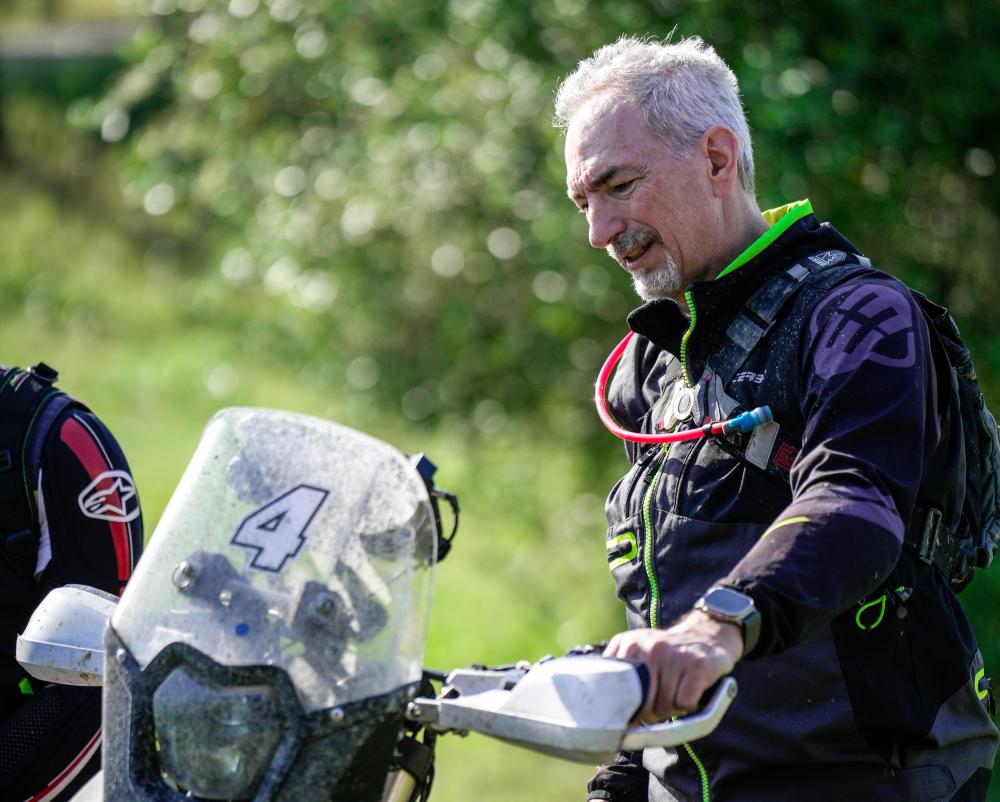
The photograph makes no grand claim about leadership. It simply returns some everyday texture to a career otherwise told in titles and transactions. The same person who appeared in financing announcements also made time for motorcycles. There is room in a life for both a board agenda and a ride, even if only one usually gets included in the company biography.
Costa died in February 2024, aged 58. Noema honoured its co-founder and former CEO, recognising his contribution from the company’s inception. Papiernik remembered him as a “positive, high energy individual.” Franken recalled an energetic, interesting person who enjoyed life and had many hobbies. These were personal recollections from people who had worked with him, alongside the formal acknowledgement from the company.
“Positive, high energy individual.”Antoine Papiernik, remembering Luigi Costa
The career left several visible landmarks: international operations at established companies, an Oslo IPO, board appointments, and the early organisation and financing of Noema. The recollections add the person who occupied those roles. Costa’s story holds the public reckoning as well as the successful rounds, the handovers as well as the beginnings, and the rider alongside the executive.