The Georgetown physics major who decided the sky needed better ears. He builds passive RF sensors small enough to palm, sharp enough to find a drone before it finds you.
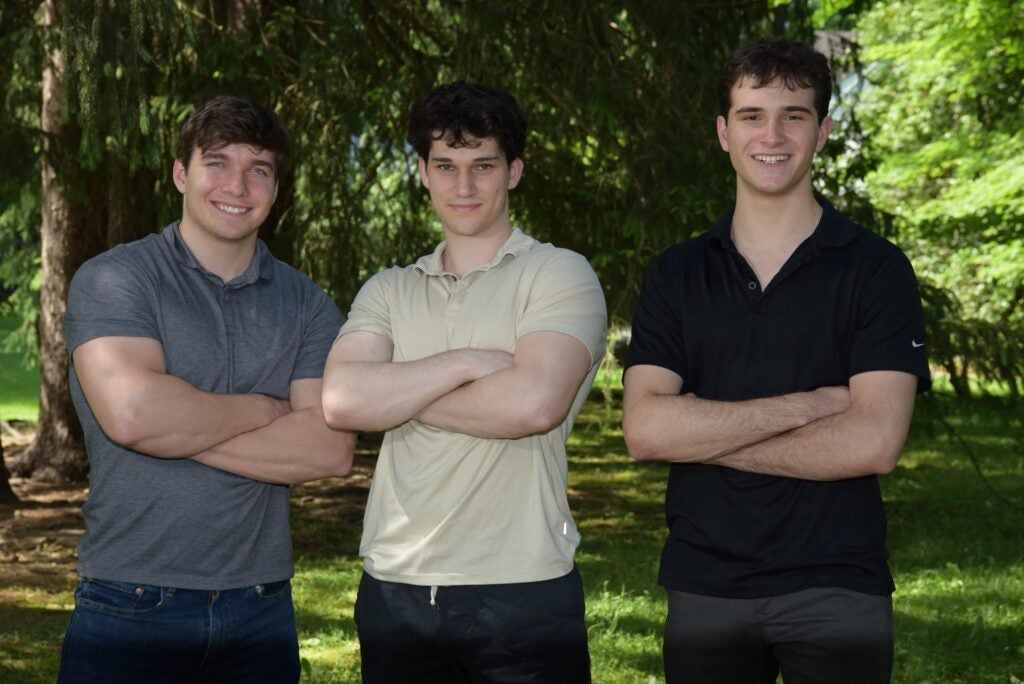
Three physics majors who forgot to name their hackathon team. Lucas Raskin with Guardian RF co-founders John Andrzejewski and Eli Kerstein. Photo: Georgetown University Dept. of Physics
Lucas Raskin runs Guardian RF, a defense company whose whole premise is an imbalance. The weapon is cheap. The defense was not. He set out to flip that. His sensors - the flagship is called Scout - fit in the palm of a hand, cost a fraction of legacy systems, and do something quietly clever: they listen. They pick up the radio chatter between a drone and its operator, and they never transmit a thing back, so they can't be found themselves. Always listening, never broadcasting.
Deploy enough of them in a mesh and they stop being individual ears. They become a net. Triangulate a signal across several nodes and you don't just know a drone is there - you know where it is, and where the person flying it is standing. Guardian RF calls the larger ambition "the data layer for low-altitude airspace." It is a tidy phrase for a messy problem: nobody really has continuous, affordable eyes on the slice of sky where cheap drones do their damage.
Today that pitch has teeth. Guardian RF has been fielded at Vandenberg Space Force Base under a fast-tracked AFWERX contract, named a finalist in the Pentagon's premier counter-drone exercise, and adopted by law enforcement and commercial security teams. In early 2026 Raskin landed on the Forbes 30 Under 30 list for Transportation and Aerospace. Not bad for a company that began because three students were too rushed to name their hackathon team.
If you think of the long arc of weaponry, bending toward things that are cheaper and able to be used from further away, drones are the pinnacle of that.
In February 2024, Raskin and two fellow Georgetown physics majors - John Andrzejewski and Eli Kerstein - drove a drone-detection idea into a 24-hour defense hackathon in El Segundo, California. They were so certain they'd flame out that they never bothered to name the team. The organizers needed something to put on the board, so: "Georgetown Physics." Then they made the finals.
Ukrainian Ministry of Defense officials and U.S. national security people were in the room, and they leaned in. Back on campus, the founders built hardware prototypes during three straight all-nighters in Walsh Hall while cramming for finals, then applied to Y Combinator. Raskin had been pointed toward a telecommunications career. The hackathon rerouted him.
What set Guardian RF apart wasn't the demo. It was what Raskin did next. Rather than guess how drones behave in a real fight, he embedded for roughly six months with Ukrainian ground troops through the Dare to Defend Democracy initiative - gathering firsthand intelligence on drone tactics, countermeasures, and what actually fails under fire.
That tour rewrote the roadmap. The result was hardware built for the soldier holding it, not the procurement officer reading about it: off-the-shelf parts, low power, Starlink for comms when the network is contested, and an interface that talks to the tools operators already use.
A 24-hour hackathon in El Segundo. The unnamed "Georgetown Physics" team builds a real-time drone-detection prototype and unexpectedly reaches the finals.
Guardian RF is founded with co-founders Andrzejewski and Kerstein, and joins Y Combinator's Summer 2024 batch.
Raskin embeds for about six months with Ukrainian ground troops, studying drone behavior and countermeasures in live combat.
Guardian RF is fielded under an AFWERX Direct-to-Phase-II SBIR with the 30th Security Forces Squadron at Vandenberg, and named a finalist in the DoD's Falcon Peak 25.2 counter-UAS exercise.
Raskin makes the Forbes 30 Under 30 list for Transportation and Aerospace. Guardian RF partners with Picogrid to harden drone defenses at Vandenberg Space Force Base.
A deployable, low-power RF sensing node built from off-the-shelf components. It detects and classifies drone control signals at standoff range, collects passively with no emissions, and integrates with TAK and operational APIs. Cheap and attritable by design - meant to be scattered, not babied.
Many Scouts, stitched together. Mosaic extends coverage across complex, austere terrain with persistent low-altitude monitoring and classification of non-Remote-ID drones - all without active emissions. Enough nodes, and the network triangulates both the drone and its operator.
We need to have a countermeasure and can't be treating this issue reactively. That's where the name Guardian came from - about protecting people and doing what's right.
So sure they'd lose, the founders forgot to name their team. "Georgetown Physics" went on the board - and then it went to the finals.
The first prototypes were soldered together over three consecutive all-nighters in Walsh Hall, in between studying for final exams.
Instead of theorizing about combat, Raskin went to it - six months alongside Ukrainian troops, taking notes the spec sheet could never give him.
Guardian RF's sensors are passive - they listen for a drone's control link and never transmit, so they can't be detected in return.
Scout fits in the palm of your hand, a deliberate jab at the refrigerator-sized radar it competes with.
The systems lean on SpaceX's Starlink for low-latency comms when the network is degraded or contested.
Raskin co-designed a new Georgetown physics course focused on entrepreneurship.
He was headed for a career in telecommunications before a single hackathon redirected him into defense tech.
Build the data layer for low-altitude airspace - so cheap, lethal drones get met proactively, not reactively.