There are two versions of every public construction project. The first is the one we photograph: steel rising, concrete curing, a ribbon cut against a blue sky. The second is mostly invisible. It lives in certified payroll, apprentice ratios, subcontractor lists, meeting notes and the question of whether the people who live nearby will get any of the work. Lowe Consulting Group has built a business in that second project.
The Oakland firm is neither the architect nor the general contractor. It occupies a less cinematic position between the agency that writes a community-benefit promise, the prime contractor expected to deliver it, the smaller businesses trying to participate, and the residents hoping the project might become a career. Its staff reviews labor records, monitors local hiring, trains contractors, conducts site visits, organizes public meetings and reports what happened.
This is why a phrase such as “supplier diversity” looks different from inside LCG. On paper, it is a goal. In practice, somebody must find a qualified business, make sure the scope is meaningful, explain the bid, track the award, watch the invoices and tell the client when reality drifts from the promise. Policy is a noun. Compliance is a sequence of verbs.
The promise has to survive the handoff
Andrea Lowe founded the company in 2006 after working in community affairs at Turner Construction, leading INROADS in Northern California, and holding a human-resources role at Bank of America. It is an unusually useful résumé for this niche. Construction supplied the operating logic. Workforce development supplied the human stakes. Human resources supplied a feel for systems that must work for actual people.
Lowe is an Oakland native. That detail matters because LCG’s advantage is not a proprietary formula hidden in a black box. It is accumulated local knowledge: who can convene a room, which workforce organization can prepare a candidate, which small contractor is bid-ready, and how to explain a complicated construction schedule without making residents feel they have wandered into somebody else’s meeting.
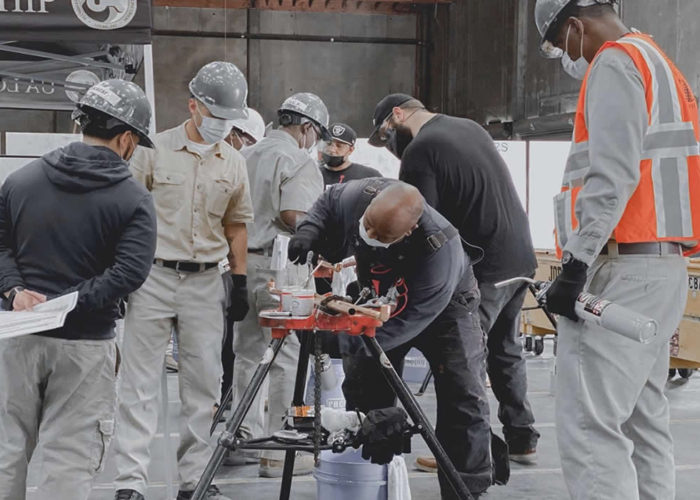
Consider Oakland Unified School District. LCG says it has administered and overseen the district’s project labor agreement since 2019, coordinating compliance tracking, workforce engagement, reports and conversations among district staff and labor representatives. Public board records make the work unusually legible. A 2021 amendment added $198,000 and raised one agreement’s ceiling to $588,000. A separate agreement approved in 2024 put $183,810 toward labor-compliance consulting through June 2025. LCG now lists the broader assignment at approximately $915,000 in project value.
“A local hiring target does not hire anyone. A supplier-diversity goal does not write a scope. Someone must turn the sentence into a routine.”The operating lesson inside LCG’s portfolio
Auditor, translator, host
The firm’s five service lines sound separate: labor compliance and workforce development; supplier diversity and contract compliance; policy development; communications and community engagement; and project management. On a live project, they behave more like a relay team.
From clause to consequence
- Translate itTurn a goal into tasks, owners, definitions and a reporting cadence.
- Instrument itCollect payroll, participation, outreach and contractor records while work is underway.
- Keep people in itTrain firms, interview workers, convene stakeholders and correct drift early.
At the Port of Oakland, LCG monitored the Maritime and Aviation Project Labor Agreement, convened oversight meetings and tracked local-hire participation. At Alameda County Transportation Commission, it designed contractor outreach and supported equity tracking under the Local Business Contract Equity Program. At a Contra Costa housing development, the assignment includes certified-payroll monitoring and Section 3 oversight. Each job begins with a different acronym. The underlying problem is the same: the client needs evidence that intent became action.
Then there is the host role. For the renovation of Oakland’s historic Malonga Arts Center, the firm ran public-input sessions and focus groups, then organized the feedback for the design process. For multiple Prologis development sites, it handled outreach, stakeholder communications and public-relations coordination. Good community engagement is not a microphone at the end of a finished presentation. It changes what information moves, when it moves, and who can respond before a decision hardens.
The product is connective tissue
LCG sells professional services through direct agency contracts and roles on larger project teams. Sometimes it is the consultant of record. Sometimes it works beneath a prime. Alameda County records show the latter becoming the former: LCG first supported sheriff’s-office planning as a small-business subcontractor to ESTOA Group, then received a direct, six-month agreement worth up to $65,000 to continue facilitation, planning and report development.
Its public certifications help explain how the business enters this market. LCG identifies itself as a disadvantaged business enterprise, an Oakland local business enterprise, an Alameda County small local emerging business, an ACTC very small local business enterprise, and a California small business. Those designations can open a door. They do not keep it open for 20 years. Repeat work depends on something less procedural: becoming the person a project team calls when its obligations begin colliding.
The competition is broad. A large engineering consultancy can bundle compliance into program management. An agency can hire its own staff. Software can collect payroll and vendor data. A communications firm can run public meetings. LCG’s distinction is the combination - field compliance, small-business outreach, workforce connections and community communications - delivered by a compact team rooted in the Bay Area.
What another project can borrow
The useful lesson is not “hire a consultant.” It is to stop treating community benefit as a paragraph written at procurement and checked again at close-out. LCG’s portfolio suggests a more practical architecture.
A copyable operating rhythm
- Define “local,” “diverse,” “apprentice” and “meaningful scope” before the first report is due.
- Give every promise an owner, a data source and a review date.
- Train subcontractors before paperwork becomes a compliance problem.
- Pair dashboards with worker interviews, site visits and community conversations.
- Create a corrective-action route that fixes drift while there is still work left to award.
This approach is suited to projects with explicit labor, local-hire, supplier or engagement commitments and enough duration to monitor behavior. It has less leverage when goals are vague, decision-makers will not assign responsibility, contractors withhold usable records, or outreach begins after the consequential choices are made. Relationships help, but they cannot rescue a program whose incentives point elsewhere.
The most telling result in LCG’s public record may be modest beside the multimillion-dollar figures: more than 400 people submitted career-interest forms after an AC Transit radio and web campaign. The firm then helped resource continued community-relations support. An advertisement became an inquiry; an inquiry entered a system; the system had a person responsible for the next step. That is the whole LCG idea in miniature.
We tend to judge infrastructure by what remains after the crews leave. A station. A school. A renovated cultural center. Lowe Consulting Group asks for a second accounting: Who learned a trade? Which small firm gained a consequential contract? Were workers paid what the agreement required? Did residents understand what was happening early enough to shape it? Concrete tells only half the story. The other half is filed in a report, deposited in a paycheck and carried home.