At nine o’clock at night, somebody applies for a caregiving job. The office is dark. The recruiter will arrive in the morning, answer email, make coffee, inspect yesterday’s numbers, and eventually open the applications after lunch. By then, Louie Frank would argue, the organization has already made a decision. It has chosen its routine over the applicant’s attention.
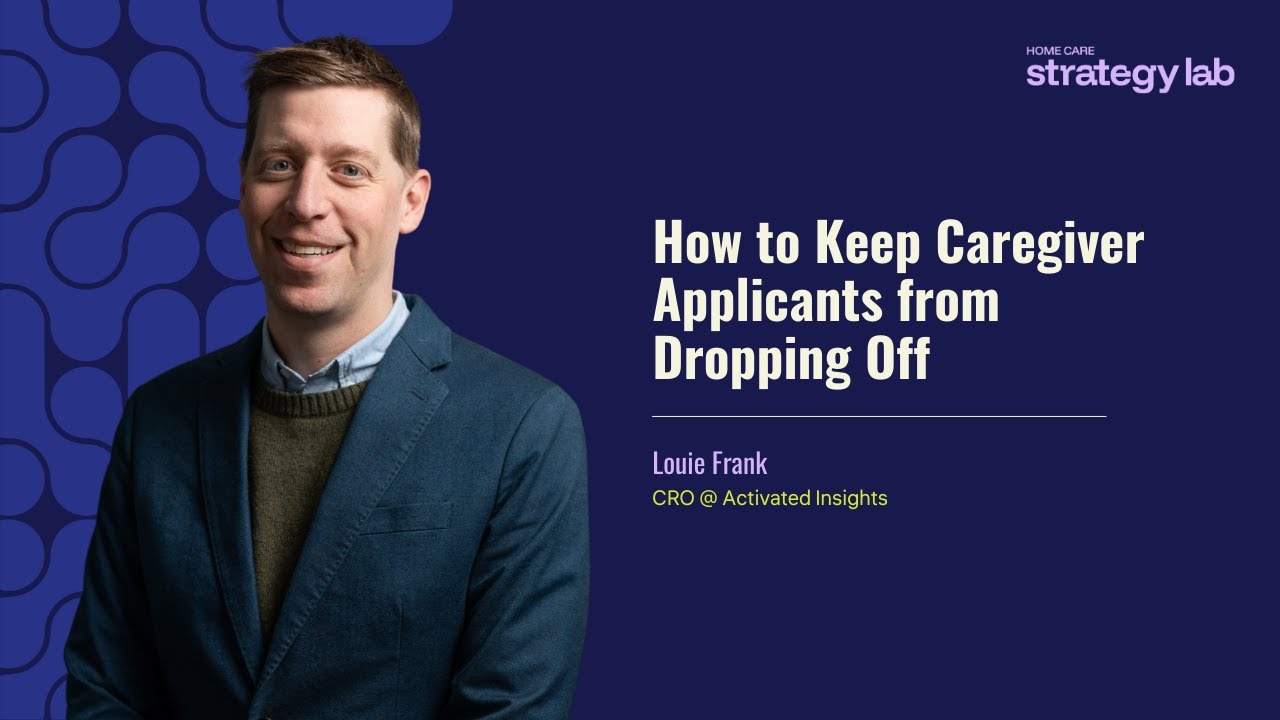
Frank, the chief marketing officer of Activated Insights, likes clocks because clocks expose what flowcharts politely conceal. A hiring funnel might look orderly on a slide: application, qualification, interview, offer, first shift. In real life it is a series of waits, each one giving a good candidate time to accept another offer. Frank’s shorthand is wonderfully severe: “24 minutes is the new 24 hours.”
The line is catchy enough for a conference badge, but its author is not really selling haste. He is selling attention. Qualified frontline workers, he has said, are often hired somewhere within three days. They apply outside office hours, while large retailers and other employers use automated systems or evening staff to respond almost immediately. The home-care agency that waits until tomorrow afternoon may still have a perfect job available. It may no longer have an audience.
A marketer discovers the middle
Frank’s career has been a long education in the distance between attracting interest and producing an outcome. He studied entrepreneurship at the University of St. Thomas from 2001 to 2005, made the dean’s list, and worked two part-time jobs while carrying a full course load. One job put him behind the wheel of a Zamboni. He later described it as both the best and worst job he ever had, an appraisal so perfectly balanced that one suspects the machine offered lessons in momentum.
His early professional stops included an internship at Augeo Affinity Marketing and marketing work at Productive Corporation. Former colleagues remembered a creative style, hard work, and an ability to move ideas into execution. Then came ABILITY Network, where he progressed through lead-generation and digital-marketing roles. A case study from that period records his enthusiasm for turning a labor-intensive newsletter workflow into a largely automated, scalable process. The technology has aged. The instinct has not.
In 2017, Frank moved to Vanco, which provides payment technology to churches, schools, and other community organizations. Over six years he held senior marketing and revenue posts, including chief marketing officer and chief revenue officer. The sequence matters. Many executives learn the border between marketing and sales by peering across an org chart. Frank occupied both countries.
Entrepreneurship, two part-time jobs, and one memorably mixed Zamboni review.
Lead generation and digital marketing for revenue-cycle technology.
Senior marketing leadership, then turns as both CMO and CRO.
Inaugural CRO, care-industry speaker, and appointment as CMO.
He once wrote that a six-month stint as a sales representative was the hardest period of his professional life. It is a small revelation with a large echo. Frank did not emerge from the experience promising that marketing would deliver more leads. He built a career around what happens after the lead arrives. The neglected middle of a funnel is where elegant strategy encounters ringing phones, split duties, unreturned texts, and somebody who has gone to lunch.
The afternoon recruiter problem
On the Home Care Strategy Lab podcast in 2025, Frank told a story about speaking with an agency employee whose day was evenly divided between analytics and recruiting. Each morning went to the numbers. Each afternoon went to applicants. Frank asked what happened to someone who applied the previous night. The answer was plain: that person waited until the following afternoon. His advice was plainer. Flip the schedule.
This is characteristic Frank: find the bottleneck before buying a grand solution. His first recommendation to employers is to apply for their own job. Use the listing a candidate would use. Answer the questions. Submit at nine in the evening. Notice when the first acknowledgment arrives and whether the next step is obvious. The exercise turns an internal procedure into an experience. It also has the useful virtue of being free.
The measurement is not decorative. Frank cited a national applicant-to-interview rate of roughly 20 to 22 percent, compared with about 30 to 35 percent in the recruiting software data he discussed. The numbers do not prove that every agency should buy the same product. They locate the argument: the top of the funnel may be busy while the middle is quietly losing people.
From there, his prescriptions are almost stubbornly practical. Add screening questions that distinguish deliberate applicants from mass clicks. Contact qualified people quickly. Use text, email, and phone without behaving like a stranger pounding on every window. Say who you are, why you are writing, and what will happen next. Offer a virtual first interview and an in-person second meeting. Send reminders and make rescheduling simple. Track where each source and each stage loses momentum.
There is an appealing modesty in this approach. Frank corrects the process before blaming the person. He avoids describing struggling agencies as incompetent and speaks instead about opportunities to improve. The choice is not merely diplomatic. It keeps the operator curious. If candidates vanish, inspect the experience. If a recruiter is slow, inspect the order of the day. If volume looks healthy but hiring does not, inspect the conversion step everyone assumed was fine.
Marketing returns, carrying a stopwatch
Activated Insights hired Frank in 2023 as its inaugural chief revenue officer. He led sales and marketing as the company extended its work across long-term and post-acute care. He also became a visible interpreter of the company’s benchmarking data, speaking about sales, recruitment, retention, operations, and experience measurement. In May 2026, Activated Insights moved him into the chief marketing officer role, crediting the demand-generation foundation he had built and his understanding of customers and the market.
It might look like a return to an old title. It is better understood as marketing after revenue. Frank came back to the CMO chair having been responsible for the handoff all the way through. His public writing reflects that widened view. When discussing care-industry awards, he has argued that distinction should follow recurring training, independently gathered feedback, measurement, and improvement. The marketing claim is strongest after the operating system earns it.
That pattern appeared again when Activated Insights acquired CareAcademy in late 2025. Frank described the combination in operational terms: training and compliance automation joined with analytics, benchmarking, and workforce engagement. The vocabulary is commercial, but the sequence is human. Recruit someone. Prepare them. Help them develop. Give them reasons to stay.
Outside work, the same team language becomes literal. Frank lives north of St. Paul with his wife and two children. He has said that his children are active in sports and that coaching their basketball teams consumes many nights and weekends. His LinkedIn record also lists volunteer service directing a boys’ in-house basketball program. The executive who wants employers to explain the next play clearly spends his spare time doing precisely that.
What the machines are for
Frank is an advocate for automation with an unusually clear boundary. Let software acknowledge the application, send the link, manage the reminders, and reveal the leak. Do not ask it to counterfeit the relationship. In his phrase, “Take the artificial out of intelligence and replace that with real.”
The distinction saves his argument from becoming another sermon about speed. Faster communication matters because delay signals indifference. Better data matters because it lets a manager see people who would otherwise become a percentage. Automation matters because recruiting staff should spend less time chasing and more time judging, explaining, welcoming, and listening. Efficiency earns its keep by returning a human being to the work that requires one.
Keep the conversation human.The operating principle running through Frank’s public advice
This also explains his fondness for authentic stories from caregivers, clients, and long-serving employees. A polished campaign can announce a culture. A colleague explaining why she stayed for three years can demonstrate one. Frank’s argument is that care providers already have consequential stories in ordinary acts: a weekly visit, help around a home, relief added to someone’s day. Their mistake is often confidence, not content. They need to notice the story and tell it truthfully.
The larger lesson is useful well beyond care recruitment. Every organization has an afternoon recruiter somewhere. It may be a form nobody tests, a lead nobody calls, a customer handed from one queue to another, or a reliable employee who has become so dependable that recognition stopped. The process looks efficient from the center because the waiting happens at the edge.
Frank’s remedy is less romantic than a vision statement and more humane than it first appears. Run the route yourself. Measure the pause. Reverse the morning if necessary. Use machines to shorten the silence, then arrive as a person. The clock is not the point. The person waiting at the other end is.