In October 2018, Lisa Hu got into a Lyft in Houston and met a driver with the same first name. The other Lisa was a veterinary technician. She had finished her regular working day and was driving to earn extra money for her family. Hu, already working on a business called Roo, began explaining it. The driver understood before the pitch was over. She wanted to know when she could sign up.
Here was a potential customer with the relevant qualification, the desire to work and a car heading in quite the wrong professional direction. Roo proposed something straightforward: let people find available shifts in their own field. The conversation gave Hu a human example of the mismatch she and her colleagues were trying to fix. A spreadsheet might have identified a market. A woman working a second job made it rather harder to ignore.
Hu returned to that encounter as she described Roo’s beginnings. It remains a useful introduction to her career. She has worked on making physical objects interactive, connecting workers with employers and turning everyday feelings into data. Across those changes of subject, she keeps coming back to a practical question: what useful information are people failing to exchange?
Who has something to offer - and who needs a better way to find them?
Before Roo, there was a ketchup bottle
Long before the Houston ride, Hu had a more conspicuous conversation starter. At industry events, she sometimes carried a Heinz ketchup bottle. It was a portable demonstration of an augmented reality campaign, and considerably easier to remember than another business card. The bottle gave her an opening; the technology gave her something to show once someone asked.
She was building Blippar’s American business, helping brands connect physical objects to digital experiences. Her advice to other young companies was full of the mechanics of getting acquainted: choose events carefully, make introductions for other people, understand a prospective partner’s priorities and be patient with corporate approvals. A deal could move through several layers of approval. An introduction could travel farther than a polished pitch.
The background fitted the job. Hu had worked at Accenture, including on projects in the United States, Africa and India, and held strategy and media roles at Reuters, ESPN and Amazon. She earned a BBA at the University of Michigan in Ann Arbor and an MBA at London Business School. The combination put her inside established organizations before she had to persuade them to work with a startup.
One of her stories from consulting punctures the idea that a large company automatically knows what it knows. Consultants assigned to different operating groups discovered that their corporate contacts did not know one another. They organized happy hours and made introductions. Sometimes the expensive business problem could benefit from the inexpensive expedient of putting two people in the same room.
Her observations about corporate partnerships were similarly unsentimental. A department’s approval could still leave legal review and other decision-makers ahead. Budgets could disappear. Priorities could change. She advised founders to preserve the relationship when a deal fell through. That is patient work, with very little resemblance to the instant enthusiasm promised by a product demonstration.
The can needed instructions
Blippar’s work brought an unusual sales challenge: explaining a new verb. Consumers were invited to “blipp” packaging with their phones to reveal digital content. A Pepsi promotion activated nearly 20 million cans, with opportunities including a sweepstakes and a virtual photograph beside an NFL player. The physical package became an entrance to something happening on a screen.
Hu paid attention to the entrance. Pepsi’s packaging carried directions for downloading the app and unlocking the experience. However elaborate the digital content, a customer first had to know it existed and understand what to do. It was a nicely literal version of the problem she was working on: the opportunity could be sitting in someone’s hand, entirely unused.
Her guidance for augmented reality campaigns insisted on clear instructions, worthwhile content and regular updates. A clever visual effect had to give the user a reason to return. She asked marketers to think beyond the initial surprise and make the interaction useful. Seen beside her later businesses, that concern with repeat participation is a recognizable thread.
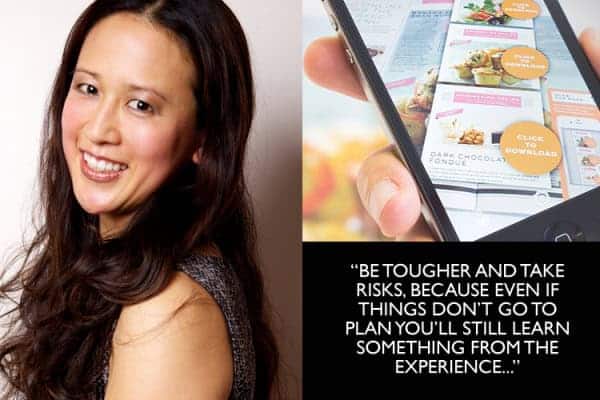
“products are the new domain names.”
Lisa Hu, on connecting physical products to digital experiences
An existing market, an awkward gap
Roo grew out of conversations with Hu’s friend and co-founder David Strauss, who brought experience of the veterinary industry. Hu brought her background in technology businesses and building teams. They began working on Roo in 2018; the platform launched in early 2019. Houston was the first market, followed by Dallas. The choice of a specific profession gave the matching problem a definite shape.
In a 2019 conversation about the business, Hu described the sequence. Employers and professionals created profiles. An employer posted a shift; a professional requested it; the employer confirmed. Payment and ratings followed. For both sides, the proposition depended on seeing enough about the other party to make a decision. An available day on a calendar became something a person could actually book.
Hu also described different ways people used it. Some made freelance shifts their main occupation. Others took a smaller number each month alongside another job. Some previously retired professionals returned for occasional work. A single booking mechanism could accommodate quite different working lives. The product did not require everyone to want the same week.
Her book recommendation that year was Platform Revolution, by Geoffrey G. Parker, Marshall W. Van Alstyne and Sangeet Paul Choudary. It was a fitting choice for someone trying to persuade two groups to participate in the same new system. Each additional registration mattered most when it helped someone else find the right match.
- 01Post a shiftAn employer lists an opening.
- 02Find a fitA professional requests it.
- 03ConfirmThe employer accepts the match.
The numbers, then the handover
By May 2021, Roo was operating across Texas and had launched in Southern California. Hu described thousands of shifts being secured each month. More than 15 percent of registered users were outside the company’s operating markets, waiting for it to arrive. That was an encouraging queue, although people waiting for a service still had to become people using it.
A seed round led by Floodgate brought in Ann Miura-Ko as an investment partner. Hu emphasized the team’s mixture of industry knowledge, marketplace experience and technical backgrounds. The founding conversation had become an organization, with expansion requiring more people, more product work and enough local participation to make each new market function.
On January 18, 2023, Roo announced an $11 million Series A led by Jackson Square Ventures. Existing backers Floodgate, AirAngels and Uplyft Funds also participated. Hu was co-founder and CEO at the announcement. Plans included improvements to the platform and app, data analytics, an enterprise offering and initiatives for students. The money came with a fairly substantial to-do list.
Then, in June, she handed over the chief executive role. Roo appointed Danny Leffel, who had founded the shift-worker communication app Crew, and announced that Hu would become a strategic advisor. The company reported more than 100,000 employment opportunities generated through its platform. Hu’s response placed the achievement with the team and expressed confidence in the incoming leader. Her next chapter would start with another familiar conversation.
Series A announced while Hu was CEO
Employment opportunities reported by Roo
A weather map for an everyday question
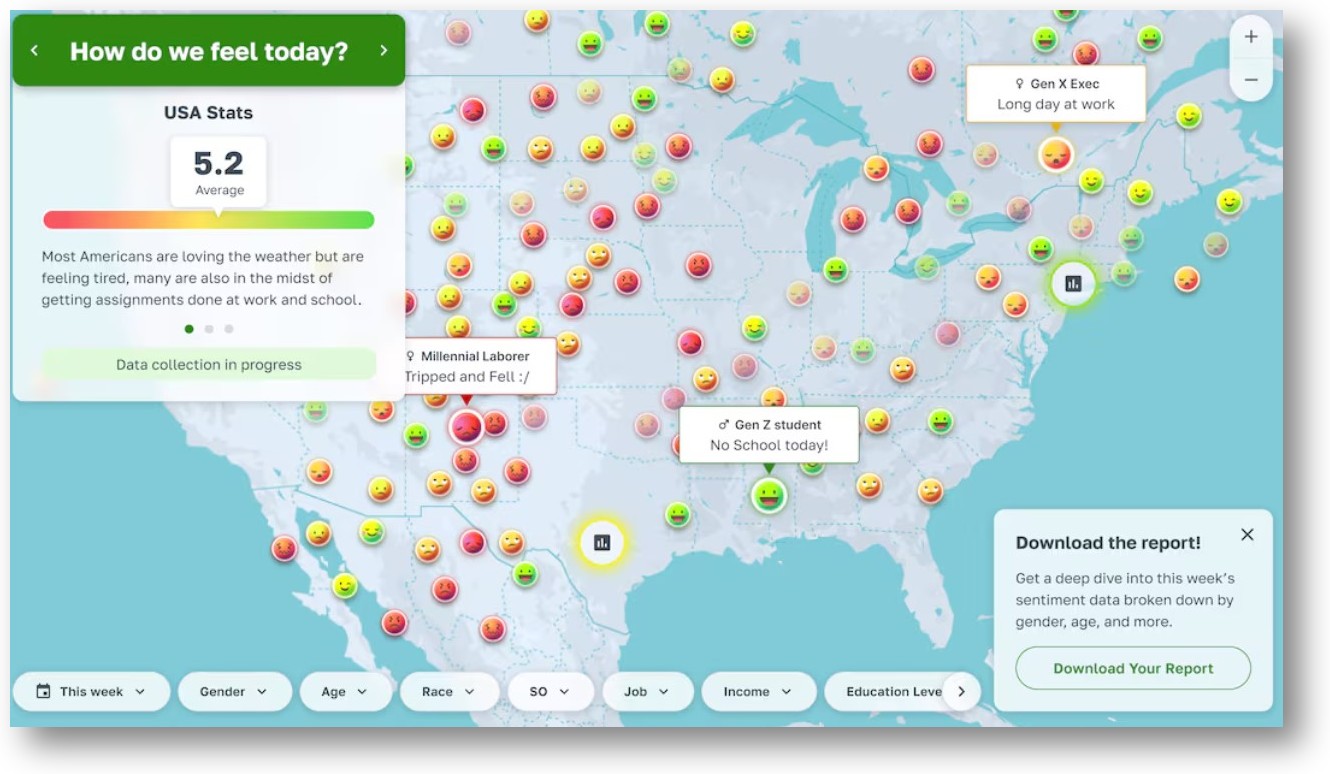
“How are you?” is an extraordinarily common question to ask and an extraordinarily easy answer to overlook. In 2024, Hu launched The Real Feel to collect those answers and present patterns in a form people could inspect. She had been thinking about the idea for years: a visual map of feeling, something as intuitively readable as the weather.
The mechanics are deliberately approachable. Participants give a mood score from one to ten, select a description of their current feeling and explain why in their own words. The numerical answer can be compared. The written answer supplies context. AI helps summarize recurring themes, while reports and a heatmap let customers examine differences across groups and places.
It is an interesting return to her earlier experience with interfaces. A ketchup bottle once needed to explain where to point a phone. This product begins with a question people already know how to answer. The technical work happens after the response, in organizing individual accounts into something useful to somebody making a decision.
The business offers reports, custom analysis, API access and technology other organizations can use under their own brands. Its stated ambition is to help organizations understand the people they serve. Hu initially had marketers in mind. By October 2026, she was describing interest from hedge funds and macroeconomic researchers, an audience she had not originally set out to recruit.
That interest brought a different standard of proof. Exploratory work with Wolfe Research examined whether emotional data could contribute to forecasting models. Hu acknowledged that the analysis needed to go further. Some customers preferred raw historical observations so they could do their own testing. The questions had become larger, but collecting answers over time remained the essential work.
The conversation continues
There are quieter details alongside the company milestones. Hu has taught and supported students in western Kenya through the International School for Champions. She has encouraged women to consider technology careers, including the business and other skills those companies need. Her interests have extended beyond a single industry or a single definition of technical work.
After living in San Francisco, she moved with her family to Westport, Connecticut. In 2024 she spoke warmly about its beaches, people and convenience, and about meeting more of her neighbors. There is an agreeable smallness to that ambition beside a business trying to chart the mood of a country. You can collect a national dataset and still want to know the people down the road.
The Houston driver, the corporate colleagues introduced over drinks, the customer willing to answer a daily question: Hu’s story is crowded with people who have something to contribute once a connection becomes easier. Her businesses have changed considerably. The work still begins close enough to hear an answer. In a career that once involved carrying ketchup to a networking event, paying attention has proved a reasonably portable skill.
Keep the conversation going
WORK, WORDS & A CONVERSATION ON TAPE
- The Real Feel - current work
- Lisa Hu on LinkedIn
- Lisa Hu on X
- Lisa Hu’s essays on Medium
- Roo - the company she co-founded
- Watch: Freelancing for Vets, with Lisa Hu (2019)
- Read: Hu’s guide to working with big brands
- Read: Hu on physical products and digital experiences
- Read: The Real Feel’s move into alternative data (October 2026)