Dr. Emily Cameron was picking up veterinary relief shifts to make ends meet. A permanent job was not the point. Then she worked four shifts at Veterinary Wellness Center of Green in Ohio. She met the team on ordinary days, watched how they handled difficult ones, and eventually accepted a full-time offer. The practice got a new veterinarian. Cameron got something harder to extract from an interview: evidence of what it felt like to work there.
- Roo matches animal hospitals with relief veterinarians, technicians and assistants who choose individual shifts.
- Hospitals can use those working days to judge a potential permanent hire through Roo's Relief-to-Hire program.
- Veterinary professionals join for free; hospitals pay for confirmed coverage, with a separate fee if they hire through the program.
- The company has expanded into externships through Roo Uni and says its community has delivered more than four million relief hours.
Cameron's story is a tidy illustration of a messy business. A clinic needs a doctor next Tuesday. A veterinarian wants an extra day of work, perhaps without committing every Tuesday thereafter. Both need to know more than a name and a rate: surgery expectations, appointment load, commute, support staff and whether the clinic feels hospitable at the end of a long day. Roo puts those particulars into a marketplace. Then it lets the working day provide the rest of the information.
A labor market with paws and paperwork
Lisa Hu and David Strauss started Roo in 2019. Hu later wrote about meeting a Houston ride-share driver who was also a veterinary technician. The technician wanted more income but was driving at night because finding extra work in her own field was difficult. It is an origin story with an unusually clear economic question: why was a trained technician selling rides when nearby animal hospitals needed trained hands?
Roo's early operation occupied a small room in a Houston animal hospital and a home office in San Francisco. It joined people who knew veterinary practice with engineers who could build a booking system. The first task was straightforward: give hospitals a way to post open shifts and professionals a way to see and request them. The app shows pay, location, dates and clinical details. A veterinarian can filter for work that fits; the hospital can examine profiles and choose among requests. Roo handles screening, paperwork, taxes and payment on the hospital side.
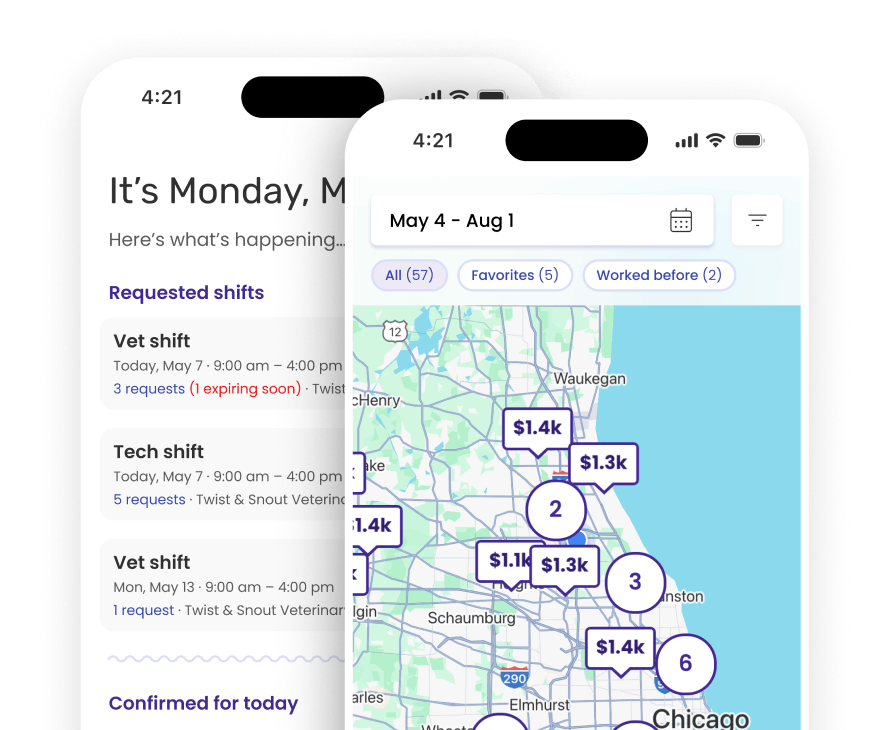
That transparency matters because a relief shift is not interchangeable labor. One clinic may want wellness appointments and no surgery; another may need emergency coverage overnight. A day with excellent technicians can be very different from a day without enough support. Roo's shift cards try to move these facts to the beginning of the conversation. The professional is free to request a few shifts or many. There is no minimum number required to keep an account.
The second use for a shift
An open shift is normally a scheduling failure waiting to happen. Roo treats it as a chance to learn. Its Relief-to-Hire program lets a hospital and a veterinary professional work together before discussing a part-time or full-time position. At the Ohio clinic, the practice manager said the team had struggled for years to find the right veterinarian through job boards and social media. Four shifts with Cameron showed them how she handled patients, colleagues and a busy room. Cameron, meanwhile, could see whether the support she felt on day one held up on day four.
“It was almost like an extended working interview. But better!”Dr. Emily Cameron, on her four-shift path to a permanent role
There is a price for that convenience. Professionals can join without a membership fee, and hospitals can post shifts without paying until they confirm coverage. The hospital's shift price depends on the location, type of work and length of the shift. A permanent hire through Relief-to-Hire brings a separate, published placement fee: 20% of a veterinarian's first-year base salary, capped at $40,000, or $1,000 to $4,000 for a technician, depending on tier. Those figures make the trade legible. Roo saves sourcing and administration time, while a hospital must decide whether the covered appointments and potential hire justify the bill.
Bond Vet offers a larger-scale example. Its workforce planning manager described the group's old relief process as manual outreach and fragmented communication across clinics. Roo built bulk posting and renewal tools around that workflow, according to its case study. Bond Vet says the relationship helped it plan weekend coverage and add appointment capacity. At a smaller California practice, AllCare Veterinary Hospital used partial-day shifts to add appointments without committing to another full-time doctor. These are distinct uses of the same marketplace: one solves coordination across locations; the other buys precisely the hours a local clinic can use.
The marketplace grows a career
A pure shift board might end at payment. Roo has kept adding reasons for people to remain in its orbit. Roo Uni lists veterinary externships at more than 800 hospitals in 47 states. Eligible students can search by specialty, location and stipend, then apply; the service is free to students and hospitals. Roo also runs continuing education and career resources. Partnerships with Fear Free let certified professionals and hospitals identify each other on profiles, while Stride Health helps independent workers compare insurance coverage.
The expansion reveals Roo's place in the market. Its direct alternatives include agency recruiters, informal networks of independent relief vets, and other veterinary staffing platforms such as Relief Rover and IndeVets. Roo's particular bet is that staffing, discovery, professional development and hiring can feed one another. More participating hospitals create more shift choice. More professionals give hospitals a better chance at coverage. Repeated work can become a relationship, and a relationship can become a job.
It has limits. In a market with few nearby professionals, a polished app cannot summon a veterinarian for tomorrow. A clinic that posts vague expectations or provides poor support may fill a shift once and struggle to bring anyone back. And relief is an expense: AllCare's account is compelling precisely because it matched partial days to enough demand to remain profitable. The lesson for another operator is practical, not magical. Start with the schedule gaps you can price, give candidates the detail they need to choose well, welcome them into the workflow, and measure whether the extra capacity pays for itself.
Roo reported that veterinarians had earned more than $100 million through its platform by October 2024, a measure of work routed to clinicians rather than revenue kept by Roo. Its current about page says the community has supplied more than four million hours of relief. Behind those large numbers sits a modest unit of observation: one shift. It can keep a clinic open for a day. In the right room, it can show a person where they want to work for years.