The first useful thing to know about Lisa Colella is that she notices what other people dismiss as atmosphere. The order in which a new executive meets colleagues. The gap between a corporate promise and a recruiter's follow-up email. The cumulative effect of four brief conversations rather than one grand appearance. In her line of work, these details are evidence. They tell an employee, an investor or a candidate what an organization truly values, sometimes before its leaders have worked it out for themselves.
Colella is a Managing Director at CRA | Admired Leadership, where she advises senior leaders through communications carrying financial, reputational and relational stakes. Her recent work includes executive coaching around sell-side transactions, buy-side integrations and fundraising, along with leadership and team transitions. By the time the decisive meeting arrives, the story has already been taking shape through dozens of choices. Her job is to make those choices cohere.
It is a fitting destination for a career built in the border country between marketing, human resources and leadership. Colella began in consumer advertising, marketing and public relations. In 2007, TMP Worldwide recruited her into the still-young field of recruitment marketing, a place then crowded with classified ads and job boards. Consumer marketers had spent decades studying attention, desire and identity. Colella saw that their tools could be aimed at a neglected question: why should a person choose to work here?
Act IThe lightbulb problem
After agency and consulting roles, she joined Alexander Mann Solutions in 2010 to launch its Employer Brand and Marketing practice in North America. Then a call from a Philips recruiter offered the chance to go inside a multinational and live with all the complexity that advisers usually observe from a polite distance. She took it.
The assignment was daunting in a wonderfully specific way. Philips needed sought-after engineers and technologists, while many people still chiefly associated the name with lightbulbs. The company was far larger and stranger than the association allowed. Colella needed to express that reality to talent, and she began with little budget and no staff.
“I didn't have a team, I was the team.”Lisa Colella on beginning the Philips employer-brand work
There is a sort of corporate comedy in giving one person a global identity puzzle and a nearly empty purse. Colella's response was to treat the organization itself as her resource. She formed relationships with corporate branding, marketing and an in-house design team. Recruiters, new hires and employees supplied the intelligence. Their experiences helped answer the question the polished corporate promise could not: what did working at Philips actually make possible?
The resulting talent platform, “Embrace the unexpected,” made room for careers with turns that candidates could not have planned. It also suited Colella's own. The capability grew from North America to a global remit and took her to Amsterdam for two and a half years. Her team became an on-call answer when the business could not attract the people its strategy required. She also helped establish an in-house labor-market intelligence capability; her public project account says it saved hundreds of thousands of euros and informed decisions as consequential as locations, acquisition work and competitive targeting.
A career moving closer to the consequential moment
Act IIThe founder becomes a coach
In 2018, Colella launched Truist, a boutique talent-brand agency created with the advertising firm Mechanica. Founding a consultancy let her carry the same basic argument across different companies: talent should be treated with the discipline reserved for customers. A company could buy a shinier careers site, but it could not purchase coherence. The promise, the recruiting process, the daily culture and the business strategy had to recognize one another.
Her writing from this period has the impatience of a practitioner who has watched expensive tools arrive before a clear purpose. Technology, she argued, was only as useful as the strategy and content it carried. Start with audience insight. Map the candidate's journey. Decide what position the organization can honestly claim. Then choose the machinery.
Colella also noticed a gap among the people doing this work. Talent-brand managers often needed three forms of help at once: confidence, technical knowledge and the ability to influence senior stakeholders. Generic coaching rarely supplied the technical side; technical training rarely touched the emotional one. Her one-to-one coaching program joined them under three headings: mindset, knowledge and influence.
She tells the story of hiring a colleague at Philips for character and intellectual potential despite having no talent-brand experience. The new hire appeared confident in interviews, yet carried considerable uncertainty. Over 12 to 18 months, Colella coached her across all three dimensions. The colleague moved from quietly wondering what an employer value proposition was to becoming someone the team regarded as a thought leader. Colella had hired potential; coaching helped the person see it too.
Four brief touchpoints can create more familiarity than a single hour-long appearance. The arithmetic is equal; the human effect, Colella argues, is greater.
Act IIIEverything has a subtext
At CRA, the stage has widened. Colella works with leaders in financial services, technology, pharmaceuticals and life sciences, among other fields. A transaction or executive transition brings the work into sharper relief. The story told before a leadership team enters the room can affect the terms of a deal. The way the team behaves inside it can affect the relationships that remain afterward.
Her advice on executive onboarding is disarmingly concrete. Treat the arrival as a launch rather than an orientation. Notice where the leader spends time, who receives the first meeting, where the leader sits and how meetings are structured. These are symbols, though “symbolic” should never be confused with decorative. People use them to forecast the future.
That attention to sequence also explains her preference for frequent contact. A leader who appears for one polished hour can remain an abstraction. Four 15-minute encounters let people observe tone, consistency and response. The minutes add up to the same total, yet the relationship gathers texture between meetings. Familiarity is built in installments. For remote and distributed teams, where chance encounters are scarce, the principle becomes even more useful: presence must be designed rather than left to architecture.
“The best leaders slow down to speed up.”Lisa Colella on executive transitions
Slowing down means listening through good questions, resisting the seduction of instant reorganization and earning credibility through smaller, well-chosen victories. It also means accepting that a leader owns the beginning of the story. As Colella puts it, a new leader owns the start, the performance and the finish. An onboarding plan is therefore less a packet of information than a deliberate sequence of meaning.
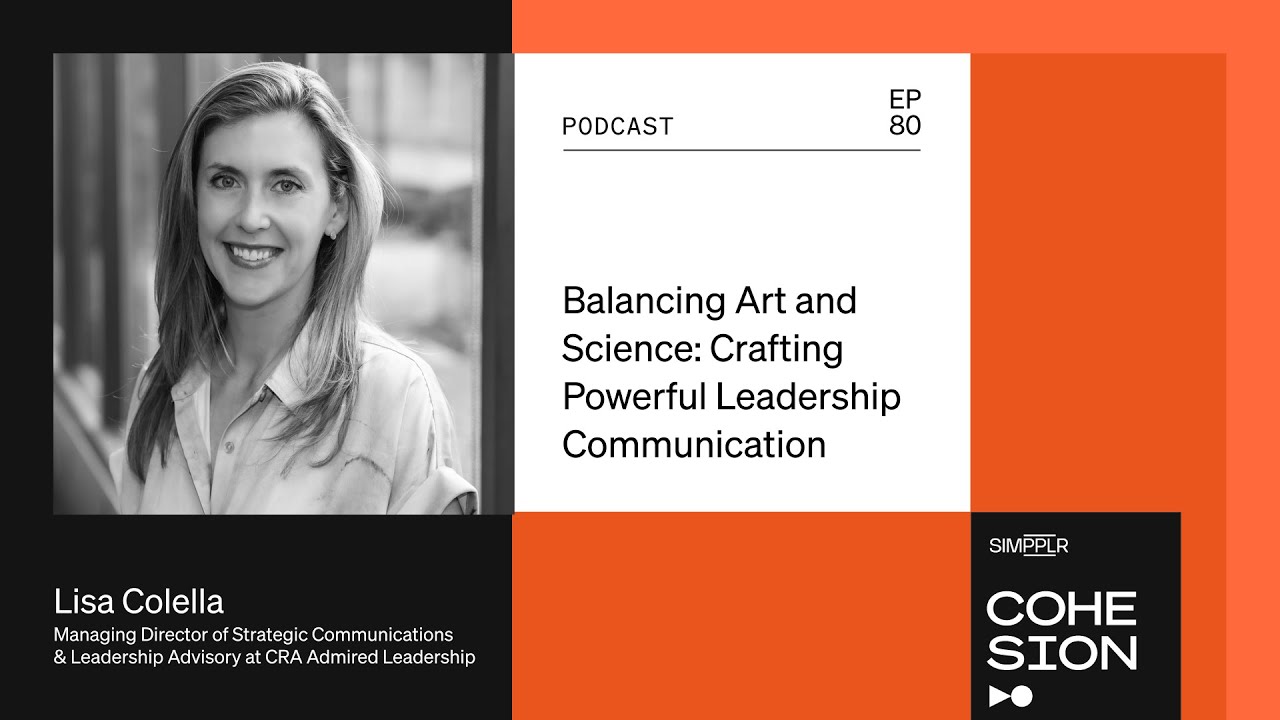
In a 2025 podcast conversation, she linked communication to psychology and behavioral science, discussing how formal messages and informal contact work together. She has also spoken about artificial intelligence in the communications profession. The technology changes; her test remains stubbornly human. Does the tool help a leader create clarity, credibility and connection? Does it support a thought-through strategy? If the answer is vague, novelty is merely wearing a clever hat.
Off the clock, still coachingA second court
Colella lives in Massachusetts with her husband and two daughters. Away from executive rooms, she coaches basketball and youth leadership at the Inly School. She has also coached youth soccer. The setting offers a charmingly literal version of her professional question: how do people learn to move together?
Her public biography adds fitness challenges, home-improvement projects and new recipes to the mix. The list feels consistent. Each activity involves a plan meeting an unruly material: a body, a house, a dinner, a team, a company. Plans matter. Then reality arrives and asks whether the plan can bend without losing its point.
Chief's Boston chapter, where Colella has been a founding member since 2021, and her advisory work with INTOO extend the network around that practice. Yet her career resists being reduced to networking. Its more interesting pattern is proximity. Advertising taught her to frame a promise. Recruitment marketing brought the promise closer to experience. Philips put her inside the system delivering it. Founding a consultancy made her responsible for the whole engagement. Executive counsel brings her close to the people whose behavior determines whether the story survives contact with reality.
Colella's subject, in the end, is followership. People choose whether to believe a company, join a team, support a transaction or give a new leader the benefit of the doubt. They make that choice from the smallest available evidence. Her work is to help leaders see the evidence they are already creating - and make it worthy of the future they are asking others to enter.