The old office was an unreliable manager, but it did have one unadvertised talent: it made people bump into one another. A question could be asked on the walk to lunch. A junior colleague might overhear the useful part of a senior conversation. Someone could look up from a screen and notice that a teammate was stuck. None of this appeared on the organizational chart, which may be why it was easy to miss until it disappeared.
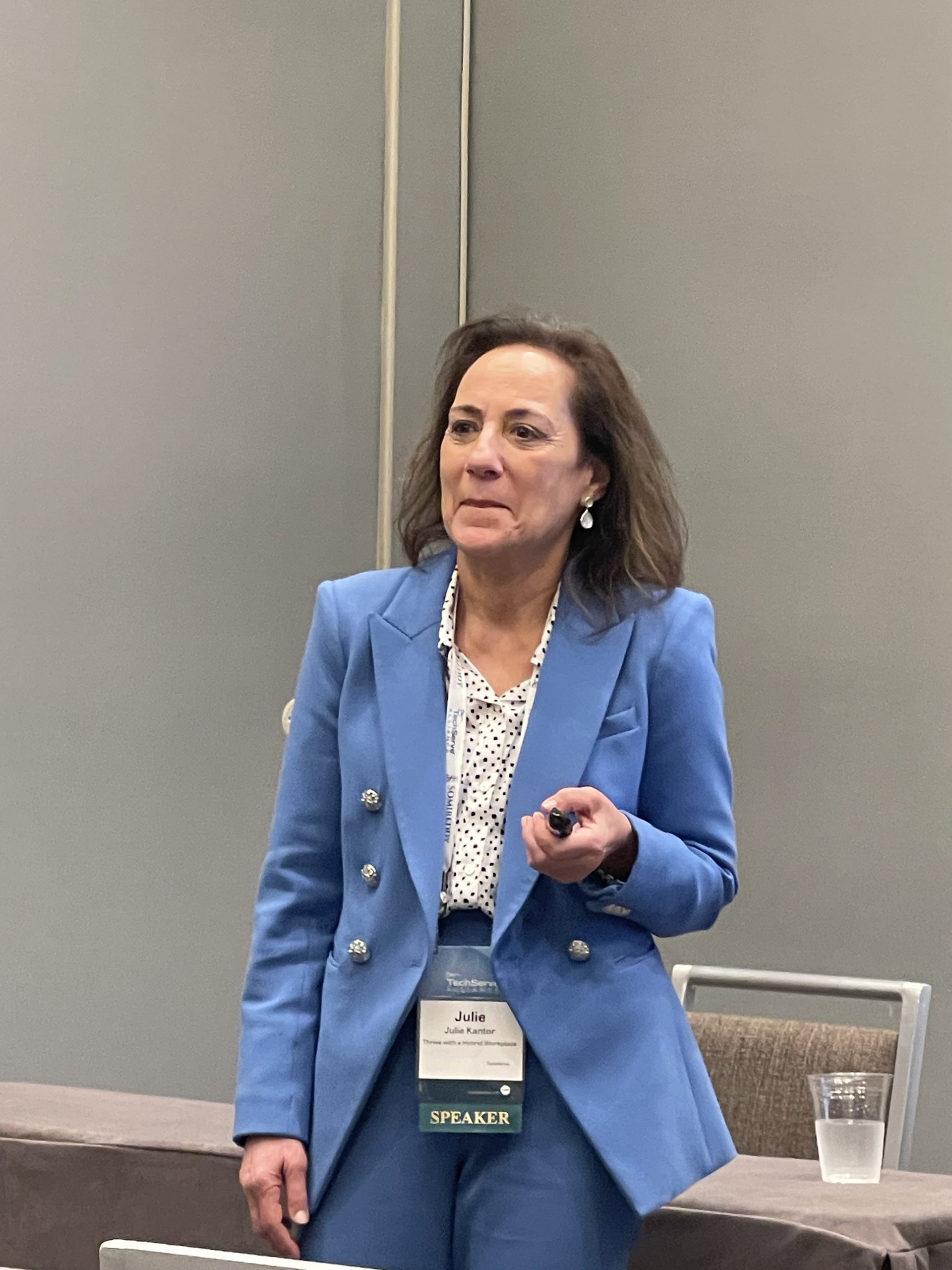
Julie Kantor noticed. A New York business psychologist and executive coach, Kantor has spent more than two decades in the narrow, consequential space where a person’s habits meet a company’s ambitions. She works with senior executives and leadership teams, founded JP Kantor Consulting, and has served as a guide and facilitator at Chief, the network for senior women. Her job, in plain English, is to help accomplished people understand what everyone around them is already experiencing.
Her useful phrase for what makes colleagues more than adjacent job descriptions is “interpersonal glue.” It includes shared stories, informal moments and the modest curiosity required to ask about something other than a deadline. Glue is not a line item, and nobody has ever bragged about exceeding the quarterly glue target. Yet when a project goes wrong, it is often the difference between people retreating into transactional messages and staying in the room long enough to solve the thing.
“The need for connection doesn’t change. What has to change is how employees are connecting.”Julie Kantor
The long experimentBefore hybrid had a name
Connection is not a fashionable detour in Kantor’s career. It is the road. At the University of Rochester, where she studied psychology, earned Highest Honors and joined Phi Beta Kappa, her honors thesis examined emotional intelligence in children. She later earned an MA and PhD in psychology at the University of South Florida. Her master’s research compared social support on and off the job. Years later, she recalled the result with appealing economy: support at work mattered enormously. A good boss or supportive team could change the experience of a working life.
Her consulting practice grew from that junction of psychology and business. The clients named publicly by her firm range across media, finance, education, retail and professional services. The work moves between individual coaching, team development, training and organizational change. Its unit of attention can be one executive’s manner in a meeting or the culture that makes the manner contagious.
Kantor’s approach is resolutely specific. Listen. Clarify the need. Assess the present state. Define the goal. Build practical steps. It is psychology without the velvet chaise longue and management consulting without the recreational jargon. One client recommendation credits her mix of psychology and business with helping during a complicated period of change at HBO. Her own writing returns to the same proposition: insight becomes useful only when it changes behavior.
A book born in lockdownGrowth meets guardrails
In 2020, a mutual colleague in human resources brought Kantor together with employment attorney Felice Ekelman to discuss working from home. The streets of New York were nearly empty. Their colleague’s boss was considering a book on remote work; the project was eventually dropped, correctly in Kantor’s telling, because a permanently remote future was not what appeared next. Something messier was arriving.
Kantor and Ekelman kept talking. The moment that clarified their partnership was almost too neat for an editor to allow. Ekelman said she had spent her career helping clients avoid risk. Kantor replied that she had spent hers helping clients grow and succeed. There, between caution and possibility, was the book.
Thrive with a Hybrid Workplace: Step-by-Step Guidance from the Experts appeared in 2023. Its structure mirrors its authors. Policies, consistency and legal guardrails sit beside the human business of leading people who work at different times and in different places. It does not pretend that one schedule fits every organization. The essential question is whether the arrangement supports the work, the mission and the people expected to perform it.
Kantor’s seven Cs of leadership
Of the seven, Kantor says she would choose connection. The decision is revealing. Hybrid-work arguments tend to fixate on geography: home or office, three days or five, camera on or camera off. Kantor directs attention to relationships. If a team comes to the office only to sit alone wearing headphones on video calls, the commute has achieved little beyond supporting the transit system.
The office should have a purpose. So should remote time. Leaders must make expectations explicit, arrange meaningful contact and resist proximity bias, the quiet preference for people who happen to be visible. They also need to replace attendance as a proxy for contribution with actual outcomes. “Leaders need training on how to measure how people are being productive,” Kantor has said, and then need to coach people through the new arrangement.
Three voices, one leaderThe signals beneath the sentence
Kantor has a second compact framework for executive presence: every leader speaks with three voices. There are the words, the face and the body. When they disagree, the audience does not politely average them. It believes the loudest. This is elementary until one watches a capable executive say “I’m excited” with a pinched expression and folded arms, or send what they imagine is a cheerful email that reads like a fire alarm.
She once described coaching a leader who could not understand why colleagues thought she was angry. Together they examined her messages. A friendly greeting, in the executive’s mind, arrived with seven exclamation marks. The sender heard enthusiasm. Everyone else heard shouting before reaching the second word. Email had removed the voice and face, so readers supplied their own. Punctuation took command.
The graphic above is a portrait of competition, not a scientific weighting. Kantor’s point is that communication is embodied and contextual. Digital work strips away context unevenly. A shared document may carry facts cleanly; a terse message about a sensitive problem invites the recipient to invent the missing human material. The leader’s task is partly editorial: choose the medium that can carry the meaning.
This is also why her advice tends to be small enough to try. Acknowledge the employee who worked late. Ask a colleague about the weekend, and listen to the answer. Explain why a team is gathering. Tell people what success looks like. The gestures would make terrible corporate merchandise, but they are behaviors, and behaviors can be repeated.
“I have never met a leader who actually communicates as clearly as he or she thinks they communicate.”Julie Kantor
Values in the wildThe bear with the management lesson
In 2025, Kantor traveled to the Great Bear Rainforest in British Columbia expecting a wildlife adventure. She returned with an organizational case study. At the lodge, guides knew the bears, the kitchen handled guests’ needs and the entire experience balanced wonder with safety. Then she saw the mission statement on the wall. The consistency was not accidental. Staff decisions made the words visible.
Her resulting essay asks readers to identify a few core values, test the hard choices between them and turn the winners into a usable mission. The test is bracing: could an observer guess the mission statement by watching the decisions? A value that lives only on a wall is interior decoration with a strategic-planning accent.
The bears supplied a cheerful closing device. During salmon season, they appeared magnificently undistracted by competing priorities. Humans have more complicated organizations, plus email, which is how seven exclamation marks enter the story. Kantor’s point was not that executives should imitate wildlife. It was that clarity makes choices easier, and choices reveal what an organization truly values.
The work after the workplaceMaking the invisible deliberate
Kantor’s more recent writing keeps widening the idea of glue. She has written about difficult conversations as opportunities for change, the alignment of verbal and nonverbal presence, and the habits that let colleagues know one another beyond tasks. Her public voice is practical with a streak of mischief: an ice-sailing hobby, a frozen video face that becomes a team joke, a bear safari drafted into management service.
At Chief, her facilitation places these ideas inside peer groups for senior women, where candor, accountability and connection are the mechanism rather than the decoration. In her firm, the same logic stretches from a single leader to a whole system. The scale changes. The central question does not: what would let these people work together better?
There is a quiet rebuke here for leaders searching for a software answer to a human problem. Tools can coordinate calendars and move information. They cannot care whether a colleague has understood, feels able to disagree or trusts the group enough to admit a snag before it becomes a failure. Those conditions require attention from a person.
The office never created them automatically. It merely offered more chances. Kantor’s contribution is to name what those chances were doing and assign the work to leadership. The accidental era is over. The glue now has to be applied by hand.